Podlaskie Muzeum Kultury Ludowej
An open-air museum with wooden architecture from Podlasie: cottages, barns, a windmill, a smithy and a manor house from Bobry Wielkie, visited with a guide.
Have only individual sections read aloud
About the museum
The Podlaskie Museum of Folk Culture was established in September 2016 from the merger of the Museum of the Białystok Countryside (Muzeum Wsi Białostockiej) with an ethnography department separated from the Podlaskie Museum in Białystok. The beginnings of the ethnographic workshop go back to 1962, and the open-air museum itself was founded in 1982 as a branch of the then Regional Museum in Białystok.
Marian Pokropek’s concept assumed the reconstruction of the forms of settlement of north-eastern Poland on an area of more than a hundred hectares. Construction began in 1984 with a smithy moved from Gródek; by the early 1990s nearly thirty buildings had been relocated, including three complete farmsteads, a forester’s homestead and a manor house with a granary. In November 1994 a fire destroyed nine buildings, including the oldest, an 18th-century barn; after a break the relocation of cottages, barns, granaries and small windmills was resumed.
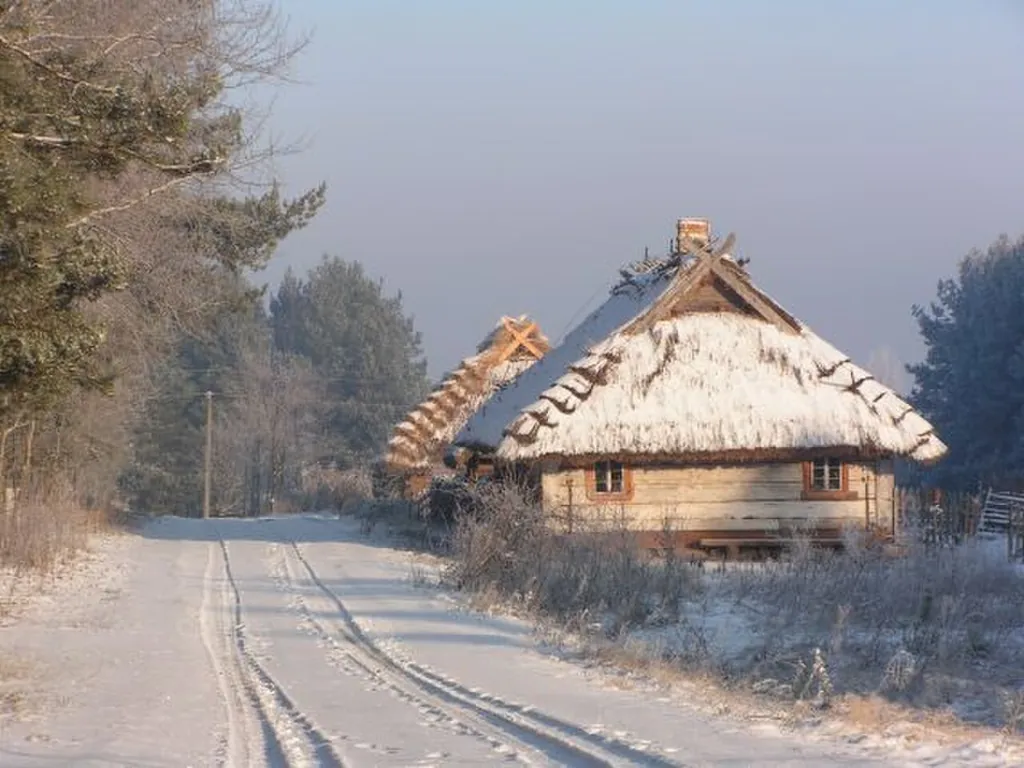
Today the open-air museum covers almost 30 hectares. Visitors see residential and farm buildings, a windmill, a water mill, a smithy, small sacred architecture such as crosses, chapels and wells, and a nineteenth-century manor house from Bobry Wielkie. The museum runs permanent exhibitions, including on the folk art of Podlasie and on the rural school in the period of the People’s Republic of Poland (PRL), as well as educational classes and family outdoor events. The institution is managed by the Podlaskie Voivodeship self-government.
Highlights
- Historic cottages, barns and granaries from Podlasie
- Manor house from Bobry Wielkie with its interiors
- Rural school from the PRL period
- Windmills, water mill and smithy
- Falconry – a centre for ornithological education
- Playground on the museum grounds
Permanent exhibitions
- Sztuka ludowa Podlasia – Permanent exhibition devoted to the traditional folk art of the region.
- Wnętrza dworskie we dworze z Bobrów Wielkich – Furnished interiors of the nineteenth-century manor house moved to the open-air museum.
- Wiejska szkoła w czasach PRL-u – Interiors of the school from Kalinowo Solki, showing rural education in the PRL period.
- Founded
- 1982
- Operated by
- Instytucja Kultury Województwa Podlaskiego
Admission & discounts
| Adults | 15 zł |
|---|---|
| Reduced | 8 zł |
| Guided tour of the exhibitions (about 2 hours) – standard ticket | 35 złSeason from 7 April to 30 September; reduced ticket PLN 25. |
| Guided tour for school and pre-school groups | 50 złChildren up to the age of 7, maximum 25 people. |
| Guided tour of three permanent exhibitions in winter | 20 złFrom Monday to Friday, notification at least 3 days in advance. |
| Guided tour in English (up to 10 people) | 200 złPlus PLN 40 per person (reduced PLN 25); for more than 10 people PLN 300 plus PLN 35 per person; booking at least 2 days in advance. |
| Museum lesson | 20 złPrice per person. |
Free admission: Monday – admission ticket free of charge (other services are charged).
The walking ticket (PLN 15 standard, PLN 8 reduced) applies to the season from 7 April to 30 September. Concessions and discounts do not add up, and entitlements must be confirmed with an appropriate document.
Accessibility
- Partially wheelchair accessible
- Elevator: not available
- Accessible restroom
- Accessible parking: no information
- Service dogs welcome
- Tactile models & exhibits
- Sign language tours: no information
- Easy-to-read materials
- Audio description
The main path through the site is a paved surface with benches and covered rest areas; obstacles are sandy paths without clear edges, uneven ground and grass around the buildings. The ticket office is reached up four concrete steps. Many cottages have thresholds and steps, but ramps lead to the barns in Karczmisko, Czarna Białostocka and Redy, and the school from Kalinowo Solki and the manor from Bobry Wielkie can be reached by a stair platform. Three toilets adapted for people with disabilities are available, as well as a mobile access ramp and staff help. There is a Braille sign at the ticket office, and the school and the manor have tactile plans. Most of the objects on the map have audio description, and three permanent exhibitions are available with audio description. Information about the museum is available in Polish Sign Language and in easy-to-read text. Guide dogs may enter the grounds and the exhibitions.
Kids & families
Great for kids & families
- Family tours & workshops
- Stroller-friendly
- Playground / play area
The museum organises “Rodzinne niedziele w skansenie” (Family Sundays in the Open-Air Museum) and workshops for parents with children, for example making Christmas-tree decorations, palms and painted eggs (pisanki). The grounds include a fenced playground with paved paths for pushchairs and benches.
Getting there & parking
By public transit
The open-air museum can be reached by city transport from Białystok (details in the PDF guide on the museum’s website).
By car
Parking available · 50 m to the entrance
A signposted gravel car park by the main entrance; about 50 m of paved road leads to the gate. During outdoor events, places on the grass are also available behind an additional gate.
The museum lies by the road towards Augustów. Driving onto the open-air museum grounds is possible after notifying a member of staff in advance.
Get directionsAmenities & dining
The museum hasn’t published any information on this.
Events & venue rental
- Spaces for rent
The price list provides for the hire of a single building (up to 4 hours PLN 400, per day PLN 1,000) and for photo and film sessions on the grounds of the open-air museum.
Inquiries & detailsPlan your visit
| Guided tours | yes · approx. 2 hrs |
|---|---|
| Audio guide | yes |
| School programs | yes |
| Good to know | The exhibitions may be visited only with a guide; tours in English must be booked at least 2 days in advance (tel. +48 85 74 36 082, ext. 24 or 34). A guide in PDF format is available on the museum’s website before the visit. |