Palacio Real de Aranjuez
Country residence of the kings of Spain in Aranjuez, with rooms decorated under the Bourbons and historic gardens in a World Heritage landscape.
Have only individual sections read aloud
About the museum
From the Christian conquest onwards, Aranjuez belonged to the Order of Santiago, whose grand masters had a palace on the site of the present one. When the office of grand master passed to the Crown, the territory was integrated among the royal palaces and country houses. Philip II wanted to turn it into a grand town in the Italian style and commissioned Juan Bautista de Toledo to lay out tree-lined streets, while the 16th-century dams regulated the Tagus and made it possible to irrigate gardens and crops.
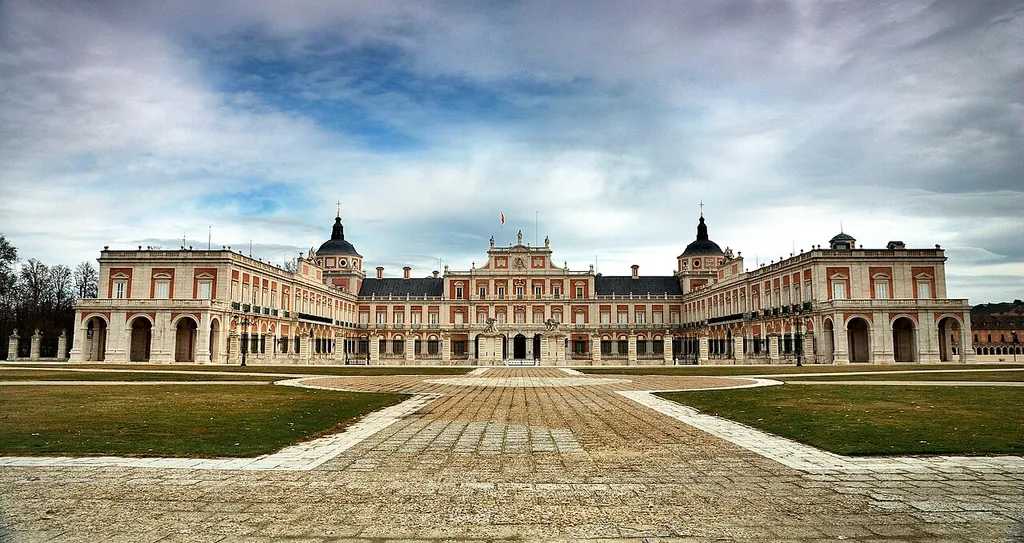
The present palace was begun in 1564 to a design by Juan Bautista de Toledo, and Juan de Herrera only managed to complete one half. Philip V resumed the works in 1715 and Ferdinand VI completed them in 1752. In 1775 Charles III commissioned Francesco Sabatini to add two wings, which gave the building its characteristic U-shaped plan. The architecture is in the classical style of the Spanish Habsburgs, alternating white stone and brick.
The Bourbons spent the whole spring at Aranjuez, from the end of Holy Week until June, and the splendour of the royal site lasted until 1870. The official rooms open to visitors today mainly retain the decoration of that period, including such unusual rooms as the Arab Cabinet, the Porcelain Cabinet and the Chinese Cabinet, adorned with some two hundred paintings given to Isabella II in 1846. The complex forms part of the Cultural Landscape of Aranjuez, declared a UNESCO World Heritage Site, and is surrounded by more than one hundred hectares of gardens open to visitors.
Highlights
- Porcelain Cabinet
- Hall of Mirrors
- Arab Cabinet
- Chinese Cabinet with some 200 paintings given to Isabella II
- Queen’s dressing room, ballroom and state dining room
- Prince’s Garden, Island Garden and Parterre Garden
Permanent exhibition
- Salones oficiales del Palacio Real – Tour of the rooms decorated mainly in the Bourbon period, including the Porcelain, Arab and Chinese Cabinets.
- Operated by
- Patrimonio Nacional
Admission & discounts
| Adults | €9 |
|---|---|
| Reduced | €4People aged 5 to 16 (with identity document or passport from age 14), over-65s and students up to age 25 with a valid student card |
| Children & teens | €4free up to age 4 · Reduced rate for ages 5 to 16; under-5s do not pay. |
| Seniors | €4Reduced rate from age 65, with accreditation. |
| Visitors with disabilities | freecompanion free · Free admission with a recognised disability of 33% or more. The companion also enters free if essential and stated on the disability card or ruling. |
| Students & apprentices | €4Reduced rate up to age 25 with a valid national or international student card. |
| Groups | –Agency rate: €7 per person. |
| Families | –Members of large families with accreditation enter free. |
| Guided tour (supplement) | €8With Patrimonio Nacional staff; tours booked online are in Spanish. |
| Audio guide | €5 |
| Casa del Labrador (single rate) | €10Separate ticket for the Casa del Labrador, in the Prince’s Garden. |
Free admission: Wednesdays and Sundays 15:00–18:00 (October to March) or 15:00–19:00 (April to September) for citizens of the European Union and Ibero-America with accreditation, only for self-guided visits; 18 May and 12 October for all visitors.
Also free of charge: under-5s, people who are legally unemployed, active teachers, official tourist guides and members of ICOM and ICOMOS, with accreditation. The Island and Prince’s Gardens are free of charge. The visit is eligible for the Bono Cultural Joven. Time-slot free admission tickets are sold only at the ticket office.
Accessibility
- Wheelchair accessible
- Elevator: no information
- Accessible restroom: no information
- Accessible parking: no information
- Service dogs welcome: no information
- Tactile models & exhibits: no information
- Sign language tours: no information
- Easy-to-read materials: no information
- Audio description: no information
Access for people with reduced mobility is available, and manual wheelchairs are provided at the palace.
Kids & families
| Kids’ admission | free up to age 4 |
|---|
- Family tours & workshops
Educational activities for families are organised on special dates.
Getting there & parking
By public transit
Cercanías C-3 train from Atocha station to Aranjuez; Madrid–Aranjuez bus (AISA and SAMAR) from the Méndez Álvaro South Bus Station.
By car, via the A-4 motorway (Madrid–Aranjuez) and the turn-off onto the M-305. Visitor access to the palace is at the main façade, next to Plaza de Parejas.
Get directionsAmenities & dining
The museum hasn’t published any information on this.
Events & venue rental
The museum hasn’t published any information on this.
Plan your visit
| Guided tours | yes · approx. 60 min |
|---|---|
| Audio guide | yes |
| Photography | Photography without flash is permitted for personal use; tripods and selfie sticks are not allowed. |
| Good to know | The guided tour lasts about one hour and is offered on several days, in the morning and afternoon; times are checked when buying tickets. Guided groups are not permitted during the free Wednesday and Sunday slot. |