Museum of city history in the Landvogteischloss in Baden with the digitally networked exhibition "Geschichte >verlinkt<" on the spas, the Diet and industry.
The exhibition by the Berner Generationenhaus asks what we inherit from our ancestors and pass on, such as genes, money, beliefs or traumas. Visitors follow the route wearing a vest full of inheritance terms.
About the museum
The Historical Museum Baden was founded in 1875 by the Society for Public Lectures; the core of the collection consisted of archaeological finds from the town. The driving force was Bartholomäus Fricker, who also set up a museum commission in the same year. From 1877 the historical collection belonged to the town, and in 1882 the commission became a municipal institution. In July 1913 the growing museum moved from the Kurhaus to the Landvogteischloss on the Limmat.
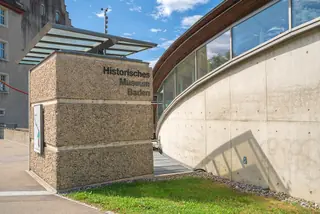
The castle once served as the seat of the bailiff and is now itself part of the tour: carefully furnished rooms, such as the bailiff's kitchen or the Biedermeier parlour of the Borsinger family, lead into ways of life from the Middle Ages to the 20th century. In 1992/93 an extension was built to plans by Wilfrid and Katharina Steib; because of its curved shape it is called the "Melonenschnitz" (melon slice) and contains the museum entrance.
In the permanent exhibition "Geschichte >verlinkt<", opened in 2016, visitors explore the history of the spas, the Diet and industry of the region at interactive stations and come across unexpected connections from object to object. The collection preserves everyday objects from the former spa town and archaeological finds, and since the 1990s it has been deliberately expanded with objects of industrial culture. Together with the friends' association Melonenschnitz, the museum looks after the Industrial Heritage Trail Limmat–Wasserschloss. The museum is run by the town of Baden.
Highlights
Multimedia permanent exhibition "Geschichte >verlinkt<" in the extension
Furnished castle rooms in the Landvogteischloss, from the Middle Ages to the 20th century
Themes: spas and Roman times, the Diet, industry (BBC)
Bat hideout as a play room for children
Industrial Heritage Trail Limmat–Wasserschloss
Permanent exhibitions
Geschichte >verlinkt< – Multimedia permanent exhibition in the extension on the history of the spas, the Diet and industry; interactive stations link the objects on the collection wall with one another.
Landvogteischloss – Furnished castle rooms such as the kitchen and Biedermeier parlour bring ways of life from the Middle Ages to the 20th century to life.
Founded
1875
Operated by
Stadt Baden
Admission & discounts
Adults
CHF 10
Reduced
CHF 8Recipients of AHV/IV (Swiss old-age and disability pensions), apprentices and students up to 26 years
Children & teens
freefree up to age 16 · Children and young people up to and including 16 years have free admission; children up to and including 12 years only when accompanied by adults.
Seniors
CHF 8AHV recipients.
Visitors with disabilities
CHF 8IV recipients.
Students & apprentices
CHF 8Students up to 26 years and apprentices.
Groups (8+ people)
CHF 8 per personGroups of 8 or more: CHF 8 per person.
Tour for private groups of 8 or more (30–45 minutes, plus admission)
CHF 1301 hour CHF 160, 1.5 hours CHF 190, 2 hours CHF 220; reduced admission CHF 8 per person extra.
Tour for school classes (1 hour)
CHF 1301.5 hours CHF 160, 2 hours CHF 190, 2.5 to 3 hours CHF 240; classes from Aargau can use the Impulskredit (cantonal funding).
Special tour, play "Frau Landvogt" (40 minutes, school class)
CHF 210For private groups CHF 230 plus admission.
Rates since 24 March 2026. Free admission with the Museums-Pass-Musée and the Swiss Museum Pass, with the Raiffeisen card, the Swiss Travel Pass, the Kulturlegi, the VMS/ICOM card, CityTickets or the guest card, with a Status F, N or S permit, with a press card, and for members of the friends' association Melonenschnitz. Teachers preparing lessons and employees of the town of Baden pay no admission. Independent visits by school classes without a tour are free.
The extension building with the museum entrance is step-free; the Landvogteischloss is not wheelchair accessible. Guide dogs are welcome. Guided tours with sign language interpretation (arranged via procom) and tours with object handling can be booked. The birthday offer in the Landvogteischloss is not accessible.
Kids & families
Great for kids & families
Kids’ admission
free up to age 16
Family tours & workshops
Activity booklet, scavenger hunt or kids’ audio guide
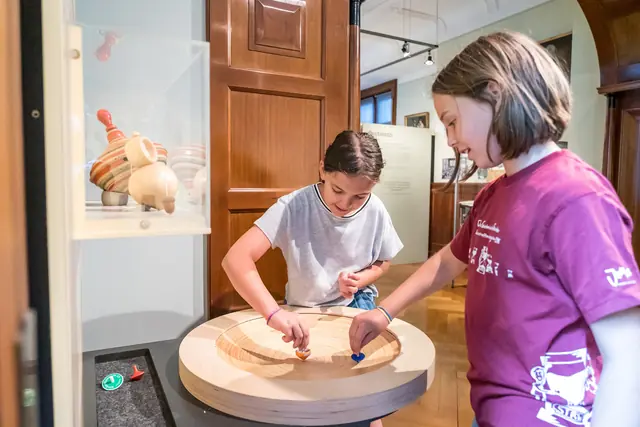
Hands-on stations
Playground / play area
Kids’ birthday parties
With the bat hideout (play and adventure room, ages 4 to 10), the Landvogteischloss is well suited to young explorers; for young people aged 11 and over, the museum recommends the exhibition "Geschichte >verlinkt<", which schoolchildren aged 8 and over can explore playfully with the museum tablet. Toddler corner in the foyer, puzzle fun with Frank the bat (ages 6 and up) and children's birthdays (ages 5 and up, Wednesdays and Saturdays at 2 p.m., 90 minutes, max. 10 children).
Getting there & parking
By public transit
Baden, Historisches Museum
About 10 minutes on foot from Baden railway station: the Promenadenlift goes from Unterer Bahnhofsplatz to the Limmat, then around 800 metres upstream to the old wooden bridge; the museum is across the bridge by the Landvogteischloss. Alternatively, take PostBus lines 352/353 (towards Endingen/Tegerfelden) or 354 (towards Kaiserstuhl) directly to the Baden, Historisches Museum stop in around 10 minutes (stops on request).
The museum entrance is in the extension ("Melonenschnitz") next to the Landvogteischloss.
Melonenschnitz with main room on the Limmat (around 180 m²), foyer, sun terrace and museum cinema (20 seats) as a party package for up to 60 people (small CHF 1,050, large CHF 1,410; Tuesday to Sunday, not Monday and Thursday). The panorama room in the Landvogteischloss (around 47 m², up to 15 people) is suitable for workshops and meetings (guide price CHF 50 per hour). Museum Pass and Raiffeisen card do not apply to room rental.
Tours for groups in German, English and French, with freely selectable topic and date (e.g. industrial history, spas and Roman spa history, the Diet and bailiwick, Industrial Heritage Trail outdoors). School classes can book tours and workshops or visit the exhibition independently with teaching materials; registration on tel. +41 56 222 75 74. A virtual exhibition tour is available online.