Musée romand de l’agriculture
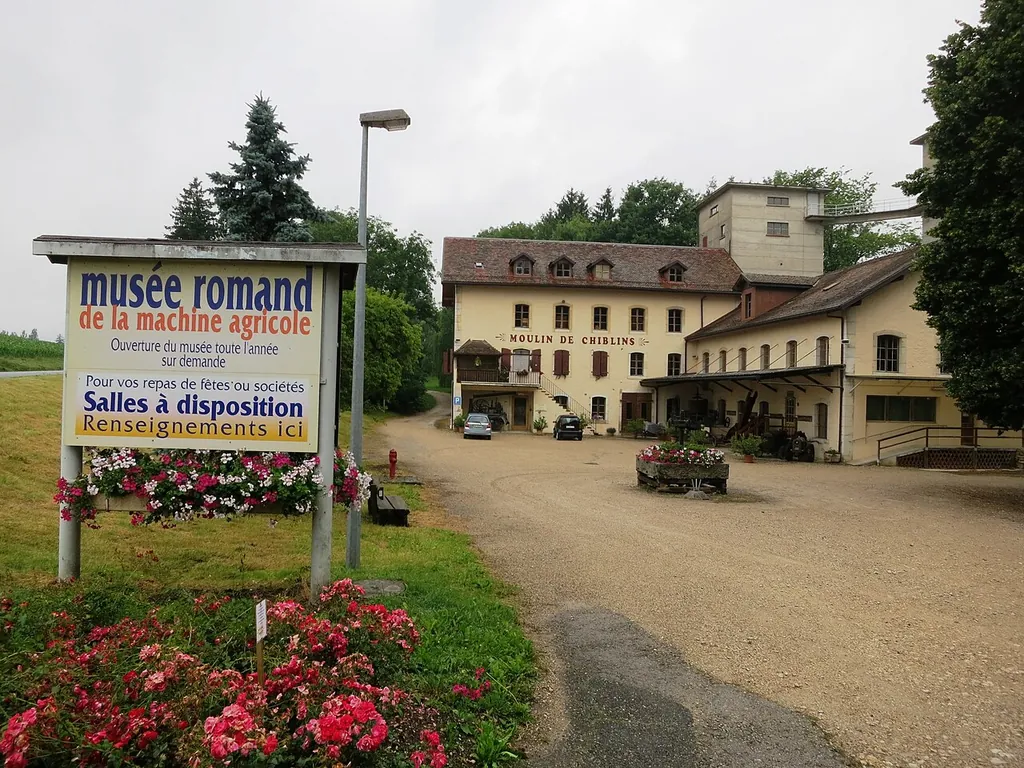
In the old mill of Chiblins, 15 rooms on four floors show around 2,000 tractors, machines and implements from agriculture in French-speaking Switzerland.
No sound? Check your device’s silent switch.
Have only individual sections read aloud
About the museum
The Chiblins mill is a place with a very long history: its first stones are said to date from 970, in the 12th century it belonged to the lords of Gingins, and in 1536, after the conquest of Vaud, it passed to the Bonmont estate under the Bernese bailiffs. After a major fire in 1862, a new custom mill was built five years later. In 1903 it was bought by an agricultural cooperative, which operated it for almost 70 years before it passed to the Federation of Vaud Agricultural Societies in 1971. After nearly 20 years, operations ceased.
In 1990 the foundation of the Musée romand de la machine agricole acquired the mill. This museum had been founded ten years earlier in Vernier; its collection goes back at its core to Victor Bertschi, a workshop manager and demonstrator at a large agricultural machinery business, who rescued old working equipment from the scrapyard. Just a year later the collection was housed in Chiblins, and the mill has been on the Swiss Inventory of Cultural Property of National and Regional Significance since 1995; after major conversions it became a permanent museum in 1997.
Today the museum shows, on four levels, tractors, agricultural machinery, horse-drawn vehicles, viticulture and forestry equipment, a saddlery, a forge, a dairy, a butcher's shop and a kitchen. The old 20th-century mill equipment has been completely preserved.
Highlights
- Collection of around 2,000 agricultural machines and implements
- 15 exhibition rooms on four floors in the historic mill
- Tractors from 1923 to 1960 on the ground floor
- Completely preserved mill equipment, roller mills still in working order
- Horse-drawn vehicles, viticulture and forestry equipment, forge and kitchen
Permanent exhibitions
- Traktoren (1923–1960) – On the ground floor, the row of tractors from the years 1923 to 1960 shows how quickly the machine replaced the horse as a source of traction.
- Mühleneinrichtung – A millstone grinding set and the roller mills, which ran until 1986 and are still in working order, document the milling operation of the 20th century.
- Gespannfahrzeuge und landwirtschaftliche Geräte – Wagons, sleighs and carriages as well as equipment for arable farming, haymaking, sowing, potatoes, viticulture and forestry show the mechanisation of agriculture.
- Founded
- 1980
- Operated by
- Fondation du Musée Romand de l’Agriculture
Admission & discounts
| Adults | CHF 8 |
|---|---|
| Reduced | CHF 6Senior citizens (AHV), disability pension recipients (IV) and students |
| Children & teens | freefree up to age 16 · Accompanied children up to 16 years free |
| Seniors | CHF 6AHV |
| Visitors with disabilities | CHF 6IV |
| Students & apprentices | CHF 6 |
| Groups (15+ people) | CHF 7 per personper person, clubs and groups of 15 or more |
| Schools – per child | CHF 3Accompanying adults CHF 8 |
| Guided visit (approx. 1.5 hrs, max. 30 people) | CHF 50Flat fee per group |
Tickets are also available online.
Accessibility
The museum hasn’t published any information on this.
Kids & families
The museum hasn’t published any information on this.
Getting there & parking
The museum hasn’t published any information on this.
Amenities & dining
- Café
Refreshment bar (buvette) on site.
Events & venue rental
- Spaces for rent
- Private parties
- Corporate events
- Weddings / ceremonies
Up to 400 guests.
Four rooms: La Taverne (100 seats), La Terrasse, Le Carnotzet and La Buvette; 35 to 400 people in total. With catering service.
Inquiries & detailsPlan your visit
| Guided tours | yes · approx. 1.5 hrs |
|---|---|
| Good to know | The guided visit with commentary takes about 1.5 hours (max. 30 people, flat fee CHF 50). |