September 2, 2026 – December 31, 2026
10 Years of To Walk Invisible
Marks ten years since the TV drama To Walk Invisible with a look at its set and costume design, including costumes by Tom Pye.

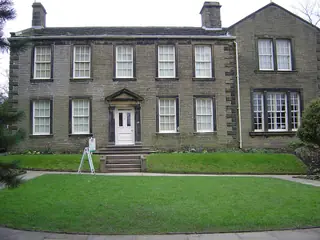
The Grade I listed home of the Brontë family in Haworth, where Charlotte, Emily and Anne wrote their novels, with original furnishings and manuscripts.
September 2, 2026 – December 31, 2026
Marks ten years since the TV drama To Walk Invisible with a look at its set and costume design, including costumes by Tom Pye.
February 23, 2026 – December 31, 2026
A prop scrapbook from the 2026 film Wuthering Heights, made by the character Isabella as a gift for Catherine, on loan from the production company.
February 4, 2026 – January 1, 2027
Explores exploration, conquest and cultural encounters around 1800 and how they shaped the Brontë siblings, from their imaginary Glass Town colonies to people of African descent working in Yorkshire.
February 4, 2026 – December 31, 2026
Charlotte Brontë's hair bracelet, thought to contain hair from her sisters, is shown with other examples of Victorian mourning jewellery.
The parsonage in Haworth was built in 1778 and 1779. The Reverend Patrick Brontë moved in with his wife Maria and their six children in 1820, and it remained the family home for the rest of their lives. Here Charlotte, Emily and Anne wrote poems and, later, novels such as Jane Eyre, Wuthering Heights and Agnes Grey. After Patrick's death in 1861 the contents were sold at auction.
The Brontë Society was founded in 1893 to collect relics of the family, and by 1895 its collection was on show in a museum above a bank in the village. In 1928 Sir James Roberts bought the parsonage, furnished it as a museum and gave it to the Society. Important early gifts included the collection of the American collector Henry Bonnell, which came to the house in 1926 and was moved into the parsonage when it opened.
Today the museum shows the rooms much as the family knew them, with furniture, clothing, books and personal objects, and it holds one of the largest collections of Brontë manuscripts and artefacts. The Grade I listed house is run by the Brontë Society, which also keeps a research library and organises exhibitions and contemporary arts projects.
| Adults | £15 |
|---|---|
| Reduced | £9Students, visitors with disabilities, households on means-tested benefits and residents of the postcode areas BD20, BD21 and BD22 |
| Children & teens | £7.50free up to age 11 · Teen ticket for ages 12 to 16. Children aged 11 and under are free as part of a family group. |
| Seniors | £13Concession ticket for visitors aged 65 and over. |
| Visitors with disabilities | £9companion free · Essential carers or companions of visitors with disabilities are admitted free. |
| Students & apprentices | £9 |
| Families | –There is no fixed family ticket; children aged 11 and under are free when they visit with a family group. |
| Ground floor ticket | £7.50For visitors who cannot reach the first floor |
A ticket allows unlimited entry for twelve months from booking. Free entry for Brontë Society members, Max Card holders, Museums Association members and Art Fund or National Art Pass holders. Prices are valid from April 2026 to March 2027.
The main entrance has steps, but a step-free entrance is available through the welcome desk at the back of the building, with a doorway 55 cm wide. There is no lift to the first floor, which is reached by 16 narrow stone steps, so a cheaper ground floor ticket is offered. A wheelchair can be borrowed. The toilet block next to the shop has an accessible toilet and a Changing Places toilet. Registered assistance dogs are welcome. Two Blue Badge spaces are in the adjacent pay and display car park. Large print guides can be borrowed, the Bloomberg Connects app has audio descriptions, and calm bags with ear defenders and sensory aids and a visual story are available. Rooms are small and the passages narrow.
Great for kids & families
| Kids’ admission | free up to age 11 |
|---|
Information panels are written with children in mind, and the upstairs exhibition room has lift-the-flap displays, a dressing-up corner, a dolls' house and a child-sized table with drawing materials. In school holidays there are crafting sessions, storytelling and trails. Pushchairs can be used on the ground floor and can be left in the shop, as they cannot go upstairs. Baby carriers are available to borrow. Calm bags are offered for families with special educational needs.
Haworth (Keighley and Worth Valley Railway) and bus stops in the village
Keighley is the nearest main railway station, with buses on to Haworth. Steam trains of the Keighley and Worth Valley Railway run between Keighley and Haworth at weekends and bank holidays and daily in summer. Regular buses run to Haworth from Bradford Interchange, Keighley bus station and Hebden Bridge station.
Paid parking
The museum has no car park of its own. Pay and display car parks nearby are the Museum Car Park (BD22 8DS, off West Lane, the closest), Brontë Village Coach and Car Park (BD22 8BW, off Sun Street, with coach facilities) and Central Car Park (BD22 8DG, off North Street). Two Blue Badge spaces are in the adjacent car park.
The museum stands at the top of the cobbled main street, behind St Michael and All Angels Church. Haworth is about 8 miles west of Bradford and 3 miles south of Keighley.
Get directionsThere is no cafe on site, but cafes and restaurants are a short walk away on Main Street. Bags and luggage cannot be stored and must be carried through the museum.
The museum hasn’t published any information on this.
| Guided tours | yes |
|---|---|
| School programs | yes |
| Good to know | The museum is self-guided, with staff in the rooms to answer questions. Private expert-led tours can be booked for Tuesdays, when the museum is closed, and include a visit to the research library. Only assistance animals are allowed inside because of the conservation of the original objects. |
Loading experiences …