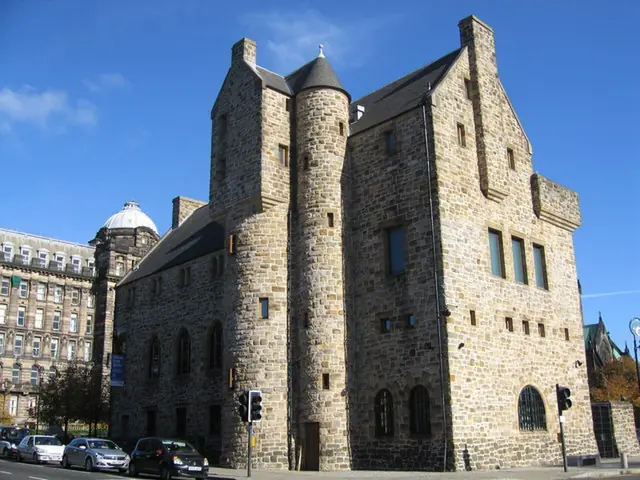
Glasgow Police Museum
Free volunteer-run museum in Glasgow's Merchant City on the history of the city's police from 1779 to 1975, plus an international police collection.
Have only individual sections read aloud
About the museum
The Glasgow Police Museum grew out of the Glasgow Police Heritage Society, founded in 1999 by mostly retired officers who had served in the City of Glasgow Police before the 1975 amalgamations and wanted the force's history preserved and retold. The society's first project was a bronze plaque at the Tron Theatre, whose old session house served as Glasgow's first police office when the force was created in 1800.
In October 2000 the society secured a lease on rooms in the former Central Police Office in St Andrew's Square, and members built the display cases themselves. The museum opened on 3 May 2002 and has been run by volunteers ever since. It is now on the first floor of 30 Bell Street in the Merchant City and has won city and visitor awards, including a City of Glasgow Award in 2024.
The Glasgow Police Historical Exhibition uses artefacts and text boards to cover the people, events and developments in Britain's first police force, the City of Glasgow Police, from 1779 to 1975. A second exhibition shows more than 2,000 items of insignia, headgear and uniforms from police forces around the world.
Highlights
- Historical exhibition on the City of Glasgow Police, 1779 to 1975
- International police exhibition with over 2,000 badges, helmets and uniforms
- Free entry and dog friendly
- Children's quiz and spotting competitions
- Run entirely by volunteers
Permanent exhibitions
- Glasgow Police Historical Exhibition – Artefacts and text boards tracing the people, events and developments of the City of Glasgow Police from 1779 to 1975.
- International Police Exhibition – More than 2,000 items of insignia, headgear and uniforms from police forces around the world, showing how policing spread globally.
- Founded
- 2002
- Operated by
- Glasgow Police Heritage Society
Admission & discounts
Admission is free.
| Groups | –Out-of-hours group tours and talks are arranged for a donation plus travel expenses agreed when booking. |
|---|
Entry is free with no need to book; donations are welcome.
Accessibility
- Wheelchair accessible
- Elevator
- Accessible restroom: not available
- Accessible parking: no information
- Service dogs welcome
- Tactile models & exhibits: no information
- Sign language tours: no information
- Easy-to-read materials: no information
- Audio description: no information
The museum is on the first floor and reached by stairs or a lift; the lift is small (about 43 inches wide by 38 inches deep) with manual doors that must be fully closed. Visitors ring the entry buzzer to be admitted, and staff can help on request via the intercom. The rest of the museum is on one level. Toilets are available but are traditional narrow cubicles, not accessible toilets. The museum is dog friendly.
Kids & families
Great for kids & families
- Activity booklet, scavenger hunt or kids’ audio guide
Children can take part in one of two competitions depending on age, using an illustrated sheet of hidden figures to find in the museum; a museum quiz is offered from age 9. The competitions are not offered during festivals or very busy periods.
Getting there & parking
By car
Paid parking
Pay and display bays in Bell Street and surrounding streets, and the Q-Park multi-storey car park with its entrance in Albion Street. Double yellow lines outside number 30 are a tow-away zone.
The museum is opposite Merchant Square, about 20 metres past Albion Street when walking west along Bell Street from High Street. Bell Street is one-way for vehicles eastwards. Cycle racks are on the south side of Bell Street at Candleriggs, about 100 yards west of the entrance.
Get directionsAmenities & dining
- Café: not available
- Restaurant: not available
Events & venue rental
The museum hasn’t published any information on this.
Plan your visit
| Guided tours | yes · approx. 1.75 hrs |
|---|---|
| Good to know | Group tours of about 1 hour 45 minutes and illustrated talks on the history of the Glasgow police are available outside normal hours for social groups; tours are limited to 20 people, with a minimum of 12. Talks are for groups of at least 15. |