Natural History Museum
A free natural history museum in South Kensington with dinosaurs, a blue whale skeleton and galleries on animals, earth and human evolution.
Have only individual sections read aloud
About the museum
The Natural History Museum grew out of the natural history collections of the British Museum, which went back to the specimens of Sir Hans Sloane. The anatomist Richard Owen, who ran those collections, argued that they needed a building of their own, and in the 1860s a site in South Kensington was chosen.
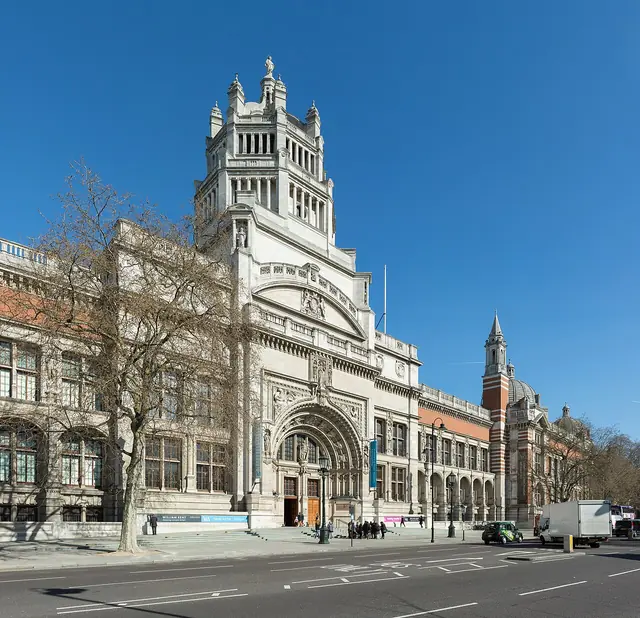
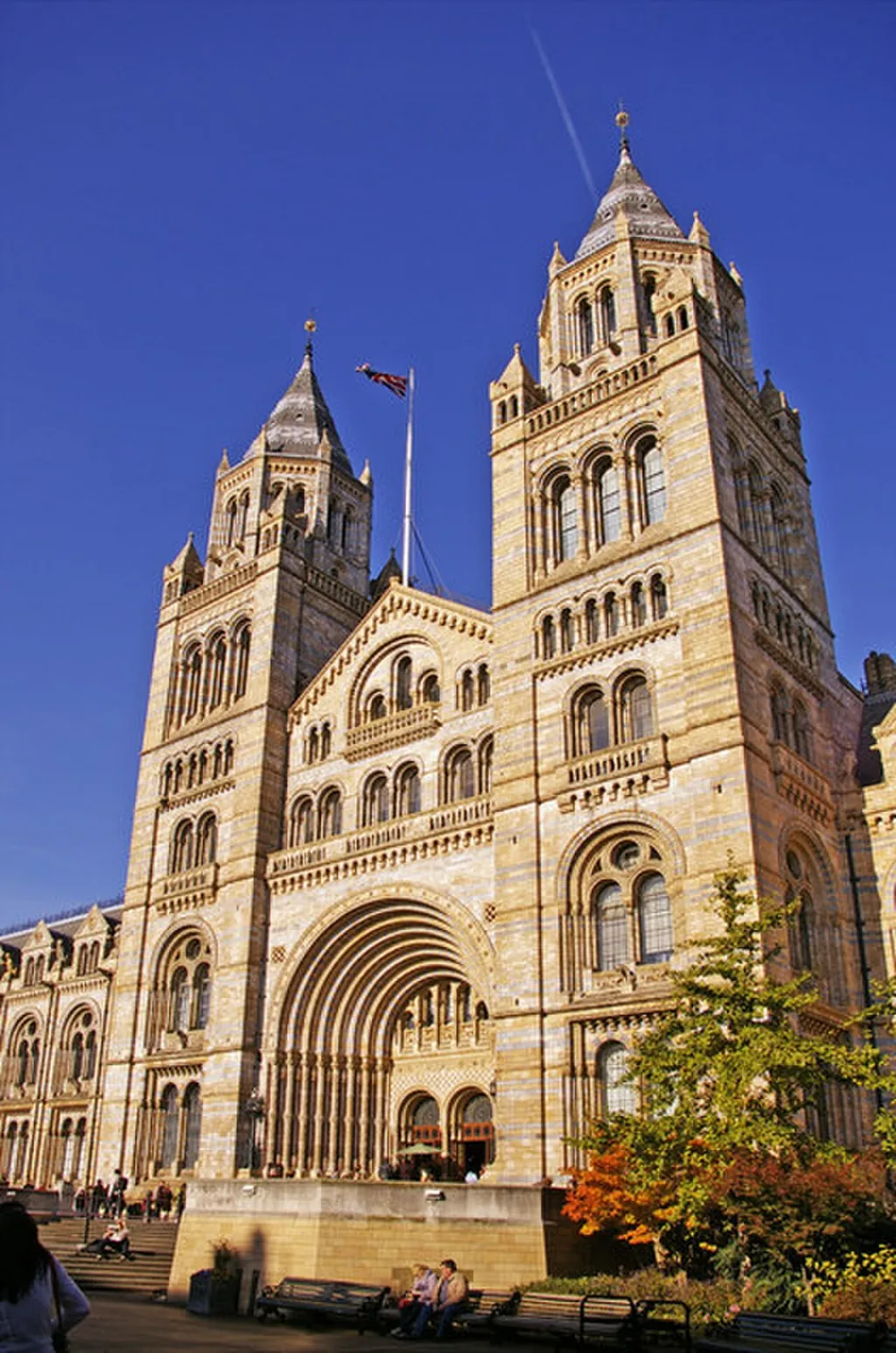
The architect Alfred Waterhouse designed the Romanesque-style building with its terracotta-clad walls decorated with plants and animals. It opened to the public in 1881, and the collections were moved from Bloomsbury to the new building, which was at first still part of the British Museum. The museum became fully independent in 1963.
The central Hintze Hall is the museum's main entrance hall. For many years it displayed a cast of a Diplodocus skeleton, nicknamed Dippy, before a skeleton of a blue whale was hung there in 2017. A separate Darwin Centre houses research collections and laboratories.
Today the museum is free to enter and shows dinosaurs, mammals, birds, minerals, volcanoes and earthquakes, and the story of human evolution. It also runs a major scientific research programme and manages the Natural History Museum at Tring.
Highlights
- Hintze Hall with the blue whale skeleton
- Dinosaurs gallery with the T. rex
- Earthquake and volcano simulator
- Minerals and gemstone galleries
- Wildlife Photographer of the Year exhibition (ticketed)
Permanent exhibitions
- Dinosaurs Gallery – Fossil skeletons of dinosaurs, including a roaring T. rex model and a Triceratops skull.
- Hintze Hall – The museum's main hall, where a blue whale skeleton hangs above the visitors.
- Volcanoes and Earthquakes – A gallery on the forces that shape the planet, with an earthquake simulator.
- Founded
- 1881
- Operated by
- Trustees of the Natural History Museum
Admission & discounts
Admission is free.
| Visitors with disabilities | –companion free · Free companion tickets are offered for paid exhibitions, with no ID or proof of disability required. |
|---|
The galleries are free to explore, and a free entry ticket can be booked to guarantee entry and skip queues; at busy times on weekends and school holidays there may be a queue. Paid exhibitions and events are charged separately, and Members enter these free.
Accessibility
- Wheelchair accessible
- Elevator
- Accessible restroom
- Accessible parking
- Service dogs welcome
- Tactile models & exhibits
- Sign language tours
- Easy-to-read materials: no information
- Audio description
The building has lifts and step-free access to most areas; the Central and West entrances are step-free with ramps, while the East entrance has a lift from its lobby. A limited number of manual wheelchairs can be borrowed free of charge from the cloakrooms but cannot be reserved. Changing Places toilets are on the Ground Floor and in the Nature Activity Centre. Hearing loops are built in at information desks, and there are large print guides, audio descriptions, visual guides, captions, quiet spaces and deaf-led BSL tours. Staff can help visitors with access needs skip the entry queue. Blue Badge spaces on site must be booked by phone, and 12 more are on Exhibition Road. Guide dogs are welcome except in the Zoology Spirit Building.
Kids & families
Great for kids & families
- Family tours & workshops
- Activity booklet, scavenger hunt or kids’ audio guide
- Hands-on stations
- Stroller-friendly
- Baby changing facilities
The museum suggests free family activities, a family favourites self-guided tour and an earthquake simulator, and all its eateries are family-friendly with children's meals and high chairs. Baby care rooms and baby-changing toilets are provided, and pushchairs can be left in the cloakroom for £5.
Getting there & parking
By public transit
South Kensington station · 5-min walk
South Kensington Underground station (Piccadilly, District and Circle lines) is about a 5-minute walk; use the subway tunnel for step-free access to the Central Entrance. Gloucester Road station is about 12 minutes from the Central Entrance and 7 minutes from the West Entrance. Several bus routes stop nearby, and Santander Cycles docking stations are on Exhibition Road and Thurloe Place.
By car
No on-site parking at the museum.
There is no visitor car park. A very limited number of Blue Badge spaces on site can be booked by phone and are reached via Queen's Gate; 12 further Blue Badge bays on Exhibition Road cannot be booked and allow four hours' parking between 8:30 and 18:30.
- Accessible parking
Three entrances: Central (Cromwell Road, step-free with a steep ramp), East (Exhibition Road) and West (Queen's Gate). Coaches drop off outside the main entrance on Cromwell Road.
Get directionsAmenities & dining
- Café
- Restaurant
- Museum shop
- Coat check
- Wi-Fi
Free wifi is listed at the T. rex Restaurant and the cafés. Venues include the T. rex Restaurant, Central Café, Earth Hall Café, a Garden Kitchen and afternoon tea in the Anning Rooms. Cloakrooms charge £3 to £6 per item and are free for Members; large or wheeled suitcases must be left there.
Events & venue rental
- Spaces for rent
Venue hire is offered by the museum.
Plan your visit
| Guided tours | yes |
|---|---|
| Audio guide | yes (EN) |
| School programs | yes |
| Good to know | Free audio guides to different parts of the museum can be listened to on a personal device, including a tour of Hintze Hall narrated by Sir David Attenborough. Two-hour self-guided tours (family favourites, hidden treasures) are available. Bags may be searched on arrival. |