Memorial site on the grounds of the first concentration camp in Nazi Germany: exhibitions on the camp, its prisoners, and the postwar period, plus memorial sites – free admission.
The exhibition in the special exhibition room examines the US military trials held in Dachau from 1945 to 1948 – crime scenes, defendants, witnesses, and judges – and raises questions of responsibility and reckoning with the past.
Om museet
The Dachau concentration camp was set up in March 1933, shortly after the Nazis came to power, on the grounds of a disused munitions factory. It operated for twelve years and served the SS as a model and training ground for the later camp system. More than 200,000 people from all over Europe were imprisoned here and in its roughly 140 subcamps; more than 41,000 of them died. On April 29, 1945, US troops liberated the survivors.
After the war, the Americans initially used the site as an internment camp and for the Dachau trials; afterward, refugees and expellees lived there for years. A small exhibition was set up in the crematorium as early as 1948, but it was dismantled and altered several times. Survivors, united in the Comité International de Dachau, campaigned persistently for a dignified place of remembrance; in 1965, the memorial site finally opened with a large exhibition, archive, and library in the former maintenance building.
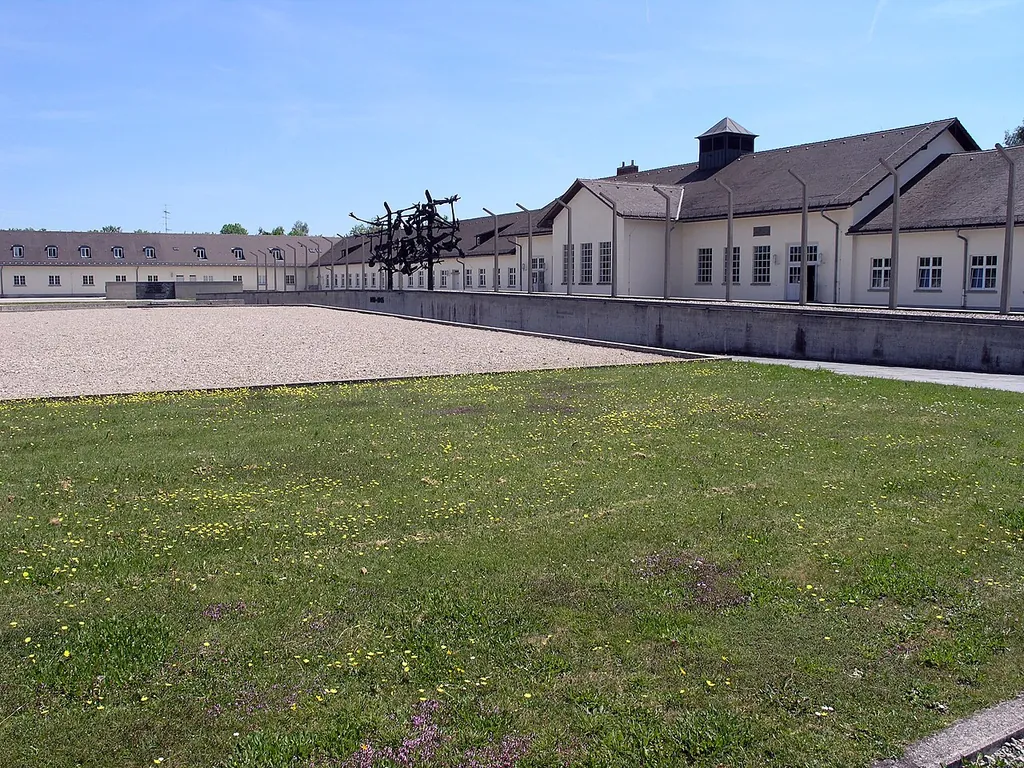
In the years that followed, religious memorials were built on the former camp grounds – a Catholic chapel, a Protestant church, a Jewish memorial, a Carmelite convent, and later a Russian Orthodox chapel – as well as Nandor Glid's International Memorial on the roll-call square in 1968. Since 2003, the redesigned main exhibition has followed the path of the prisoners through the camp; since 2005, visitors have once again entered the grounds through the historic Jourhaus with its gate, and a visitor center was added in 2009.
Today, Dachau is the most visited concentration camp memorial in Germany. It belongs to the Stiftung Bayerische Gedenkstätten (Bavarian Memorials Foundation), maintains an archive and library, runs an extensive educational program, and is being gradually redesigned, including a new exhibition in a reconstructed barrack and the renovation of the International Memorial.
Højdepunkter
Jourhaus with the camp gate and the inscription "Arbeit macht frei"
Main exhibition "Der Weg der Häftlinge" (The Path of the Prisoners) in the former maintenance building
Former camp prison (the "bunker") and reconstructed barrack
Area of the former crematorium
International Memorial by Nandor Glid and religious memorials
Documentary film "Das Konzentrationslager Dachau" in the cinema
Permanente udstillinger
Der Weg der Häftlinge – The main exhibition in the former maintenance building follows the prisoners' path across 13 rooms, from admission through daily camp life to death or liberation, and places the camp's history from 1933 to 1945 in context; texts in German and English.
Ehemaliges Lagergefängnis – In the so-called bunker behind the maintenance building, an exhibition documents the conditions of detention, punishments, and fates of the prisoners held in isolation there.
Baracken-Ausstellung – The reconstructed prisoner barrack shows how the prisoners' accommodation changed over the years and became increasingly worse.
Grundlagt
1965
Ejer
Stiftung Bayerische Gedenkstätten
Ledelse
Gabriele Hammermann
Besøgende pr. år
ca. 1.013.203 (2025)
Entrépriser & rabatter
Der er gratis entré.
Børn og unge
–Free admission. The memorial site recommends visits only from age 13; minors only when accompanied by a parent or guardian.
Grupper
–Tours, study days, and seminars for groups (max. 30 people, age 13 and up) are subject to a fee; book several months in advance at buchungen@gedenkstaette-dachau.de or +49 8131 66997-131.
Public tour (approx. 2.5 hours)
4 €daily; tickets available only on the same day at the visitor center, no later than 45 min. before the start; max. 30 people
Audio guide
5 €reduced €4 for groups and students; available at the visitor center against a deposit
Tour booklet (print)
8 €€6 as an e-book; also available in Easy Language (Leichte Sprache)
Admission and exhibitions are free, no registration needed. Fees apply for guided tours, audio guides, and the parking lot (cars €3, buses/RVs €5, cash only).
Tilgængelighed
Delvis kørestolsvenlig
Elevator: ingen oplysninger
Handicaptoilet
Handicapparkering: ingen oplysninger
Servicehunde tilladt
Taktile tilbud: ingen oplysninger
Rundvisninger på tegnsprog
Letlæste tilbud
Synstolkning: ingen oplysninger
The extensive grounds mostly have gravel paths. Wheelchairs and mobility scooters can be borrowed. Ramps lead into the former maintenance building (main exhibition), the reconstructed barrack, the former crematorium, the camp prison, the seminar rooms, and the Protestant Church of Reconciliation (Evangelische Versöhnungskirche). Accessible restrooms in the visitor center, the exhibition building, and at the seminar rooms. Certified under "Reisen für Alle" (Travel for All). Free app with more than 80 videos in German Sign Language (loan devices at the visitor center); tour booklet and AR web tour in Easy Language (Leichte Sprache); accessible educational programs for groups. Dogs are not allowed, except assistance dogs.
Børn og familie
Kun delvist egnet til børnAnbefales fra 13 år
Besøgets varighed
ca. 4 t.
Familieomvisninger & workshops: findes ikke
No separate exhibition for children; some content is not suitable for children under 13. Younger teenagers should come with parents or a companion.
Transport & parkering
Med offentlig transport
KZ-Gedenkstätte
S2 (toward Dachau/Petershausen) or regional train from München Hbf to Dachau Bahnhof (approx. 25 min.), then bus 726 (toward Saubachsiedlung) to KZ-Gedenkstätte (approx. 10 min.).
I bil
Betalingsparkering
Parking lot Alte Römerstraße 73: car/motorcycle €3, bus/RV €5, cash only. Limited capacity; the memorial recommends arriving by public transport.
Visitor center: Pater-Roth-Straße 2a. Bicycles are not allowed on the grounds; parking spaces are available.
Bistro in the visitor center (daily 9:00–17:00, coffee, cake, snacks, and hot meals). Literaturhandlung in the visitor center and the bookshop of the Comité International de Dachau at the entrance to the main exhibition (each daily 10:00–17:00). Luggage can be checked only to a very limited extent; the lockers at Munich Hauptbahnhof are recommended.
Arrangementer & udlejning
Så vidt vi ved, udlejer museet ikke lokaler til eksterne arrangementer.
As a memorial site, it is not rented out for private or commercial events.
Planlæg dit besøg
Rundvisninger
ja · varighed ca. 2,5 t.
Audioguide
ja (AR, CS, NL, EN, FR, DE, EL, HE, HU, IT, JA, ZH, PL, PT, RU, ES, TR, UK)
Tilbud til skoler
ja
Fotografering
Photos and videos for private, non-commercial purposes are allowed on the grounds and in the exhibitions (no tripods, and with respect for the dignity of the site). Not allowed: recording guided tours, drones, and filming in the crematorium.
Godt at vide
The memorial site recommends allowing about half a day. Visitor center at Pater-Roth-Straße 2a. Public tours daily in German at 12:00 and in English at 11:00 and 13:00; no advance reservations. Documentary film (38 min.) in the cinema of the exhibition building: German at 9:30, 11:00, 13:15, and 14:45; English at 10:15, 11:45, and 14:00; other languages on request. All educational programs only for ages 13 and up. Free AR app "ARt. Das KZ Dachau in Zeichnungen".