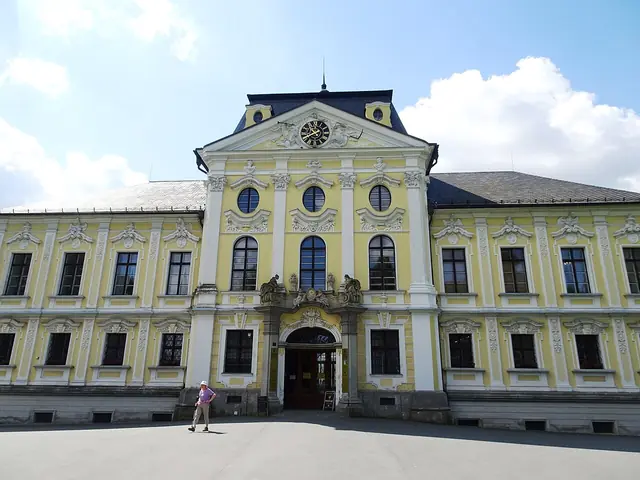
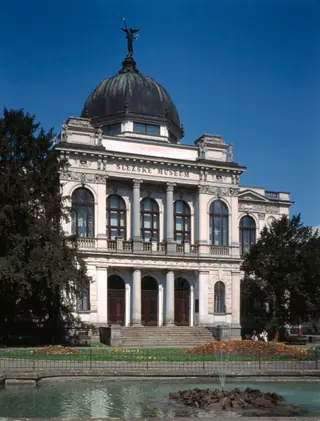
Main visitor site of the Slezské zemské muzeum (Silesian Museum) in Opava: a neo-Renaissance building with the Silesia exhibition on the natural history and history of the Czech part of Silesia.
Show individual sections
Highlights
The Silesia exhibition across three floors and the cellar
The section Nature of Silesia, with geology and biodiversity
The section Encyclopedia of Silesia, from prehistory to the 20th century
Over two hundred medals, plaques and tokens from the Opavsko region from the end of the war to the present day, including rare pieces such as a chess medal from 1967. The exhibition accompanies a book of the same name.
The exhibition presents the water and wetland environments of Czech Silesia with their plants, animals and fish. Replicas of objects linked with fishing and water management trace the period from prehistory to the late Middle Ages.
An exhibition arranged in thematic headings shows the transformation of Austrian Silesia from patrimonial administration to a modern civil society, for example in politics, the economy, education and spa culture. It also commemorates 80 years of the Slezský studijní ústav.
Drawings and illustrations by entomologist Jindřich Roháček: 48 New Year cards with fly motifs, influenced by surrealism, supplemented by illustrations from his scientific works.
The exhibition in the Památník Petra Bezruče commemorates the life and work of the poet, publicist and translator Zdeněk Bár. It presents materials from the memorial's literary archive, many of which are being exhibited for the first time.
About the museum
The Slezské zemské muzeum was founded in 1814. It presents itself to the public in several exhibition complexes; the main visitor site in Opava is the Historická výstavní budova (Historical Exhibition Building) on Komenského Street.
The neo-Renaissance building stands by the city park. It was built in 1893–1895 to designs by the Viennese architects Johann Scheiringer and Franz Kachler for the Museum of Emperor Franz Joseph for Art and Crafts, founded in Opava in 1882. The building was paid for by the chamber of commerce and trades on a plot donated by Prince Liechtenstein. In spring 1945 it was seriously damaged by bombing, and the repairs took ten years.
After the war, exhibitions opened here in 1955 and 1981, and in 1985 the building was declared a cultural monument. After an extensive reconstruction it reopened in May 2012 with the new Silesia exhibition, which occupies all three floors and for the first time also opened the cellar spaces. Since May 2019 the museum has also used the neighbouring Müller’s House with its park.
Permanent exhibitions
Slezsko – Permanent exhibition across the three floors of the Historical Exhibition Building, including the cellar spaces, divided into a section on nature and a section on the cultural history of Silesia.
Příroda Slezska – Presents the natural conditions and the diversity of life in the region, with links to Europe and the wider world; the geological section briefly shows the oldest development of Silesia and northern Moravia.
Encyklopedie Slezska – A thematic selection of examples from the history, culture and everyday life of the inhabitants of Czech Silesia, from prehistory to the 20th century.
Founded
1814
Operated by
Slezské zemské muzeum (příspěvková organizace Ministerstva kultury ČR)
Visitors per year
approx. 85,810
Admission & discounts
Adults
120 Kč
Reduced
70 Kčchildren and young people aged 6–18, students, holders of ISIC/ITIC cards, seniors over 65 (with proof of age), members of the Klub přátel výtvarného umění (Friends of Fine Arts Club), the Čtyřlístek children’s club and the Fond ohrožených dětí (Endangered Children’s Fund).
Children & teens
70 Kčfree up to age 5 · Children and young people aged 6 to 18 pay the reduced admission.
Seniors
70 KčSeniors over 65 with a valid ID card.
Visitors with disabilities
freecompanion free · Holders of ZTP and ZTP/P cards, including an escort, enter free.
Students & apprentices
70 KčWith a student card or other ID.
Groups (10+ people)
–Groups of 10 or more people receive a 20% discount when booked in advance.
Families
300 KčTwo adults and up to three children under 18.
Free admission:Free-entry days for the permanent exhibitions according to the Czech Ministry of Culture: 1 November and 6 December 2026.
Prices valid from 16 June 2026. Admission also covers Müller’s House and its park. Free entry is granted, among others, to children under 6 and to holders of AMG and ICOM cards. Photography without flash and tripod is free. Admission to the educational programme for booked groups costs CZK 50 per pupil.
Accessibility
Partially wheelchair accessible
Elevator
Accessible restroom
Accessible parking: not available
Service dogs welcome
Tactile models & exhibits: no information
Sign language tours
Easy-to-read materials: no information
Audio description: no information
The building is classed as partly accessible. Steps lead to the main entrance, which can be overcome with a ramp; the entrance doors open automatically. Inside there is a lift large enough for a wheelchair and a step-free toilet that can be unlocked with a RADAR key. There is no reserved parking space at the building; the Komenského public transport stop is nearby. The museum offers a tour in sign language, and a tablet with speech transcription can be used to communicate with deaf visitors.
Kids & families
The museum hasn’t published any information on this.
Getting there & parking
By public transit
Komenského
There is a city public transport stop, Komenského, near the building.
The museum hasn’t published any information on this.
Events & venue rental
Spaces for rent
The museum rents out the festive hall in Müller’s House (from CZK 500 per hour; with facilities for a reception from CZK 800 per hour) and offers short-term hire in the Historical Exhibition Building from CZK 4,000.
Photography without flash and tripod for personal use is free.
Dogs
not allowed (assistance dogs excepted)
Good to know
Larger backpacks and items over 30 × 40 cm must be left in the cloakroom. Children under 15 may enter the exhibitions only accompanied by an adult. Dogs are not allowed in the building.