Musée départemental breton
Museum of the Finistère Département in the former bishop’s palace of Quimper, telling the history and culture of Lower Brittany from prehistory to the present day.
No sound? Check your device’s silent switch.
Have only individual sections read aloud
About the museum
The museum was founded in 1846, when the Société archéologique du Finistère, established in Quimper in 1845, began gathering collections. It became the property of the Département in 1862, which widened its scope to art, science, history and non-European cultures. It is the oldest museum in Finistère and one of the first in France to build a collection of folk art and regional applied arts.
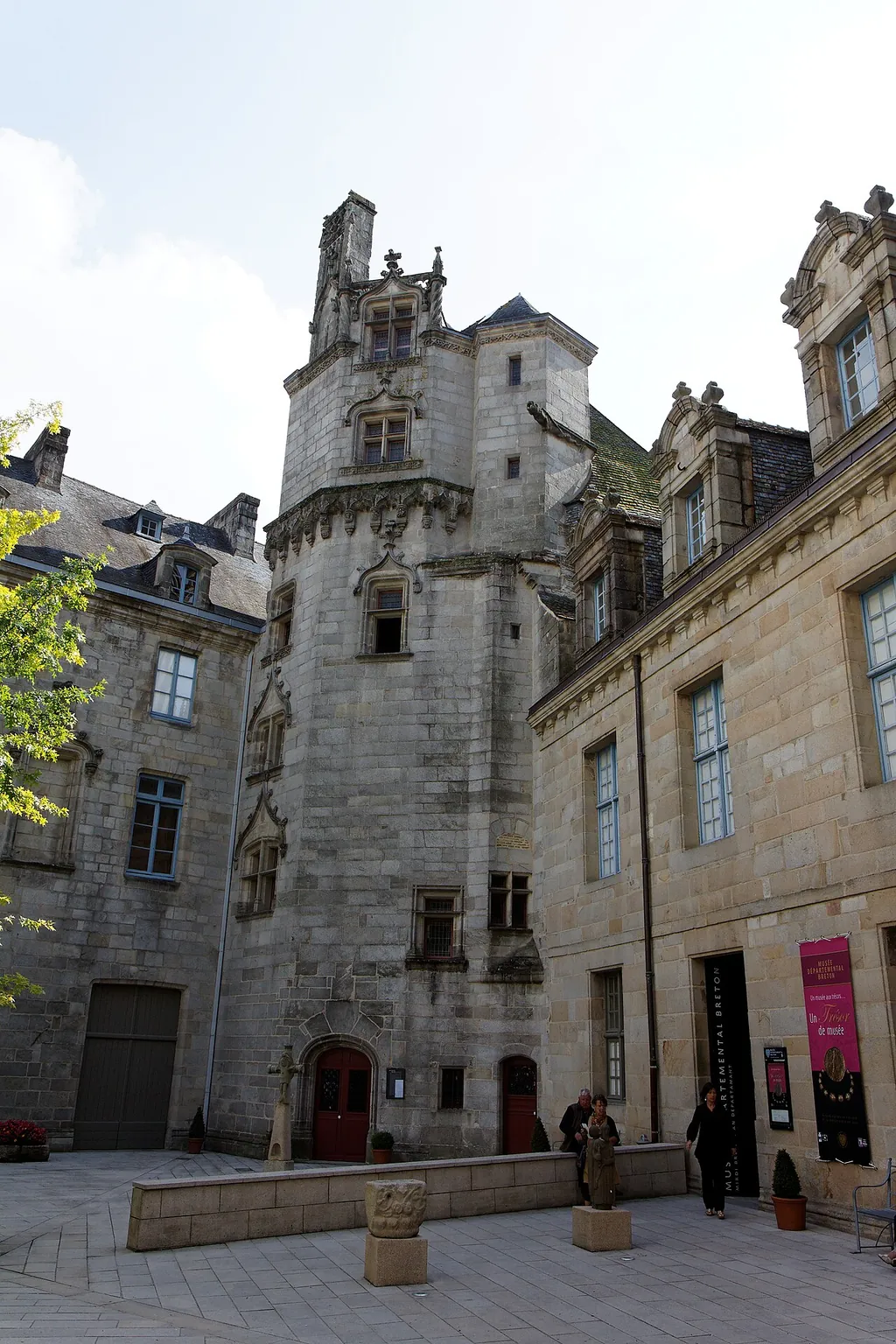
It occupies the former palace of the bishops of Cornouaille, adjoining Saint-Corentin Cathedral. The Renaissance staircase tower dates from 1507. The wing on Rue du Roi Gradlon was completed in 1645, and the wing along the Odet was built in 1776 and remodeled in 1866 with a neo-Gothic cloister. The reception is in the former palace kitchen, which has been preserved in its original state.
The collection, which holds the “Musée de France” label, comprises more than 65,000 items. The permanent route follows the history of Lower Brittany from prehistory to the present day: the Metal Ages and Antiquity, the Middle Ages, traditional costume, Breton furniture and Quimper ceramics. The museum has received the “Tourisme et Handicap” label for all four types of disability.
Highlights
- Former bishop’s palace with the 1507 Rohan Tower and fresco room
- More than 65,000 items, from prehistory to the present day
- Traditional costumes, Breton furniture and Quimper faience
- Tourisme et Handicap label for all four types of disability
- Puzzle booklets and investigation games for children from age 3
Permanent exhibition
- Parcours permanent du musée départemental breton – Ten rooms on the history of Lower Brittany, from prehistory to the present day: archaeology, medieval art, costumes, furniture and Quimper ceramics.
- Founded
- 1846
- Operated by
- Département du Finistère
- Visitors per year
- approx. 59,817
Admission & discounts
| Adults | €9 |
|---|---|
| Reduced | €7Holders of CEZAM, Gîtes de France or Loisirs en Finistère cards, or anyone presenting a full-price ticket for the Musée Sérusier, Océanopolis or another site of the Domaines et musées départementaux; groups of 10 or more |
| Children & teens | freefree up to age 17 · Free admission for under-18s. |
| Visitors with disabilities | freeFree admission for people with disabilities. |
| Students & apprentices | –Free admission for students of art, fine arts, history and heritage. |
| Groups (10+ people) | €7 per personReduced rate for groups of 10 or more. |
| Solo subscription (1 year) | €40Unlimited access to the Domaines and departmental museums, and reduced rates for events. |
| Family subscription (1 year) | €90Unlimited access to the Domaines and departmental museums, and reduced rates for events. |
Free admission: The first Sunday of the month, from September to June.
Free admission also for job seekers, recipients of RSA and minimum social benefits, members of ICOM, Friends of the Museum, holders of a press card, licensed guides and members of the Société archéologique du Finistère. Payment by cash, bank card, cheque, Pass Culture or paper Chèques-Vacances (ANCV).
Accessibility
- Wheelchair accessible
- Elevator
- Accessible restroom
- Accessible parking
- Service dogs welcome
- Tactile models & exhibits
- Sign language tours: no information
- Easy-to-read materials
- Audio description: no information
The museum holds the “Tourisme et Handicap” label for all four types of disability. All rooms are accessible: automatic door at reception, ramps, elevators, benches, folding chairs and wheelchairs available on loan, and adapted toilets on one level. Induction loops at the ticket desks and in the lecture room, five audio handsets, subtitled videos, touch elements in the rooms, tactile paving, magnifiers on request, sensory kits and a visitor guide in Easy Read. Accessible parking spaces along the Odet and opposite the museum.
Kids & families
Great for kids & families
| Kids’ admission | free up to age 17 |
|---|
- Family tours & workshops
- Activity booklet, scavenger hunt or kids’ audio guide
- Hands-on stations
- Stroller-friendly
- Baby changing facilities
- Playground / play area
Family investigation tours and age-appropriate activities from age 1, puzzle booklets and self-guided investigations from age 3, play areas and a relaxation area where breastfeeding is possible. The museum is fully accessible with strollers, with cloakrooms and a changing area near the toilets. It has signed the Môm’Art charter of the Musées Joyeux.
Getting there & parking
By public transit
Saint-Corentin
QUB city buses: lines A, B, 5, 6, 7, 8, 9, 9 express, 10 and 12 to the Saint-Corentin stop; lines 5, 6, 9 express and 10 to the Hôtel de Ville stop. Free shuttle from the railway station to the town centre. The railway station and the bus station are about 1 km away, a 10-minute walk along the Odet.
By car
Parking available
Nearby car parks: La Tourbie, La Résistance, Théodore Le Hars and De Lattre de Tassigny. Bike racks in the museum courtyard and nearby.
- Accessible parking
Entrance and exit are on Rue du Roi Gradlon, alongside the cathedral. Once through the palace gateway, the entrance is on the right in the courtyard.
Get directionsAmenities & dining
- Museum shop
- Coat check
- Lockers
Shop at the entrance, open to all without a ticket, with more than 340 titles: books, games, stationery and Breton creations. Lockers for small and medium-sized bags; suitcases and large backpacks are not accepted. A left-luggage facility with 21 lockers is available at the Conciergerie on Rue du Guéodet, five minutes from the museum (€2 per day). Relaxation area on the mezzanine and in the courtyard.
Events & venue rental
The museum hasn’t published any information on this.
Plan your visit
| Guided tours | yes |
|---|---|
| School programs | yes |
| Good to know | The route is presented in French, Breton and English. Guided tours, lectures, performances and workshops are held according to the programme; virtual visits and podcasts are available in French and English. Bags are visually checked at the entrance as part of the Vigipirate security plan. Entrance is on Rue du Roi Gradlon, through the palace gateway. |