Sciences ACO
Museum of the Anneau de Collision d'Orsay (ACO), a former particle accelerator, on light, matter and synchrotron radiation; by appointment.
No sound? Check your device’s silent switch.
Have only individual sections read aloud
About the museum
ACO stands for “Anneau de Collision d'Orsay” (Orsay Collision Ring). This circular particle accelerator operated from the 1960s to the 1980s on the campus of the Faculty of Science in Orsay, now part of Université Paris-Saclay. In its first phase, it was used to study the properties of particles: electrons and positrons, accelerated close to the speed of light, collided in the ring.
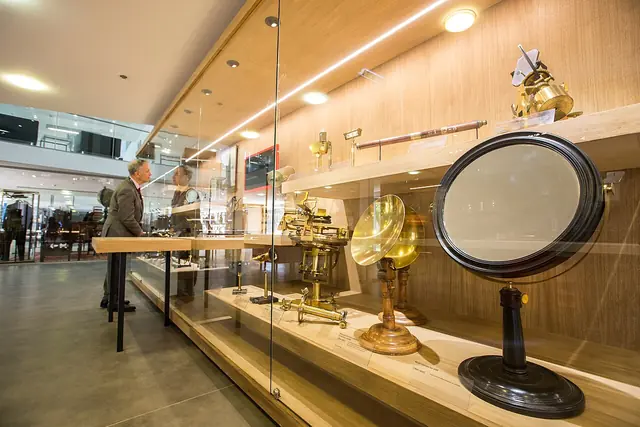
In the second phase, the ring became a source of synchrotron radiation, a light with very precise properties used to study different materials. The machine's components, such as the dipoles, the quadrupoles, the radiofrequency cavity and the beamline, are presented in the experiment hall.
Since 1993, educators and physicists have run this site, which is part of the history of the Orsay campus. The association Sciences ACO conducts the tours and presents a heritage collection made up of archives, films and an inventory of the museum's objects.
Highlights
- The ACO collision ring in its experiment hall
- Audio guide to listen to on your phone by scanning the QR codes in front of each part of the machine
- Explanations of the dipoles, quadrupoles, radiofrequency cavity and beamline
- Heritage collection: archives, films and inventory of objects
Permanent exhibition
- Salle d'expériences de l'anneau ACO – Visit to the former particle accelerator, with explanations of how it worked and of synchrotron radiation.
- Operated by
- Association Sciences ACO
Admission & discounts
The museum hasn’t published any information on this.
Accessibility
The museum hasn’t published any information on this.
Kids & families
The museum hasn’t published any information on this.
Getting there & parking
By public transit
Orsay-Ville (RER B)
RER B, Orsay-Ville station, then a walk (route map on the website).
By car: Route nationale 118, Orsay exit. The postal address is 15 rue Clemenceau, but the museum recommends setting your GPS to 99 rue Jean Teillac, the Orsay entrance to the campus of the Faculty of Science.
Get directionsAmenities & dining
The museum hasn’t published any information on this.
Events & venue rental
The museum hasn’t published any information on this.
Plan your visit
| Guided tours | yes |
|---|---|
| Audio guide | yes (FR) |
| Good to know | Visit requests by email to the site's booking address, stating the desired period, the number of people, and postal and phone contact details. The audio guide can be accessed by scanning the QR codes placed in the room. |