Deutsches Kartoffelmuseum
Volunteer-run museum on the cultural history of the potato in the former synagogue of Fußgönheim (Palatinate) – currently closed due to water damage.
Show individual sections
About the museum
The idea for the potato museum grew out of the Heimat- und Kulturkreis Fußgönheim (local heritage and culture society), founded in 1968. From 1980 the local history enthusiasts accompanied the annual opening of the early potato harvest with small exhibitions on the history of the tuber in the castle courtyard. The response led to the founding of a separate association in 1987; as early as 1988 it was able to set up a first museum in rooms of a bank across from the castle.
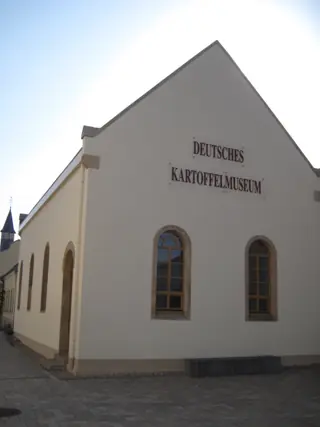
The municipality later acquired the synagogue, built in 1842 and rebuilt after a fire in 1901, which had seen no services since the Jewish community came to an end in 1928 and had been used as a grain store from the 1930s. In the mid-1990s the municipality and the association had the listed building restored with grants, donations and a great deal of volunteer labor; the windows, paint scheme and large rose window were reconstructed. The museum has used the building since 1997.
The tour follows the potato from its domestication in the Andes and its arrival in Europe, where it was first regarded as an ornamental plant, to its breakthrough as a staple food – with a look at Frederick the Great and the Palatinate as an early growing region. Other topics include breeding, pests, processing and use as a raw material, as well as easily confused plants such as the sweet potato and Jerusalem artichoke. A kitchen corner recalls the everyday life of earlier generations; larger farm machinery is on display in the neighboring agricultural museum.
Since July 2026 the museum has been temporarily closed after water damage. In the meantime, some exhibits can be seen on loan at the Regionalmuseum Oberhavel in Oranienburg.
Highlights
- Museum in the restored 1842 synagogue with its reconstructed rose window
- The potato's journey from the Andes to the Palatinate
- Old kitchen with household utensils of earlier generations
Permanent exhibition
- Die Kartoffel – von den Anden in die Pfalz – Tour through the former synagogue on the origins, spread, cultivation, breeding and uses of the potato, complemented by a historic kitchen.
- Founded
- 1988
- Operated by
- Deutsches Kartoffelmuseum Fußgönheim e. V.
Admission & discounts
Admission is free.
| Groups | €5 per personGuided groups €5 per person, including the castle church and the local history museum. |
|---|
Free admission; donations welcome.
Accessibility
- Wheelchair accessible
- Elevator: no information
- Accessible restroom
- Accessible parking: no information
- Service dogs welcome: no information
- Tactile models & exhibits: no information
- Sign language tours: no information
- Easy-to-read materials: no information
- Audio description: no information
The museum is wheelchair accessible and has an accessible toilet.
Kids & families
The museum hasn’t published any information on this.
Getting there & parking
By car
Parking available
Car park at the Bürger- und Jugendhaus Fußgönheim.
Address & contact
Deutsches KartoffelmuseumHauptstraße 62
67136 Fußgönheim
Rhineland-Palatinate, Germany
Amenities & dining
- Museum shop
Books about the potato are on sale.
Events & venue rental
The museum publishes information on events on its website.
Plan your visit
| Guided tours | yes · approx. 1.5 hrs |
|---|---|
| Good to know | Allow about an hour and a half for a tour; special tours by arrangement with the museum guides (contact via the website) or by email. Can be combined with the castle church, the castle garden and the local history museum in Schloss Fußgönheim. |
Visitor experiences
Loading experiences …