Friedensmuseum Brücke von Remagen
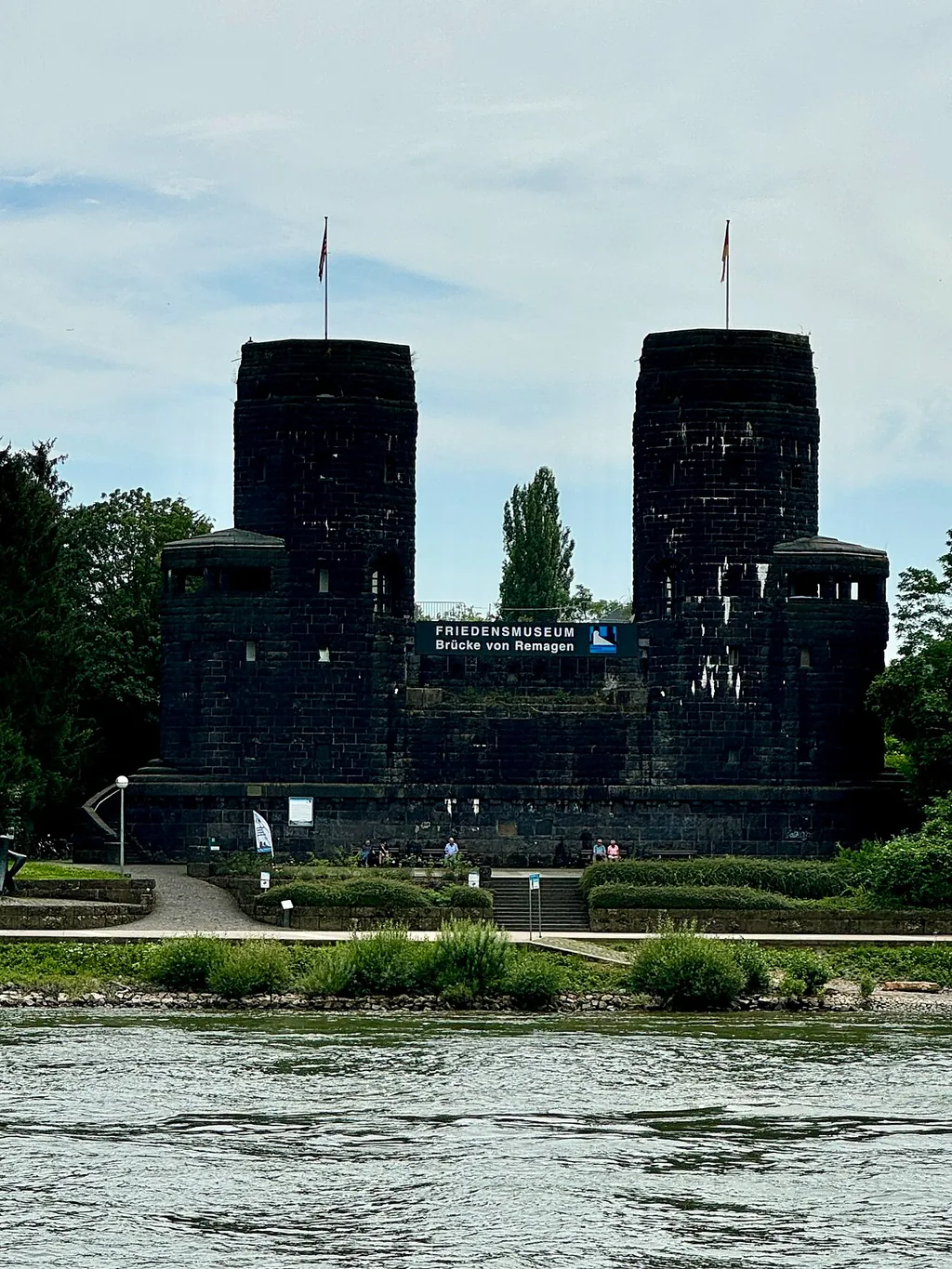
Peace museum in the bridge towers of the Ludendorff Bridge: the capture of the Rhine bridge in March 1945, the prisoner-of-war camp and peace work.
About the museum
The railway bridge at Remagen was built during the First World War as a military link to the Western Front, but was completed too late for that purpose. It became world-famous on March 7, 1945, when a small American advance party captured the bridge intact after the planned demolition failed. The bridgehead thus gained enabled the Western Allies to advance eastward more quickly. Ten days later the bridge collapsed during repair work, killing at least 30 US soldiers.
The 1968 Hollywood film "The Bridge at Remagen" made the town internationally known and attracted visitors from around the world. After long negotiations, the then mayor Hans Peter Kürten acquired the railway embankment and the tower ruins on the left bank of the Rhine, had them restored and opened a museum in them on March 7, 1980 – deliberately as a peace museum rather than a war museum, as a place of encounter and reconciliation of former adversaries.
At the request of former prisoners, remembrance of the American prisoner-of-war camp on the "Goldene Meile" (Golden Mile) was added, where numerous people died in 1945. With donations, the peace chapel "Schwarze Madonna" (Black Madonna), inaugurated in 1987, was built there and belongs to the museum. Today a nonprofit association runs the museum on a volunteer basis; it has been recognized as a place of German democracy history and is part of the European networks Liberation Route and Forte Cultura. Every year on March 7, the events are commemorated with international guests.
Highlights
- Exhibition in the original left-bank bridge towers of the Ludendorff Bridge
- Capture of the bridge on March 7, 1945, from the German and American perspectives
- Memories of Remagen's civilian population from the war years
- Section on the 1945 prisoner-of-war camp between Remagen and Bad Breisig
- Peace chapel "Schwarze Madonna" with the clay figure modeled in the camp
Permanent exhibitions
- Die Brücke von Remagen – Photos, documents, objects, films and audio recordings on the history of the Ludendorff Bridge from construction to its collapse in 1945, from the German and American perspectives as well as from the viewpoint of Remagen's population.
- Kriegsgefangenenlager Remagen 1945 – Section on the American prisoner camp in the fields between Remagen and Bad Breisig and on the catastrophic conditions under which many prisoners died there in 1945.
- Wege zum Frieden – Documentation under development which, together with further rooms, addresses the importance of active peace work.
- Founded
- 1980
- Operated by
- Friedensmuseum Brücke von Remagen e. V.
- Visitors per year
- approx. 16,500 (2025)
Admission & discounts
| Adults | €6 |
|---|---|
| Reduced | €5Seniors and people with disabilities (with ID); €4 for school students up to age 16, university students and federal volunteer service participants (BFD) |
| Children & teens | €4free up to age 7 · Children up to and including age 7 free; school students up to age 16 €4. |
| Seniors | €5With appropriate ID |
| Visitors with disabilities | €5With appropriate ID |
| Students & apprentices | €4School students up to age 16, university students and federal volunteer service (with ID) |
| Groups (10+ people) | €5 per personFor 10 or more people, per person. School classes €4 per person. |
| Families | €12 |
€5 instead of €6 with a voucher from the Arp Museum, with a Rheintaler or with the WelcomeCard Bonn; discounts cannot be combined. Members of the friends' association (€24 per year) have free admission.
Accessibility
- Wheelchair accessible: not available
- Elevator: not available
- Accessible restroom: no information
- Accessible parking: no information
- Service dogs welcome: no information
- Tactile models & exhibits: no information
- Sign language tours: no information
- Easy-to-read materials: no information
- Audio description: no information
Not accessible (historic, listed site): the grounds can be reached from the Rhine promenade only via a steep ramp or a staircase, and the museum itself only via a staircase; in the towers, the exhibition is spread over several floors with a total of about 180 steps. Animals are not permitted in the museum.
Kids & families
| Kids’ admission | free up to age 7 |
|---|---|
| Family ticket | €12 |
Children up to and including age 7 have free admission; family ticket €12.
Getting there & parking
By public transit
Remagen Bahnhof · 20-min walk
From Remagen station and the town center about 20 minutes on foot along the Rhine promenade.
By car
Parking available · 300 m to the entrance
Parking at the Rheinhalle Remagen (Goethestraße), just under 300 m on foot to the bridge towers.
The museum itself is not directly accessible by car. Access by car or tour bus via the B9 (southern entrance), Josef-Rovan-Allee and Goethestraße, signposted. The museum is located directly on the Rhine cycle route.
Get directionsAmenities & dining
- Museum shop
Events & venue rental
The museum hasn’t published any information on this – please ask the museum directly.
Plan your visit
| Guided tours | yes · approx. 1.5 hrs |
|---|---|
| School programs | yes |
| Photography | Photography for private purposes is allowed; publishing interior photos (including on social media) is prohibited. |
| Good to know | Group tours with the museum's own guides on request via the booking form (max. 15 people per guide, approx. 90 minutes, €70 per guide plus admission). External guides are not permitted in the museum or on the grounds. Contact: fuehrungen@bruecke-remagen.de. |