Gedenkstätte Seelower Höhen
Memorial site on the April 1945 battlefield with a Soviet memorial, war cemetery and museum on the battle and the history of remembrance.
About the museum
In the spring of 1945, the Seelow Heights on the edge of the Oderbruch were meant to halt the Red Army's advance on Berlin. In the battle that began on April 16, Soviet and Polish troops fought the Wehrmacht; very many soldiers died before the heights fell and the road to Berlin lay open. In May, Marshal Zhukov commissioned the sculptors Lev Kerbel and Vladimir Tsigal to create monuments along the line of advance; on November 27, 1945, the memorial with a burial site for fallen Red Army soldiers was dedicated in Seelow – one of the first Soviet monuments outside the Soviet Union.
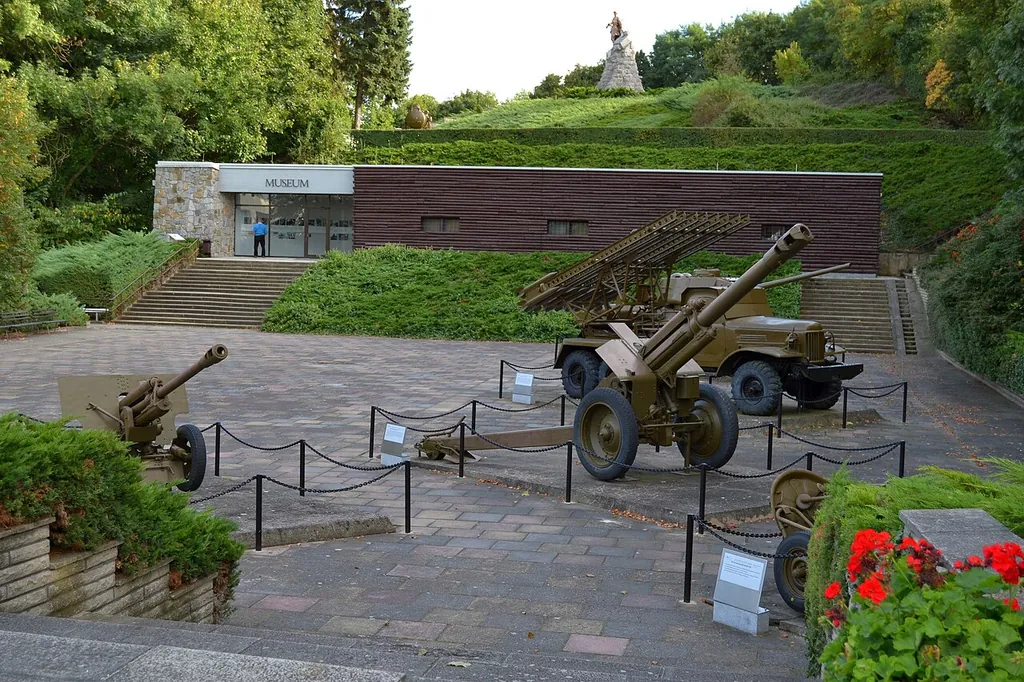
In the GDR, the site was used for wreath-laying ceremonies, oath-taking ceremonies and youth gatherings. By December 27, 1972, it had been expanded into the "Memorial of Liberation": on a new lower level, a museum whose design recalls Zhukov's command bunker, a utility building and a square with heavy military equipment were built. In 1985, a semicircular entrance area and a new exhibition were added, which followed the state's interpretation of history entirely.
After 1990, this presentation was removed and the commemoration was reoriented. An exhibition opened in 1995 put more focus on the German fallen; the current permanent exhibition of 2012 tells in three chapters of the fighting between the Oder and Berlin, of the creation of the memorial and of the changing culture of remembrance. The institution, run by the district of Märkisch-Oderland, also keeps a collection of equipment, weapons, photographs and personal papers and offers educational projects for school classes.
Highlights
- Memorial by Lev Kerbel (1945) with a Soviet war cemetery
- Museum building in the shape of Zhukov's command bunker
- Permanent exhibition with eyewitness interviews and media stations
- Panoramic view over the Oderbruch and the former battlefield
- Documentary films and a slide-and-sound presentation at the relief map in several languages
Permanent exhibitions
- Von der Oder nach Berlin – Dauerausstellung – The bilingual exhibition covers the fighting in the spring of 1945, the creation of the memorial and the changing culture of remembrance after 1990, deepened by media stations and eyewitnesses.
- Außenanlage mit Ehrenmal und Kriegsgräberstätte – On two levels are the Kerbel monument with the soldiers' cemetery, heavy military equipment and eleven multilingual panels on the individual elements of the grounds.
- Founded
- 1972
- Operated by
- Landkreis Märkisch-Oderland
Admission & discounts
| Adults | €5 |
|---|---|
| Reduced | €3Students, trainees, volunteer service participants, severely disabled visitors with a degree of disability (GdB) of 50 or more, recipients of unemployment benefit I (ALG I), Bürgergeld (citizen's income) or basic income support in old age, holders of the Ehrenamtskarte Berlin-Brandenburg and the Kurkarte Buckow |
| Children & teens | freefree up to age 17 · Children and young people up to their 18th birthday free |
| Visitors with disabilities | €3companion free · with a degree of disability (GdB) of 50 or more |
| Students & apprentices | €3 |
| Groups (25+ people) | €3 per personAdult groups of 25 or more pay the reduced price. |
| Combination ticket with the Brecht-Weigel-Haus Buckow | €8reduced €5 |
| Short tour (45 min.), per person | €10reduced €7, only in addition to museum admission |
| Overview tour (90 min.), group flat fee | €90School, youth and student groups €45; English-language tours €20 surcharge; plus museum admission |
The prices apply to the museum; the outdoor grounds and visitor center are free. Free admission also for school classes from the district of Märkisch-Oderland on visits for educational purposes.
Accessibility
- Wheelchair accessible
- Elevator: no information
- Accessible restroom: no information
- Accessible parking
- Service dogs welcome: no information
- Tactile models & exhibits: no information
- Sign language tours: no information
- Easy-to-read materials
- Audio description: no information
People with mobility impairments can get in and out at the forecourt; from there, accessible access to the visitor center, museum and outdoor grounds. Accessible parking spaces on the lower level. Basic information in Easy Language on the website.
Kids & families
Only partly suitable for kids
| Kids’ admission | free up to age 17 |
|---|
Memorial site for the Battle of 1945; the educational programs are aimed at school classes. Children and young people have free admission.
Getting there & parking
By public transit
Seelow (Mark) · 3-min walk
From Berlin, take the RE1 to Frankfurt (Oder) and continue with the RB60 to Seelow (Mark); alternatively, take the RB26 to Seelow-Gusow and continue by bus to Seelow bus station (from there a 20-minute walk or bus to the stop Gedenkstätte).
By car
Parking available
Visitor parking lot on the lower level, with accessible parking spaces there as well. Motorhomes and trailers park at the roadside of Bahnhofstraße opposite the memorial.
- Accessible parking
Check the operating days for bus connections.
Get directionsAmenities & dining
- Museum shop
Museum shop with German- and English-language literature on World War II and the memorial as well as souvenirs; visitor center accessible free of charge.
Events & venue rental
The museum hasn’t published any information on this – please ask the museum directly.
Plan your visit
| Guided tours | yes · approx. 1.5 hrs |
|---|---|
| Audio guide | yes (DE, EN, PL, RU) |
| School programs | yes |
| Good to know | Tours by registration only: overview tour of the grounds (90 minutes, up to 25 people, Tue–Sun, in English on request) and short tour (45 minutes, up to 10 people, Tue–Fri). The audio guide for the outdoor grounds is available to download to your own device. Documentary films and a slide-and-sound presentation run in several languages. |