Haus Herold
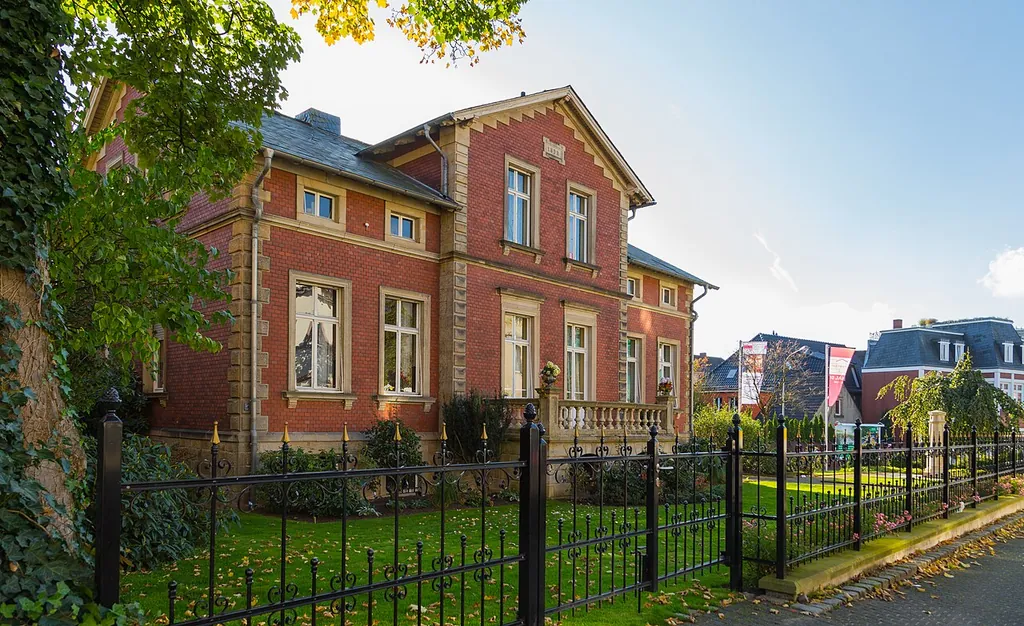
Gründerzeit villa from 1892 in Ibbenbüren, where the volunteer-run city museum shows home furnishing culture around 1900 and the 1950s.
About the museum
The brick villa on Breite Straße was built in 1892 to plans by the Ibbenbüren master carpenter and architect Julius Hövel, who built it for his father Bernhard. The street between the train station and the Mauritiuskirche was then the preferred address of wealthy citizens, and the house, with its sandstone articulation, stucco ceilings, and elaborate staircase, reflects that aspiration. In 1912 the villa passed to the Többen family, and later the Herold family lived here, after whom the building is now named.
The city of Ibbenbüren acquired the house in 1982, and it has been a listed monument since 1987. In August 2007 committed citizens founded the Förderverein Stadtmuseum Ibbenbüren (friends' association of the city museum), to which the city made the building available for museum use in November 2007.
Since then the association has been furnishing the rooms on a volunteer basis: on the first floor, the ladies' room, salon, dining room, parlor, bath salon, and kitchen can be seen with Gründerzeit furniture and fittings, and many tiles and stucco works are preserved in their original state. The second floor is devoted to everyday life in Ibbenbüren in the 1950s with kitchen, living room, and playroom. In addition, the association collects documents, maps, plans, and more than 40,000 historical photographs on the city's history, which it regularly presents at picture evenings. One room also serves as a wedding room of the registry office.
Highlights
- Originally preserved Gründerzeit rooms with stucco ceilings
- Bath salon and kitchen with original tiles
- 1950s floor with kitchen, living room, and playroom
- Tin toy railway from 1925 and a large dollhouse
- Photo collection with over 40,000 historical images
Permanent exhibitions
- Wohnkultur der Gründerzeit – On the first floor, the ladies' room, salon, dining room, bath salon, and kitchen show how a wealthy family lived with its servants around 1900.
- Milchbar, Nierentisch und Sammeltassen – die 1950er Jahre in Ibbenbüren – On the second floor, a furnished kitchen, living room, and playroom recall everyday life in the economic miracle era.
- Founded
- 2007
- Operated by
- Förderverein Stadtmuseum Ibbenbüren e. V.
Admission & discounts
Admission is free.
| Groups | –Group tour €30 per group (up to 12 people, larger groups are split), appointment by arrangement |
|---|
Free admission.
Accessibility
- Partially wheelchair accessible
- Elevator: no information
- Accessible restroom: no information
- Accessible parking: no information
- Service dogs welcome: no information
- Tactile models & exhibits: no information
- Sign language tours: no information
- Easy-to-read materials: no information
- Audio description: no information
Accessible entrance at the rear of the building with a wheelchair stair lift to the first floor (assistance from the museum team); the basement is reachable at ground level. The listed house is too narrow for electric wheelchairs.
Kids & families
The museum hasn’t published any information on this – please ask the museum directly.
Getting there & parking
By public transit
Ibbenbüren Bahnhof · 200 m
Ibbenbüren train station (Osnabrück–Rheine line), approx. 200 m on foot.
By car
No on-site parking at the museum.
No parking at the museum; public parking in the parking garage at Neumarkt or on Breite Straße.
By car via the A30, exit Ibbenbüren, then toward the city center/train station.
Get directionsAmenities & dining
The museum hasn’t published any information on this – please ask the museum directly.
Events & venue rental
- Weddings / ceremonies
One room of the villa serves as a wedding room for civil ceremonies of the city of Ibbenbüren.
Plan your visit
| Guided tours | yes |
|---|---|
| Good to know | Group tours by arrangement by phone, also outside opening hours. Once a month the friends' association shows historical photos compared with current images at the picture evening "Altes Bild – neues Bild" (Old Picture – New Picture) in the Kulturhaus (Oststraße 28). |