This traveling exhibition from the Naturhistorisches Museum Wien shows museum and household pests such as beetles, moths and mold, infested objects and control methods, as well as the impact of climate change.
This exhibition in the entrance hall accompanies the move of the collections, library and laboratories to the new Senckenberg campus in Görlitz and shows the logistics behind it. End date not specified.
Udo Vieth transforms satellite images of human-shaped landscapes into pictorial worlds, while Sabine Emmerich presents delicate insect models – two artistic perspectives on nature and the environment.
About the museum
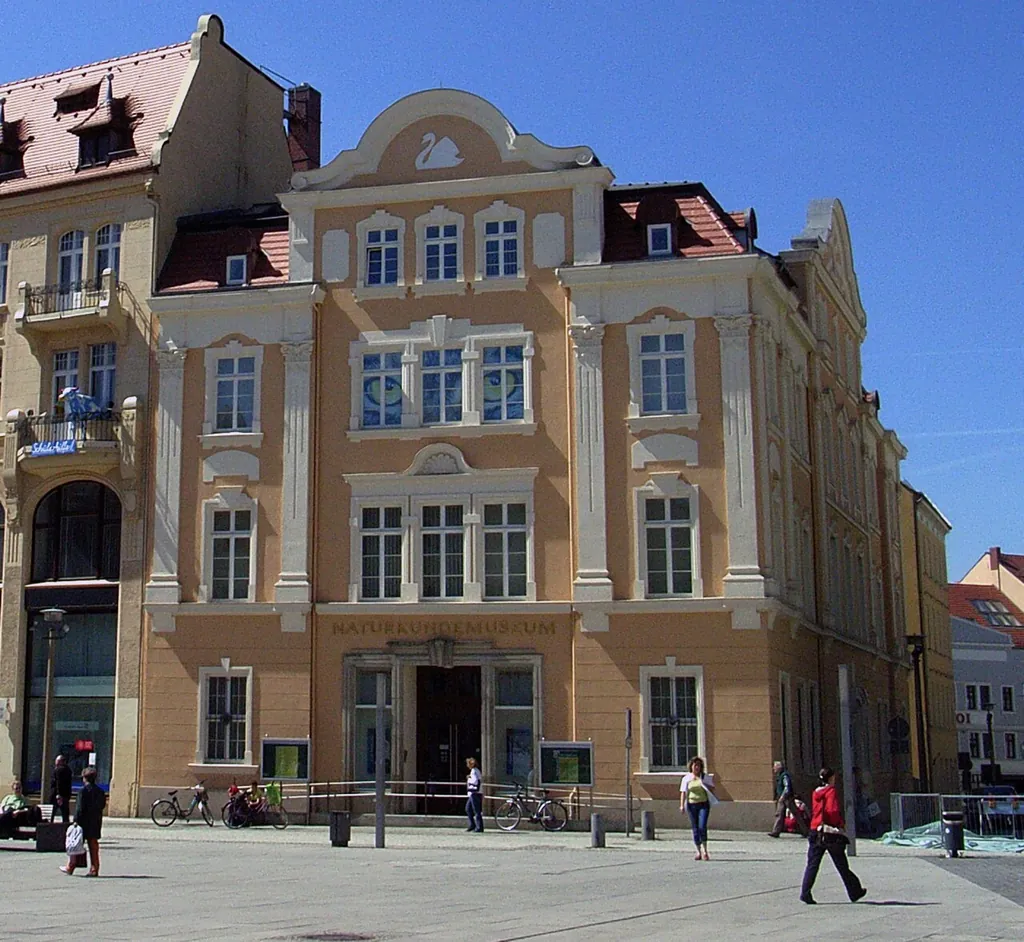
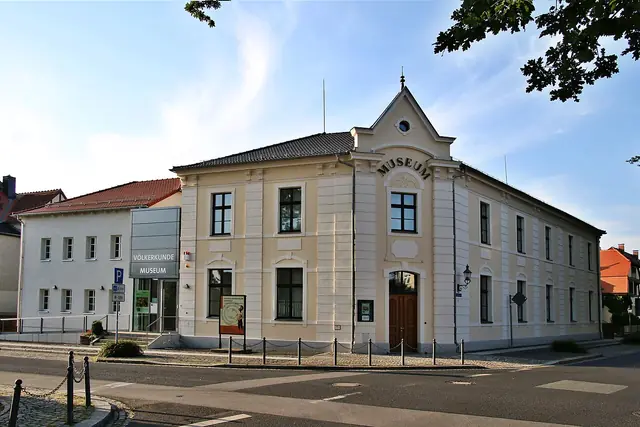
The museum's roots go back to 1811, when an Ornithological Society was founded in Görlitz. Since its members soon became interested in nature as a whole, it renamed itself the Naturforschende Gesellschaft (Natural Research Society) in 1823 and from 1827 published its own scientific journal, which today appears as the soil zoology journal “Soil Organisms”. In 1860, the museum building on Marienplatz, still in use today, was built.
After World War II and the dissolution of the society, the museum was declared a state research museum of the GDR in 1953. In February 1991 it was given the status of a state museum of the Free State of Saxony, and since January 1, 2009 it has been an institute of the Senckenberg Gesellschaft für Naturforschung and thus part of the Leibniz Association. Its research focuses on soil zoology.
The exhibitions present the flora and fauna of Upper Lusatia, from the heath and pond landscape to the Zittau Mountains, as well as the region's geology. A hall with historic specimens conveys the biodiversity of tropical rainforests, a vivarium shows live animals, and a 5.7-meter-high soil column, magnified 30 times, takes visitors into the world of soil organisms.
The scientific collections of more than six million objects, the library and the laboratories are currently being gradually consolidated in a new Senckenberg campus in Görlitz; the historic museum building remains open to visitors. The special exhibition “Eingepackt & Ausgepackt” accompanies this move.
Highlights
5.7-meter-high soil column showing soil organisms magnified 30 times
Rainforest hall with historic specimens from hummingbirds to gorillas
Vivarium with live animals and monthly public feedings
Animals, plants and geology of Upper Lusatia
A look behind the scenes at “Senckenberg Backstage”
Permanent exhibitions
Tiere und Pflanzen der Oberlausitz – The exhibition presents the ecological communities of Upper Lusatia's three landscape zones – from the heath and pond landscape through the hill country to the Zittau Mountains.
Regenwald – Hundreds of historic specimens of mammals, birds and reptiles from the tropics around the world are displayed in an open, atmospheric setting, complemented by a media table.
Bodensäule – A 5.7-meter-high model shows a section of soil from a deciduous forest magnified 30 times, bringing the research topic of soil zoology to life.
Founded
1860
Operated by
Senckenberg Gesellschaft für Naturforschung
Director
Kristin Baber
Admission & discounts
Adults
€5
Reduced
€3School students, university students, trainees, volunteer service participants, pensioners, seniors 66 and over, people with disabilities, unemployed people
Children & teens
€2free up to age 5 · Children aged 6 to 16 €2; according to the price list, children under 6 pay nothing (no rate listed), kindergartens free.
Seniors
€3Discount for pensioners and seniors 66 and over.
Visitors with disabilities
€3Reduced admission for people with disabilities; rules for companions not specified.
Students & apprentices
€3
Groups (8+ people)
€3 per personGroups of 8 or more: adults €3, reduced €2, children €1 per person; school classes from the European city of Görlitz/Zgorzelec free.
Families
€102 adults and max. 5 children; mini family (1 adult + max. 5 children) €6.
Mini family (1 adult + max. 5 children)
€6
Annual pass, adults
€25Reduced €15, children €9, family €50, mini family €25.
Public lecture
€3Reduced €2, children up to age 16 free; annual lecture pass €12 (reduced €8).
Free admission:every first Sunday of the month
50% discount with the Sächsische Ehrenamtskarte (Saxon volunteer card), Görlitzer Familienpass, GEOcard and Aktionskreis für Görlitz. Free admission with, among others, the Sächsischer Familienpass and for members of the Deutscher Museumsbund, ICOM, the friends' association and the Naturforschende Gesellschaft der Oberlausitz. Private guided tours €12 per 45 min (€24 on weekends) plus admission; project days €40, special tours with scientists €50. Children's birthday party (2 hrs, up to 10 people) €55.
Accessibility
Wheelchair accessible
Elevator
Accessible restroom
Accessible parking
Service dogs welcome
Tactile models & exhibits
Sign language tours: no information
Easy-to-read materials: no information
Audio description
Building wheelchair-accessible with elevator; wheelchair available to borrow free of charge; accessible restroom reachable by elevator. Three accessible parking spaces opposite the main entrance (Marienplatz/Elisabethstraße). Free audio guide with tactile objects for blind and visually impaired visitors, plus a tactile floor guidance system; free sign language guide (videos in German Sign Language, DGS) available to borrow; tactile tours on request. Only assistance dogs allowed.
Kids & families
Great for kids & families
Kids’ admission
free up to age 5
Family ticket
€10 · 2 adults and max. 5 children; mini family (1 adult + max. 5 children) €6.
Family tours & workshops
Activity booklet, scavenger hunt or kids’ audio guide
Hands-on stations
Playground / play area
Kids’ birthday parties
Certified as a family-friendly destination: play stations such as wooden memory games and a crawling tunnel, hands-on stations and models to touch, children's and family quiz, explorer booklet (€1.50), child-friendly tours, public feedings in the live animal area, holiday programs, children's academy, and birthday parties (up to 10 people, 2 hours).
Getting there & parking
By public transit
Demianiplatz · 1-min walk
Tram 2 and 3 and city buses A, B, C and line P (from Poland) to Demianiplatz (1 min walk); approx. 20 min walk from the main train station
By car
Parking available · 200 m to the entrance
Parking lot at Obermarkt, about 200 m from there along Steinstraße; three accessible parking spaces opposite the main entrance at Marienplatz/Elisabethstraße (about 30 m).
Museum shop with nature books, toys, minerals, and fossils.
Events & venue rental
The museum hasn’t published any information on this – please ask the museum directly.
Plan your visit
Guided tours
yes
Audio guide
yes (DE)
School programs
yes
Photography
Permitted free of charge for private purposes, without flash or tripod.
Good to know
Themed tours (online or on site) and educational programs via the inquiry form or bildung-goerlitz@senckenberg.de. The audio guide is designed for blind and visually impaired guests. Regular excursions with scientists, mushroom consultations, and scientific colloquia according to the event calendar. Private tours last 45 or 90 minutes.