Wilhelm-Busch-Mühle
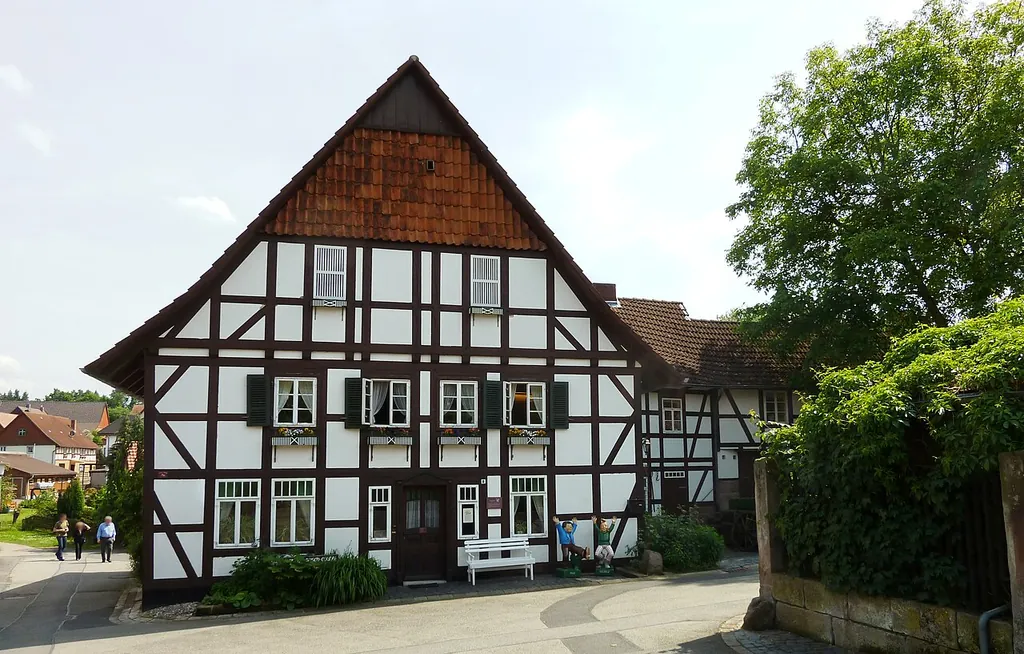
Working water mill in Ebergötzen where Wilhelm Busch, as a child, befriended the miller's son Erich Bachmann.
About the museum
A mill on this site in Ebergötzen is documented as a manorial mill as early as the 14th century; the core of the present building dates from the 16th century. In the 19th century the mill belonged to the Bachmann family of millers.
From 1841, the young Wilhelm Busch lived in Ebergötzen with his uncle, the pastor Georg Kleine. Here he made friends with the miller's son Erich Bachmann, who was the same age – a friendship that lasted a lifetime. His childhood impressions of the village and the mill are regarded as one source of Busch's later work; a mill plays a decisive role in "Max und Moritz."
The mill ground grain commercially until 1938 and only occasionally after that. After World War II the rooms served as emergency housing, and the building fell increasingly into disrepair. When demolition loomed in the early 1970s, committed citizens founded the Förderkreis Wilhelm-Busch-Stätten, acquired the mill and had it painstakingly restored. It opened as a museum in 1977.
Today the Förderkreis guides visitors through the house and the mill building, setting the waterwheel and the historic milling machinery in motion. An exhibition tells the story of Busch and his friend Bachmann, and a book collection shows translations of "Max und Moritz" from around the world.
Highlights
- Demonstration of the working water mill with historic milling machinery
- Stations on the boyhood friendship of Wilhelm Busch and Erich Bachmann
- Collection of "Max und Moritz" translations from around the world
- Mill barn and cottage garden, also used for weddings
- Combination ticket with the nearby Europäisches Brotmuseum (European Bread Museum)
Permanent exhibitions
- Wassermühle und Mahltechnik – During tours, the restored mill is set in motion to explain how grain was turned into flour using water power.
- Wilhelm Busch und Erich Bachmann – Exhibition on Busch's childhood in Ebergötzen and his lifelong friendship with the miller's son.
- Max und Moritz in aller Welt – Book collection with translations of the picture story into numerous languages.
- Founded
- 1977
- Operated by
- Förderkreis Wilhelm-Busch-Stätten Ebergötzen e. V.
Admission & discounts
| Adults | €6 |
|---|---|
| Children & teens | €5Children and young people aged 6 to 18 €5; the price list gives no rate for younger children. |
| Groups (20+ people) | €5.50 per personChildren's groups of 20 or more €4.50 per person. |
| Families | €17 |
| Combination ticket with the Europäisches Brotmuseum – adults | €11 |
| Combination ticket – children (6–18) | €9 |
| Combination ticket – family | €25 |
| Combination ticket – groups of 20 or more | €10per person; children's groups €8 per person |
The demonstration of the milling machinery is included in admission. The Europäisches Brotmuseum is about 700 m away.
Accessibility
- Wheelchair accessible: not available
- Elevator: no information
- Accessible restroom: no information
- Accessible parking
- Service dogs welcome: no information
- Tactile models & exhibits: no information
- Sign language tours: no information
- Easy-to-read materials: no information
- Audio description: no information
According to the culture portal kulturis, not wheelchair-accessible. There are a few parking spaces for people with walking disabilities right at the mill entrance.
Kids & families
The museum hasn’t published any information on this – please ask the museum directly.
Getting there & parking
By public transit
Ebergötzen Mitte
Bus 170 (VSN) from Göttingen toward Duderstadt to the Ebergötzen Mitte stop.
By car
Parking available
Large, signposted parking lot on Pulvergasse at the Festplatz; a few spaces for people with mobility impairments directly in front of the mill.
- Accessible parking
Amenities & dining
The museum hasn’t published any information on this – please ask the museum directly.
Events & venue rental
- Spaces for rent
- Weddings / ceremonies
Civil weddings through the registry office of the Samtgemeinde Radolfshausen; the mill barn and the mill yard with its cottage garden are available for receptions.
Inquiries & detailsPlan your visit
| Guided tours | yes |
|---|---|
| Good to know | Visits take the form of a tour through the house and the mill building, with a demonstration of the milling machinery while the waterwheel is turning. |