Museum of the Haus der Geschichte Foundation in Leipzig’s city centre on the SED dictatorship, everyday life in the GDR, the Peaceful Revolution and reunification – free admission.
Using the example of Leipzig’s Grünau district, the exhibition looks at life in GDR prefabricated housing blocks: the construction period, residents’ daily lives with photographs and mementos, and the district’s transformation after 1990.
Temporary exhibition on the transformation of gardens in Germany since 1945, from kitchen gardens to urban gardening, with hands-on stations and a focus on the social functions of allotment and community gardens.
About the museum
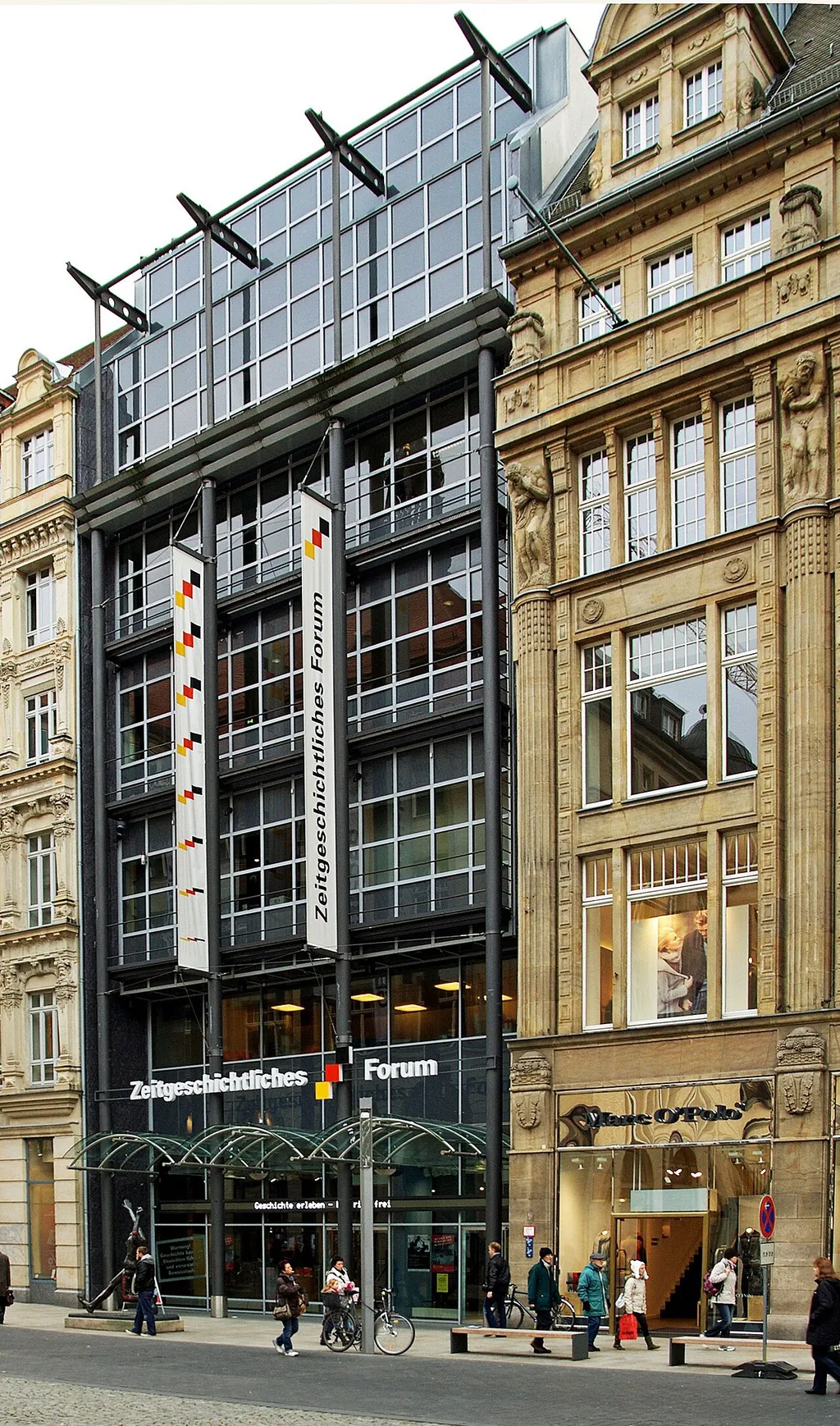
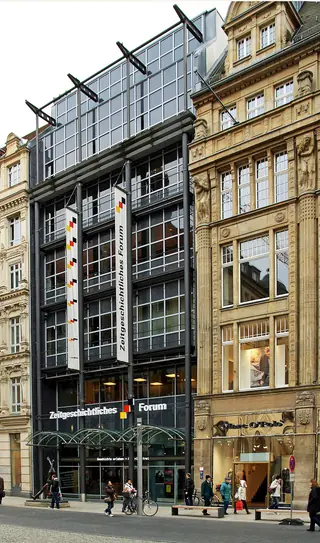
The Zeitgeschichtliches Forum Leipzig belongs to the Foundation Haus der Geschichte of the Federal Republic of Germany, which, besides its main building in Bonn, also runs the Tränenpalast and the museum in the Kulturbrauerei in Berlin. It opened on 9 October 1999 – deliberately on the exact day ten years after the great Monday demonstration that became a symbol of the Peaceful Revolution in the GDR.
The museum is housed in the former Zentral-Messepalast on Grimmaische Straße, a long-established trade fair building in the middle of the old town. For its new use the building was comprehensively renovated after 1990 and completely rebuilt inside.
The permanent exhibition “Our History. Dictatorship and Democracy after 1945” on the second floor takes visitors, with around 2,000 objects, photos, documents and eyewitness accounts, from the post-war period through the Soviet occupation zone and SED rule to the Peaceful Revolution. A particular focus is on the upheavals and the growing together of Germany since 1990. On the third floor the house presents several temporary exhibitions a year.
The collection on GDR history comprises more than 200,000 objects, including important holdings on opposition and resistance as well as the estate of Hannes Hegen (Johannes Hegenbarth), creator of “Mosaik”. Panel discussions, readings and film evenings also make the house a venue for debate on contemporary history.
Highlights
Permanent exhibition “Our History. Dictatorship and Democracy after 1945” with around 2,000 exhibits
Focus on the Peaceful Revolution of 1989 and the years of upheaval after reunification
Opened on the 10th anniversary of the Leipzig Monday demonstration
Admission and public guided tours free of charge
Online audio guide available in Easy Language, sign language and with audio description, among others
Permanent exhibition
Unsere Geschichte. Diktatur und Demokratie nach 1945 – A tour from the post-war period through SED rule, everyday life in the GDR and the opposition to the Peaceful Revolution and the upheavals since 1990, told through objects and eyewitness voices.
Founded
1999
Operated by
Stiftung Haus der Geschichte der Bundesrepublik Deutschland
Director
Uta Bretschneider
Admission & discounts
Admission is free.
Adults
free
Reduced
free
Children & teens
free
Seniors
free
Visitors with disabilities
free
Students & apprentices
free
Groups (15+ people)
free per personGroup tours for 15 or more people are free of charge; register at least two weeks in advance with the visitor service.
Families
free
Admission, public tours and bookable tours are free of charge.
Accessibility
Wheelchair accessible
Elevator
Accessible restroom
Accessible parking: not available
Service dogs welcome
Tactile models & exhibits
Sign language tours
Easy-to-read materials
Audio description
Level entrance with swing door; permanent and temporary exhibitions accessible without steps via two lifts. Accessible toilet on the 3rd floor. Wheelchair, walkers, walking aids and folding stools available on loan at the information desks. Three tactile orientation plans, touch tours for groups on registration, neck loops for hearing aids during tours and events. No designated disabled parking spaces nearby; the Augustusplatz and Marktgalerie underground car parks have lifts.
Kids & families
Great for kids & families
Family ticket
free
Family tours & workshops
Activity booklet, scavenger hunt or kids’ audio guide
Baby changing facilities
“Family Tour” card set for families with children aged about 8 and over at the information desk on the 2nd floor. Tours for parents with babies (“ElternZEITgeschichte”) on selected dates; a room for breastfeeding and changing is available. There is little space for pushchairs in the exhibitions, so a baby carrier is recommended.
Getting there & parking
By public transit
Markt · 50 m
S-Bahn S1–S5, S5X and bus 89 to “Markt”; tram to “Augustusplatz”, “Wilhelm-Leuschner-Platz”, “Thomaskirche” or “Hauptbahnhof”.
By car
No on-site parking at the museum.
No car park of its own; car parks Am Neumarkt, Augustusplatz, Burgplatz/Petersbogen, Marktgalerie and the Promenaden Hauptbahnhof East/West. Coaches at the coach parking lot on the east side of the main station and at the Thomaskirche (west side).
Accessible parking: not available
About a 10-minute walk from the main station through the city centre.
Small shop at the information desk with publications and souvenirs; free cloakroom lockers.
Events & venue rental
The museum hasn’t published any information on this.
Plan your visit
Guided tours
yes · approx. 60 min
Audio guide
yes (DE, EN, FR, ES)
School programs
yes
Photography
Photography and filming for private purposes are permitted, without flash, tripod or selfie stick.
Good to know
Public tours of the permanent exhibition on Saturdays at 3 pm and Sundays at 11 am (approx. 60 min.), with sign language interpretation on selected dates. Group tours (90 min., permanent exhibition) in German, English, French, Spanish and Polish. The audio guide is accessed online on your own smartphone (also in Easy Language, with audio description and in sign language). Large bags, backpacks and winter coats must be put in the lockers.