Museo "Franco Azzinari"
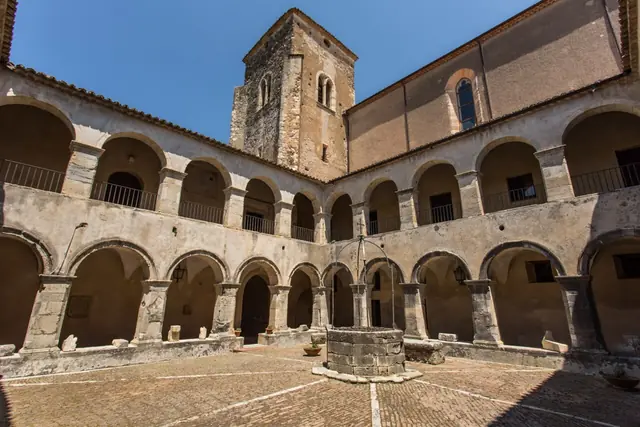
Permanent museum dedicated to the painter Franco Azzinari, housed in the Torre dei Pallotta, a Norman tower in the historic centre of Altomonte.
Have only individual sections read aloud
About the museum
The museum is housed in the Torre dei Pallotta, a square-based Norman tower about 25 metres high, built around 1050 and remodelled in 1269 by Guglielmo Pallotta, after whom it is named. After restoration the building was assigned to house the works of the Calabrian painter Franco Azzinari.
Azzinari was born in San Demetrio Corone and at the age of fourteen left the village to work in Europe, with a long stay in Normandy and in Paris, where he was captivated by the masters of Impressionism. Back in Calabria in 1978, he became attached to the Mediterranean scrub landscape, which became the centre of his painting: wheat fields swaying in the wind, olive trees, agaves, the colours of land and sea. The then mayor of Altomonte, Costantino Belluscio, appreciated his art and made the tower’s rooms available for a permanent museum.
According to the Ministry of Culture, the rooms were entrusted to the painter in 2002, and the exhibition brings together about forty works gathered under the title “Vent’anni con la natura”.
Highlights
- Works by Franco Azzinari shown in the Torre dei Pallotta
- The cycle “Vent’anni con la natura”
- Landscapes of the Mediterranean scrub and wheat fields swaying in the wind
- Norman tower in the historic centre of Altomonte
Permanent exhibition
- Vent'anni con la natura – About forty paintings by Franco Azzinari devoted to Calabrian landscapes, displayed in the Torre dei Pallotta.
- Founded
- 2002
Admission & discounts
The museum hasn’t published any information on this.
Accessibility
The museum hasn’t published any information on this.
Kids & families
The museum hasn’t published any information on this.
Getting there & parking
The museum hasn’t published any information on this.
Amenities & dining
The museum hasn’t published any information on this.
Events & venue rental
The museum hasn’t published any information on this.