Kupiškio muziejus
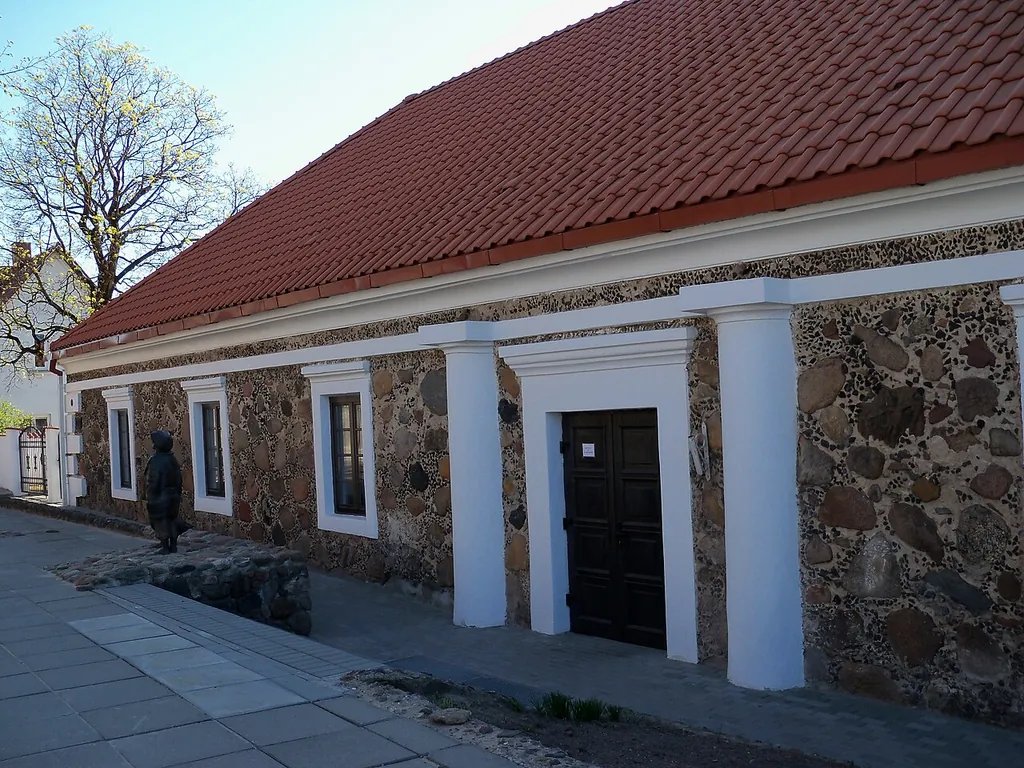
The Kupiškio muziejus on Gedimino Street presents an ethnographic exhibition on the everyday life of village people at the end of the 19th and the beginning of the 20th century, their customs and wedding traditions; admission is free.
Have only individual sections read aloud
About the museum
The idea of founding a museum in Kupiškis arose among the town's intelligentsia as early as 1935, but the first museum was established only in 1941–1943. After the war its activities came to an end, and the exhibits were thrown out into the street and plundered. The museum was revived in 1962 as a branch of the Šiauliai History and Ethnography Museum in the Kupiškis Cultural House; an important impetus was given by the 1961 ethnographic exhibition of the Glemžaitė sisters.
In 1984 the museum moved into the former parish school of Kupiškis, built in 1823, and a new annex on Gedimino Street. Having collected a rich ethnographic and folk art collection, the museum was officially named an ethnography museum in 1989. Today it is called the Kupiškio muziejus and comprises several units: the Adomo Petrausko muziejus, the Veronikos Šleivytės paveikslų galerija, the Laukminiškių kaimo muziejus, the Adomynės dvaras and the Palėvenės vienuolynas.
The permanent ethnographic exhibition shows the everyday life of village people of Kupiškis at the end of the 19th and the beginning of the 20th century and the life cycle from birth onwards. The first hall displays farm tools, household utensils, cross carving and the tradition of wayside shrines; the second hall presents the gryčia (traditional farmhouse room); the third presents the seklyčia (parlour, also called “stancija”) with a collection of wedding customs and old costumes.
Highlights
- Permanent ethnographic exhibition on the everyday life and life cycle of the people of Kupiškis
- Farmhouse room (gryčia) and parlour (“stancija”) of Kupiškis
- Wedding customs: invitation cap, straw garden, dowry chest and old costumes
- Tradition of cross carving and wayside shrines
- Free admission
Permanent exhibition
- Etnografinė ekspozicija – Three halls show the everyday life of village people at the end of the 19th and the beginning of the 20th century: farm tools, cross carving, the farmhouse room and the parlour with wedding customs and a collection of old costumes.
- Founded
- 1962
- Operated by
- Kupiškio muziejus (biudžetinė įstaiga)
Admission & discounts
Admission is free.
| Adults | free |
|---|---|
| Children & teens | free |
| Groups | –Guided tour in Lithuanian (1 hour): for groups of up to 10 persons €5 per person, for larger groups €2 per person; in a foreign language €6 and €3 per person. |
| Guided tour in Lithuanian (up to 10 persons, 1 hour) | €5Price per person. |
| Guided tour in Lithuanian (more than 10 persons, 1 hour) | €2Price per person. |
| Guided tour in a foreign language (up to 10 persons, 1 hour) | €6Price per person. |
| Guided tour in a foreign language (more than 10 persons, 1 hour) | €3Price per person. |
Admission to the museum is free; only guided tours and educational sessions are paid (prices approved by a decision of the Kupiškis district municipal council of 12 February 2026).
Accessibility
- Wheelchair accessible
- Elevator
- Accessible restroom: no information
- Accessible parking: no information
- Service dogs welcome: no information
- Tactile models & exhibits: no information
- Sign language tours: no information
- Easy-to-read materials: no information
- Audio description: no information
The museum has an adapted lift and an entrance to the premises for visitors with mobility impairments.
Kids & families
Great for kids & families
| Time needed | approx. 60 min |
|---|
- Family tours & workshops
Educational programmes are offered for pre-school and school-age children.
Getting there & parking
By car
Free parking
There is no separate car park next to the museum, but cars can be left in the museum courtyard; nearby is the car park of the Church of the Ascension of Christ (Gedimino g. 1).
Amenities & dining
The museum hasn’t published any information on this.
Events & venue rental
The museum hasn’t published any information on this.
Plan your visit
| Guided tours | yes |
|---|---|
| School programs | yes |
| Good to know | A visit takes up to one hour. Guided tours and educational sessions can be booked by phone on +370 459 35439 or through the Kultūros pasas (Culture Pass) system. Animals are not allowed in the museum, but a pet can be left for a short time in the courtyard. |