Gräne gruva
Former feldspar mine (1899–1932) and open-air area in Svenljunga Municipality, part of Ekomuseum nedre Ätradalen, with an open-pit quarry, sculptures and hiking trails.
Have only individual sections read aloud
About the museum
Feldspar and quartz were quarried at Gräne gruva in periods between 1899 and 1932. The minerals were used, among other things, in porcelain manufacturing. The ore was hauled by horse-drawn carts to a narrow-gauge railway towards Falkenberg harbour and then shipped by boat on to Germany. The mine also yielded the radioactive mineral euxenite, which was ground and sewn into so-called radium cloths.
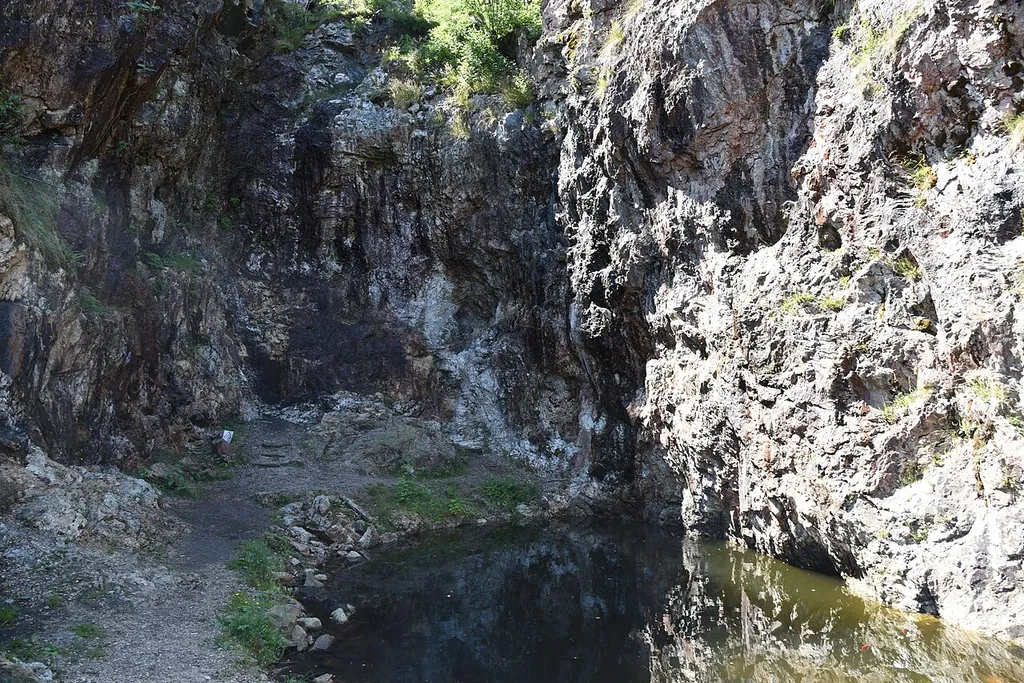
The quarrying was done as day labour by workers from nearby farms, using simple tools such as sledgehammers, hand drills and dynamite. The traces are visible today as a vertical open-pit quarry with rock walls about 20 metres high. In the 1970s Allan Svensson in Brunarp took it upon himself to make the site known as a destination for tourists and recreation, and together with others he succeeded in stopping a new round of quarrying in the 1990s.
Today the area is run by the non-profit association Gräne Gruva 1899 in cooperation with the landowner, and it functions as an open-air recreation area and outdoor museum. The mine is part of Ekomuseum nedre Ätradalen. Sheet-metal sculptures, information boards and excavations at the smithy bring the mining work to life, and there are hiking trails, barbecue areas, a rhododendron park and the playground Trolltorget. Visiting the area is free of charge.
Highlights
- Open-pit quarry with rock walls about 20 metres high
- Sheet-metal sculptures and information boards about the mining work
- Three hiking trails of 1.8, 3.6 and 4.6 kilometres
- Trolltorget and Trollstigen for children
- Rhododendron park and pollination area
Permanent exhibition
- Gruvan och Ekomuseum – The open-pit quarry, sheet-metal sculptures and information boards show the mining work, the transport and the industrial history of the area.
- Operated by
- Föreningen Gräne Gruva 1899
Admission & discounts
Admission is free.
Visiting Gräne Gruva is free of charge, and the firewood at the barbecue areas may be used free of charge. The association accepts voluntary donations via Swish (mobile payment).
Accessibility
- Partially wheelchair accessible
- Elevator: no information
- Accessible restroom: no information
- Accessible parking: no information
- Service dogs welcome: no information
- Tactile models & exhibits: no information
- Sign language tours: no information
- Easy-to-read materials: no information
- Audio description: no information
The trails have serpentine paths with a gentle gradient, which makes them accessible for pushchairs and people with disabilities. On the steeper sections the gradient can still be a challenge. Mobility aids are exempt from the ban on motor vehicles on the trails.
Kids & families
Great for kids & families
- Family tours & workshops
- Hands-on stations
- Stroller-friendly
- Playground / play area
Trolltorget with a maze, tree stumps, a log tunnel and a tyre figure, as well as Trollstigen, a trail for the youngest visitors. The trails can be reached with a pushchair.
Getting there & parking
By public transit
Brunarp · 2 km
Bus 362 (Älvsered–Svenljunga) and 302 (Mjöbäck–Svenljunga–Lockryd) pass by. Get off at the Brunarp stop; from there it is about 2 kilometres on foot to the mine.
By car
Parking available
Main car park at the open-pit quarry, from where the trails start.
The mine lies between the lakes Holsjön and Lilla Hallången, by county road 154 between Holsljunga and Överlida. The entrance is marked with an Ekomuseum sign.
Get directionsAmenities & dining
Barbecue areas with free firewood, a large barbecue shelter, about twenty picnic tables and information boards at the main car park.
Events & venue rental
The museum hasn’t published any information on this.
Plan your visit
| Guided tours | yes |
|---|---|
| Good to know | Guided tours can be arranged, depending on the availability of volunteers, against a donation to the association. It is not permitted to take stones from the mine, and riding and motor vehicles are prohibited on the trails. The Swedish right of public access (allemansrätten) applies because the land is privately owned. |