Medelhavsmuseet
State museum of the cultures of the Mediterranean and the Near East, with exhibitions on Egypt, Cyprus, ancient Greece and Rome, and a Gold Room.
Have only individual sections read aloud
About the museum
The Medelhavsmuseet was formed in 1954 when the Egyptian Museum in Stockholm, which had opened in 1928, was merged with the Cyprus collections. King Gustaf VI Adolf played an important part in its creation. The Cyprus collection derives from the excavations of the Swedish Cyprus Expedition in 1927–1931 under the leadership of Einar Gjerstad, and is the largest collection of Cypriot excavation finds outside Cyprus.
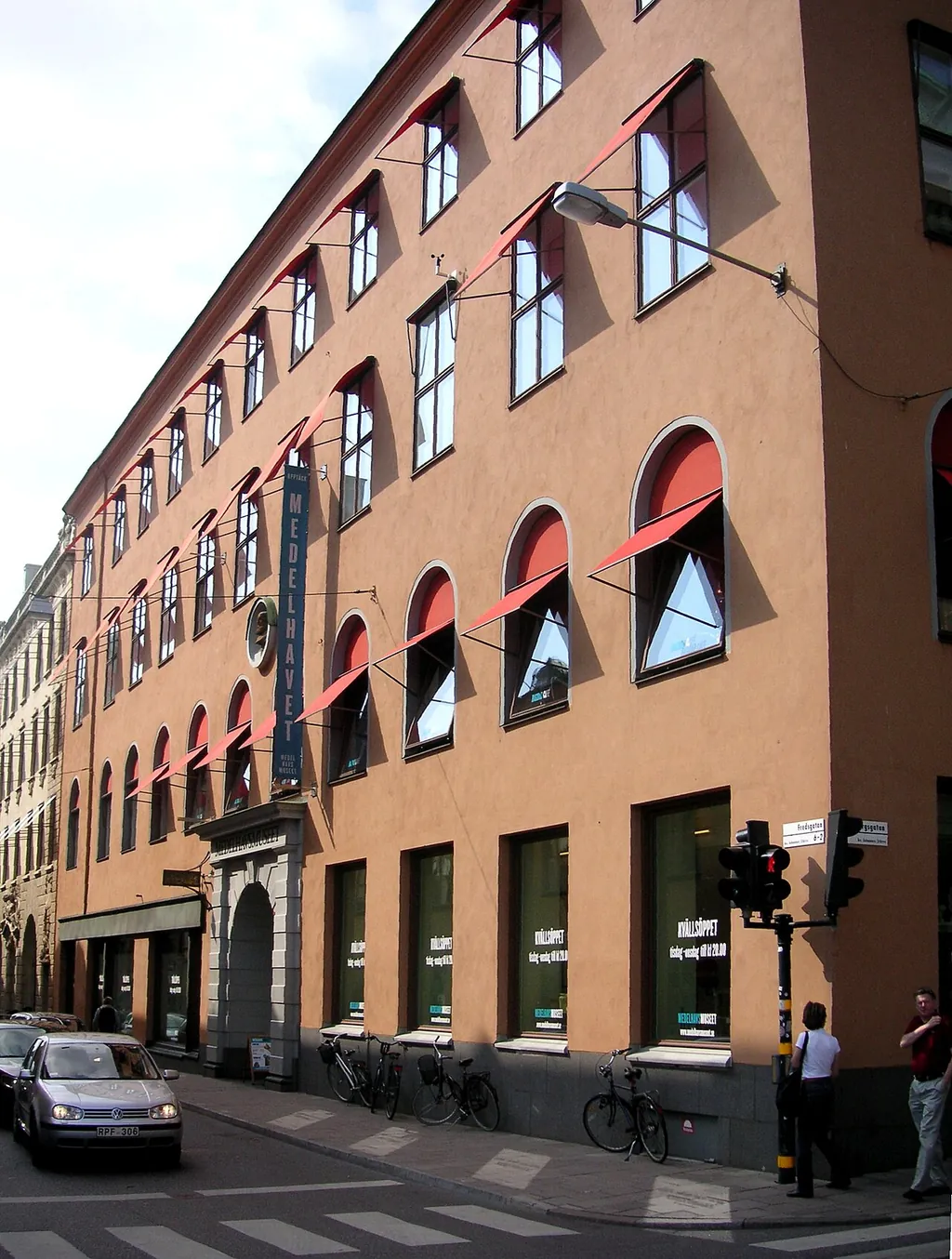
Plans for a museum building of its own existed as early as the 1930s and after the Second World War, but no such building was ever built. In the 1970s the museum moved into premises that were intended as a temporary solution, and in 1981 it was offered the former bank premises at Fredsgatan 2. There the museum opened on 16 September 1982.
The building at Gustav Adolfs torg contains parts of Gustav Horn's palace from 1648. After a fire in 1873 it was rebuilt as the Stockholms Inteckningsbank (Stockholm Mortgage Bank) to drawings by Rudolf Arborelius, and its bank hall is today an exhibition space. Since 1999 the museum has been part of the Statens museer för världskultur, now the Världskulturmuseerna. The collections comprise objects from Egypt, Cyprus, ancient Greece and Rome, and the Near East, and the Gold Room shows gold and silver jewellery from across the Mediterranean region.
Highlights
- The Egypt exhibition with mummies, coffins and burial customs
- Cyprus through the ages, with nearly a thousand terracotta figures from Ajia Irini
- The Gold Room with jewellery from Anatolia, Mesopotamia, Egypt, Greece and Byzantium
- Ancient Greece and Rome
- The 19th-century bank hall as an exhibition space
Permanent exhibitions
- Egypten – The history of Egypt over some 7,000 years, with an emphasis on the time of the pharaohs, with mummies, coffins, 3D scans and an insight into everyday life.
- Cypern genom tiderna – The island's history from the Stone Age to the Roman imperial period, with finds from the cult site of Ajia Irini and nearly a thousand terracotta figures.
- Guldrummet – Gold and silver jewellery from Anatolia, Mesopotamia, Egypt, Greece, Italy and Byzantium, arranged by origin.
- Founded
- 1954
- Operated by
- Statens museer för världskultur (Världskulturmuseerna)
- Visitors per year
- approx. 287,081 (2017)
Admission & discounts
| Adults | SEK 160 |
|---|---|
| Reduced | SEK 140Seniors |
| Children & teens | freefree up to age 18 · Free admission for everyone under 19. |
| Seniors | SEK 140 |
| Annual pass (365 days, also valid at the Etnografiska museet and the Östasiatiska museet) | SEK 200 |
| Audio guide Jakten på guldskarabén (The Hunt for the Golden Scarab), for children from age 7 | SEK 40 |
Free admission: 2-for-1 Friday: on the last Friday of every month, two people visiting the museum together pay for one ticket.
The day ticket is bought at the reception. Free admission also for asylum seekers with a valid LMA or UT card and for members of ICOM or Sveriges museer with a valid card.
Accessibility
- Wheelchair accessible
- Elevator
- Accessible restroom
- Accessible parking
- Service dogs welcome
- Tactile models & exhibits: no information
- Sign language tours: no information
- Easy-to-read materials: no information
- Audio description: no information
All exhibitions can be reached by wheelchair, and a wheelchair is available to borrow. The museum has a lift, automatic door openers on all doors and an accessible toilet with an alarm at the entrance. The lecture hall has an induction loop, and tours use a Univox system with a receiver and earpiece; a neck loop can be borrowed at reception. Lighting is dimmed in some exhibitions. Special transport stops outside the Ministry for Foreign Affairs or the Ministry of Defence, where some kerbs are high. Two disabled parking spaces are at the Opera. Adapted meals can be ordered from Bagdad Café. Adapted tours can be ordered via visning.stockholm@varldskulturmuseerna.se.
Kids & families
Great for kids & families
| Kids’ admission | free up to age 18 |
|---|
- Family tours & workshops
- Activity booklet, scavenger hunt or kids’ audio guide
- Stroller-friendly
- Baby changing facilities
Families can do independent activities, including the audio guide Jakten på guldskarabén (from age 7) and the free treasure hunt Mumien Bakenrens bortglömda saker (The Forgotten Things of the Mummy Bakenren), taking about 30 minutes. Prams are allowed on the ground floor but not on the second floor; pram parking and a changing room are available. Bagdad Café has a children's menu.
Getting there & parking
By public transit
Gustav Adolfs torg
Metro to Kungsträdgården or T-Centralen. Bus 65 to Gustav Adolfs torg, and buses 3 and 53 to Tegelbacken.
By car
Parking available
Parking is available in the car park by Regeringsgatan, and on Jakobsgatan, Malmtorgsgatan and in the Gallerian garage.
- Accessible parking
Amenities & dining
- Café
- Restaurant
- Museum shop
- Lockers
- Wi-Fi
Bagdad Café is a café, restaurant and wine bar with a Mediterranean-inspired menu; the kitchen closes an hour before the museum. Food and drink brought from home may not be taken in. Lockers near the entrance for rucksacks, larger bags and umbrellas (largest locker 40 × 30 × 40 cm). Free Wi-Fi for visitors.
Events & venue rental
The museum hasn’t published any information on this.
Plan your visit
| Guided tours | yes |
|---|---|
| Audio guide | yes |
| School programs | yes |
| Photography | Photography without flash, tripods and selfie sticks is permitted; commercial photography must be registered with the reception. |
| Good to know | Group tours are booked via the website. A children's audio guide is available in the Egyptian collection. The library and archive are open by arrangement. |