Free-entry natural history museum run by the University of Cambridge, with a 21-metre fin whale skeleton overhead and specimens collected by Charles Darwin.
Show individual sections
Highlights
Skeleton of a 21-metre fin whale in the Whale Hall, with a suspended walkway
Darwin’s beetle box and fish collected on the voyage of the Beagle
Asian elephant, Komodo dragon and a thylacine (Tasmanian tiger)
Goblin shark, giant clam and a hydrothermal vent chimney
Ichthyosaur, a fish-like reptile from about 150 million years ago
An exhibition designed by Year 12 students from across the UK, who chose its theme and content to highlight biological connections around the planet; shown in the museum galleries and the Botanic Garden.
About the museum
The Museum of Zoology has stood on Cambridge’s New Museums Site since 1865, when a purpose-built Museum of Comparative Anatomy and Zoology was opened to house two older collections: the university’s comparative anatomy collection and the natural history collection of the Cambridge Philosophical Society. The two were combined in 1877. Most of the specimens were acquired between 1865 and 1915 through purchases, gifts of private shell, insect and bird collections, and expeditions to the Indian Ocean, Africa, South East Asia and Australia, although new material is still added every year.
The oldest part of the collection comes from Sir Busick Harwood, professor of anatomy from 1785, and includes some of the earliest kangaroo and emu specimens to reach Britain. Through the Philosophical Society’s founders Adam Sedgwick and John Henslow, who were mentors to Charles Darwin, much of Darwin’s own material found its way here, including the fish he collected on the voyage of the Beagle.
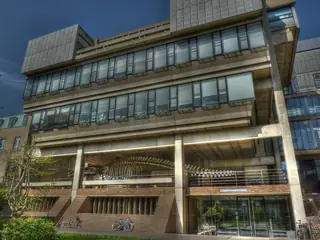
The 1865 building was demolished in 1965 and replaced by a new building designed by Philip Dowson, which opened in 1970 and was completed in 1974. The collections were given Designated status in 1988. The museum closed in 2013 for a £4.1 million refurbishment supported by the Heritage Lottery Fund, which created a new glass entrance hall. Within it hangs the museum’s most famous specimen, the skeleton of a fin whale. The museum now occupies the David Attenborough Building, which it shares with the Cambridge Conservation Initiative.
Permanent exhibitions
Whale Hall – A glass entrance hall in which a 21-metre fin whale skeleton hangs from the ceiling, with a suspended walkway for a close-up view.
Upper and lower galleries – Thousands of specimens from across the animal kingdom, including a Komodo dragon, goblin shark, thylacine and Darwin’s beetle box.
Founded
1865
Operated by
University of Cambridge
Visitors per year
approx. 138,886
Admission & discounts
Admission is free.
Groups (10+ people)
£3 per personSelf-led groups of 10 or more must book in advance. A £3.00 administration fee per person applies to commercial groups such as tour operators, language and summer schools; community and non-commercial groups may be exempt.
Admission is free; donations are welcome and help to keep the museum free. Adult groups can request a one-hour overview tour with a subject specialist for a charge.
Accessibility
Partially wheelchair accessible
Elevator
Accessible restroom
Accessible parking
Service dogs welcome
Tactile models & exhibits
Sign language tours: no information
Easy-to-read materials: no information
Audio description
The museum entrance can be reached from street level by a ramp or 11 steps, and the lower gallery is fully step-free. A lift links the upper and lower galleries and the café, but there is no lift to the mezzanine level between the galleries. One accessible parking bay on the New Museums Site must be requested at the intercom on arrival and cannot be booked; limited blue badge parking is in the Grand Arcade car park. A wheelchair can be borrowed, foldaway stools are available, and induction loops are in the Demonstration Room and Discovery Space. Audio-described and touch tours are offered through the University of Cambridge Museums “Making Sense” programme and for groups on request. Guide dogs, hearing dogs and dogs for disabled people are welcome. A visual story and dementia-friendly resources are available online.
Kids & families
Great for kids & families
Time needed
approx. 60 min
Family tours & workshops
Activity booklet, scavenger hunt or kids’ audio guide
Baby changing facilities
Family events run throughout the year, and printable and in-museum trails are available (the explorer bags are not currently lent out). The free Young Zoologists Club (ages 6 to 12) and Zoology Club (ages 13 to 18) offer workshops and events. Baby-changing facilities are near the reception desk, and breastfeeding and bottle feeding are welcome everywhere.
Getting there & parking
By public transit
Drummer Street bus station · 5-min walk · 500 m
The museum is a 5-minute, 500-metre walk from Drummer Street bus station. Cambridge railway station is a 20-minute, 1.1-mile walk away; there are frequent trains to London King’s Cross.
By car
No on-site parking at the museum.
There is no visitor parking. The nearest car park is the Grand Arcade multi-storey, entered from Corn Exchange Street; Cambridge also has several Park and Ride sites.
Accessible parking
Enter the New Museums Site through the Pembroke Arch on Downing Street; the museum entrance is through the Whale Hall.
Whale Café above the Whale Hall (open Tuesday to Saturday, 10:00 to 15:00), a shop selling zoology-themed gifts (contactless payment only) and free lockers. Large items such as suitcases and scooters may not be taken into the galleries; pushchairs can be left in the Whale Hall.
Events & venue rental
Spaces for rent
Private parties
Corporate events
The Whale Hall and the Lower Gallery can be hired for drinks receptions, networking events and formal dinners.
Photographs for non-commercial purposes are welcome, without flash, tripods, selfie sticks or lighting. Drawing may be allowed when the museum is quiet.
Good to know
An average visit takes about one hour. Guided tours such as “From Darwin to Dodos” run on selected dates, and adult groups can request a one-hour overview tour. Children under 11 must be accompanied by an adult.