Polar Museum
Free museum of the Scott Polar Research Institute in Cambridge on Arctic and Antarctic exploration, with relics of Scott’s expedition.
Have only individual sections read aloud
About the museum
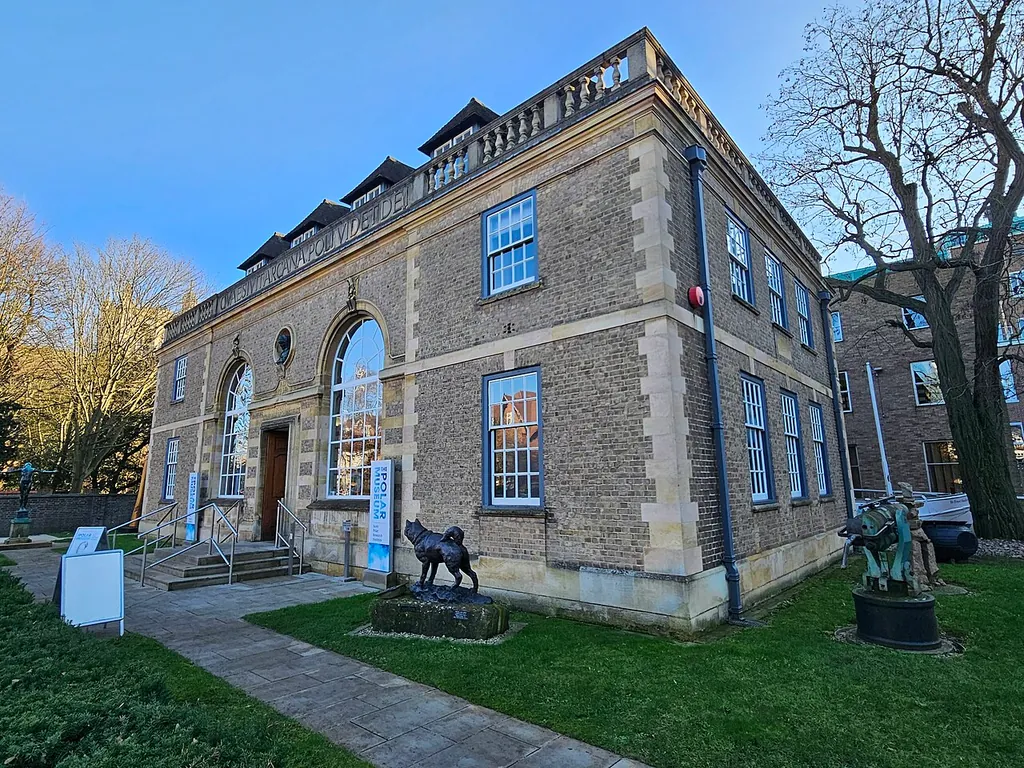
The Polar Museum is part of the Scott Polar Research Institute, which was founded in 1920 as a memorial to Captain Robert Falcon Scott and his companions. The idea came from Frank Debenham, who felt that British polar explorers needed a base to share their findings. The Grade II listed building on Lensfield Road was designed by Sir Herbert Baker and built in 1933–34; its small halls have shallow domed ceilings painted by MacDonald Gill.
The museum was redeveloped and reopened to the public in 2010 to wide acclaim and was shortlisted for the Art Fund Museum of the Year prize in 2011. It shows permanent displays on Arctic art and artefacts, the Northwest Passage, the Heroic Age of Antarctic exploration and present-day polar research, together with changing special exhibitions.
The collections include objects from Scott’s polar journey, such as his folding camera and last letters, Captain Oates’s reindeer-skin sleeping bag, and Captain Frank Worsley’s sextant from the James Caird. There is also art and photography by artists including Herbert Ponting, Edward Wilson, Frank Hurley, Sidney Nolan and Inuit artists. The museum offers online material on Shackleton, learning resources and school visits.
Highlights
- Relics of Scott’s polar expedition including his last letters
- Captain Oates’s reindeer-skin sleeping bag
- Arctic art and artefacts and Northwest Passage displays
- Art and photography by Ponting, Wilson and Hurley
- Free entry
Permanent exhibition
- Permanent polar displays – Displays on Arctic and Antarctic exploration, polar art and artefacts, the Northwest Passage and present-day polar research.
- Operated by
- Scott Polar Research Institute, University of Cambridge
Admission & discounts
Admission is free.
| Groups | –Self-led group visits are free but must be booked. Guided museum tours for groups cost £200 plus VAT during weekday opening hours. |
|---|
The museum is free to visit and donations are welcome.
Accessibility
- Wheelchair accessible
- Elevator: no information
- Accessible restroom
- Accessible parking
- Service dogs welcome: no information
- Tactile models & exhibits
- Sign language tours: no information
- Easy-to-read materials: no information
- Audio description
The main entrance is up three steps with handrails; a step-free ramp is reached through the car park to the right of the main entrance. One fully accessible toilet is at the back of the special exhibition gallery. A wheelchair is available on site. One free accessible parking space in the institute car park can be booked in advance, and roadside parking outside is free for Blue Badge holders. Audio descriptions of the building layout and ten Shackleton objects are available on a handset at the front desk, and subtitled films, visual stories and a floor plan are online. Torches, magnifying sheets and mirrors for viewing objects behind glass are available, and a handling collection of replicas and tactile materials can be requested in advance.
Kids & families
Great for kids & families
- Family tours & workshops
The museum runs activity days for families.
Getting there & parking
By public transit
Cambridge railway station · 10-min walk · 1 km
Several buses stop on nearby Station Road. The museum is about a ten-minute walk, roughly 1 km, from Cambridge railway station along a busy road.
By car
No on-site parking at the museum.
Parking is not available at the museum. The closest town car park is Queen Anne Terrace. Free accessible parking in the institute car park (entrance on Lensfield Road) must be booked in advance.
- Accessible parking
The museum is close to the city centre and the Fitzwilliam Museum. Park and Ride sites are recommended for drivers.
Get directionsAmenities & dining
- Museum shop
A museum shop is listed on the website.
Events & venue rental
The museum hasn’t published any information on this.
Plan your visit
| Guided tours | yes |
|---|---|
| School programs | yes |
| Good to know | Self-guided visits are free for groups of up to 20; larger groups need separate booking times. Guided tours (up to 15 adults) can be requested by email. Learning resources for teachers are available. |