fra 18. juni 2026
Mineral Evolution
Traces how the diversity of minerals increased over 4.5 billion years of Earth’s history – from their origins in space through oceans and oxygen to human influence. No end date given.
Display collection of the Mineralogische Staatssammlung in Munich’s Kunstareal: crystals, gemstones, and meteorites, plus a new special exhibition each year.
fra 18. juni 2026
Traces how the diversity of minerals increased over 4.5 billion years of Earth’s history – from their origins in space through oceans and oxygen to human influence. No end date given.
fra 30. april 2026
Paintings by South Korean artist Dong-Hee Kim in dialogue with minerals from the state collection, in the foyer. No end date given.
Museum Mineralogia – formerly known as “Reich der Kristalle” (Realm of Crystals) – is the publicly accessible part of the Mineralogische Staatssammlung München (Bavarian State Collection of Mineralogy), a research institution of the Staatliche Naturwissenschaftliche Sammlungen Bayerns (SNSB).
The state collection grew together from numerous individual holdings in the 19th century. Especially formative was the natural history cabinet of the Dukes of Leuchtenberg in Eichstätt, with high-quality specimens from Russia and Brazil, which came to Munich in 1858 and was merged with the state collection. Under Paul von Groth, director from 1880, it rose to become one of the most important mineral collections in Europe. However, an air raid in April 1944 destroyed well over three-quarters of the holdings, and in 1972, shortly before a move, numerous top pieces were lost in a burglary.
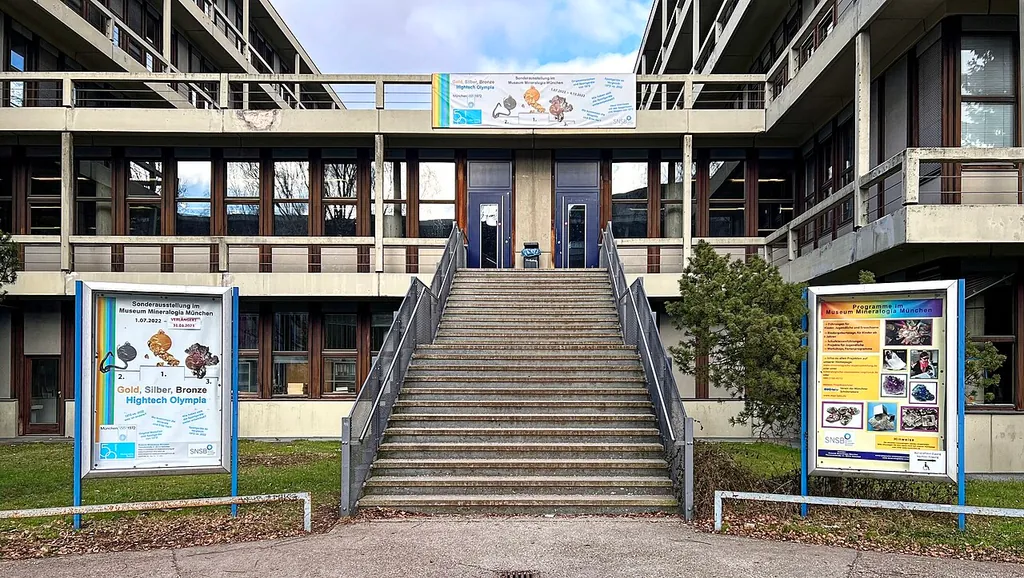
Since the 1970s, the collection has been housed in a university building on Theresienstraße, opposite the Pinakothek der Moderne. The display cases are grouped around the large lecture hall and along a connecting corridor, where models and self-service experiments explain basic concepts such as crystal structure, symmetry, and crystal growth. Among the best-known pieces are a large Russian emerald specimen, the King Ludwig Diamond, and the main mass of the Mauerkirchen meteorite. A dedicated room shows a new special exhibition every year, and the foyer also hosts art and jewelry presentations in dialogue with minerals.
| Voksne | 5 € |
|---|---|
| Nedsat pris | 3 € |
| Børn og unge | 1 €Children pay €1 (age limit not specified). |
| Familier | 6 € |
Cash only. Different prices may apply for special exhibitions. While the special exhibition room was being remodeled in spring 2026, admission was free Tue–Fri and half price on weekends.
Tactile tours and workshops for blind and visually impaired people (“Minerale und ihre Eigenschaften” [minerals and their properties], “Vulkane und Plattentektonik” [volcanoes and plate tectonics], 60–75 minutes, also for individuals, registration by email). No information on physical accessibility; the entrance is up an outdoor staircase.
Velegnet til børn og familier
| Familiebillet | 6 € |
|---|
Special children's tours and workshops for children and teenagers on request; children's birthday parties possible at the museum. Family ticket available.
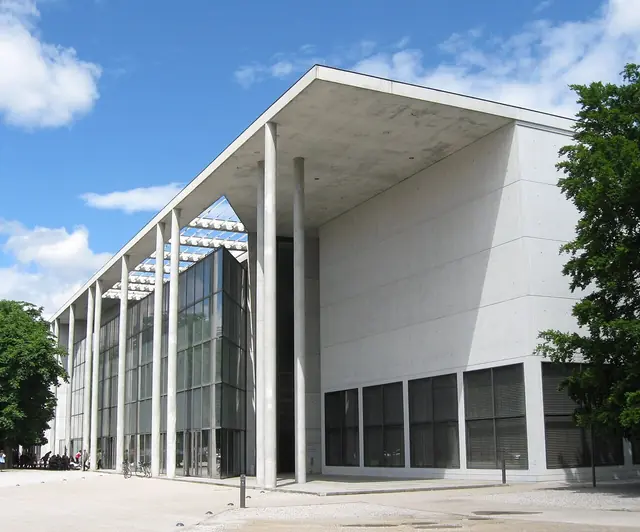
Trams 27 and 28 to “Pinakothek”; U2 to “Theresienstraße” or U3/U4/U5/U6 to “Odeonsplatz.” Opposite the Pinakothek der Moderne.
Museet har ikke offentliggjort oplysninger om dette – spørg venligst museet direkte.
Museet har ikke offentliggjort oplysninger om dette – spørg venligst museet direkte.
| Rundvisninger | ja |
|---|---|
| Tilbud til skoler | ja |
| Godt at vide | Tours of the permanent and special exhibitions for 5 or more people can be booked by email. School class tours on topics such as meteorites, gemstones, smartphone raw materials, or volcanism (register at least two weeks in advance); student lab. |
Cookies hjælper dig med at bruge websitet. Kort og statistik indlæser vi kun med dit samtykke.