An interactive family exhibition on carrying children as a universal human activity, on the relationship between parent and child and on technical solutions; it includes a sensory zone and a creative corner.
A travelling panel exhibition in the museum's arcades on the role of women in the Polish, Czech and Slovak anti-communist opposition; the curator is Marta Dzido.
An exhibition marking a decade of the Česko-japonské kulturní centrum shows the dialogue between Czechia and Japan through festivals, education, art and everyday life.
The history of Ostrava's cafés from the early 20th century to the present, using the examples of the Praha, Elektra, Fénix and Palace establishments; coffee as a plant, a drink and a social phenomenon is also covered.
About the museum
The first museum in Ostrava was founded in 1872 in Slezská Ostrava by the teacher and collector Karel Jaromír Bukovanský. In 1904 a German industrial and trade museum was established in Moravská Ostrava, alongside which a Czech museum of applied arts existed. In 1924 these three museums were merged into one city museum, and in 1931 its seat became the Old Town Hall on Masaryk Square. It was solemnly opened on 4 October 1931.
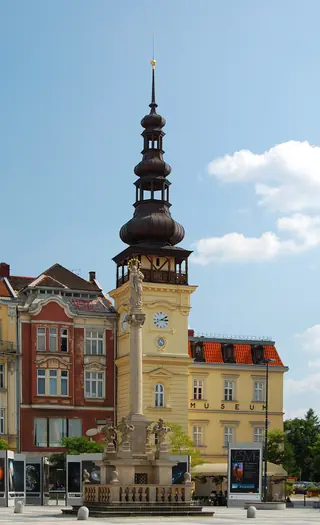
The Old Town Hall building is one of the oldest in Ostrava and is a listed monument. The first written mention of it dates from 1539. Its present form developed gradually: the tower was rebuilt in the Baroque style in 1727, the town hall was rebuilt in the Empire style in 1831–1837, and a second floor was added in 1859. During reconstruction in 2004–2006, remains of stone walls of a house probably dating from the 14th century and a silver Prague groschen of John of Luxembourg came to light beneath the floor of the ground floor.
The permanent exhibitions draw on the museum's collections and present art-historical collections, the history of the city from 1267 to 1989, mining, ethnography, archaeology and the nature of the Ostrava region. Among the best-known exhibits are a mammoth tusk from the River Oder, a bronze sword from Koblov and Maška's indoor astronomical clock. The museum also offers a lookout tower with guided tours and holds temporary exhibitions and accompanying programmes.
Permanent exhibitions
Dějiny Ostravy – The history of the city from its founding in 1267 to 1989, shown in period photographs and collection objects, including the period of the world wars and life in the city after 1945.
Hornictví a etnografie – Mining exhibition with a unique collection of mining lamps and surveying instruments and an interactive city map from 1928, supplemented by an ethnographic section on folk art and customs.
Příroda a krajina Ostravska – The natural history section presents geology, minerals, Carboniferous fossils, archaeological finds and the living nature and landscape of the region.
Founded
1960
Visitors per year
approx. 10,825 (2024)
Admission & discounts
Adults
100 Kč
Reduced
70 Kčchildren aged 6–15, students aged 15–26, seniors over 65 and holders of a ZTP card
Children & teens
70 Kčfree up to age 5 · Children under 6 enter free.
Seniors
70 KčSeniors over 65.
Visitors with disabilities
70 Kčcompanion free · Holders of a ZTP/P card and their companion enter free.
Students & apprentices
70 KčStudents aged 15–26.
Groups (10+ people)
60 Kč per personSchool groups of 10 or more people without an educational programme: CZK 60 per person; other groups of more than 10 people receive a 20% discount.
Families
290 Kč2 adults and up to 2 children aged 6–15.
Guided tour with a guide (surcharge on the ticket)
25 KčFor the current exhibition or the museum.
Lookout tower – tower entry only
55 Kč
Lookout tower – with a museum ticket
45 KčEntry to the tower is only possible with a guide, for no more than 5 people.
Special accompanying programme (creative workshops, workshops, experience programme)
170 KčReduced CZK 130.
The basic admission applies to the permanent exhibitions and all temporary exhibitions. Free admission for members of AMG (Asociace muzeí a galerií) and ICOM, and for the accompanying teachers of school groups. Holders of an Ostravacard receive a 20% discount. The museum accepts VISA and MasterCard payment cards.
Accessibility
Partially wheelchair accessible
Elevator
Accessible restroom: no information
Accessible parking: no information
Service dogs welcome: no information
Tactile models & exhibits: no information
Sign language tours: no information
Easy-to-read materials: no information
Audio description: no information
The museum is barrier-free, with the exception of the lookout tower and the attic exhibition spaces. There is a lift to the third floor above ground and a platform lift with a load capacity of 250 kg.
Kids & families
Great for kids & families
Kids’ admission
free up to age 5
Family ticket
290 Kč · 2 adults and up to 2 children aged 6–15.
Family tours & workshops
Stroller-friendly: not available
The museum offers family tickets as well as workshops and programmes for children and schools. Pushchairs cannot be taken into the exhibitions; by arrangement with staff they can be left in a designated place before entering the exhibition spaces.
Getting there & parking
By public transit
Elektra · 5-min walk
Trams nos. 1, 2 and 8 to the Elektra stop (about 5 minutes on foot); trams nos. 4, 6, 10, 12 and 14 to the Výstaviště stop (about 5 minutes on foot); buses nos. 22, 38, 71 and trolleybuses nos. 101, 105, 106, 107, 108 and 109 to the Most Miloše Sýkory stop (about 7 minutes on foot), or bus no. 99 to the Divadlo loutek stop (about 6 minutes on foot).
By car
No on-site parking at the museum.
The museum has no car park of its own for visitors. It recommends the paid car parks at Černá louka, Smetanovo náměstí, Biskupská and by OC LASO.
The museum is located in the listed Old Town Hall on Masaryk Square in the centre of Ostrava.
Cloakroom with lockable lockers; bags larger than A4 cannot be taken into the exhibition spaces.
Events & venue rental
Spaces for rent
The museum offers rental of spaces; details are on the page Pronájem prostor (Venue Rental).
Plan your visit
Guided tours
yes
School programs
yes
Good to know
Group guided tours of the temporary and permanent exhibitions must be booked in advance by telephone on +420 720 077 716 or by e-mail. Educational programmes for nursery, primary and secondary schools are booked through the education department. Entry to the lookout tower is only with a guide, and at most five people at a time. An English-language guide to the exhibitions is also available.