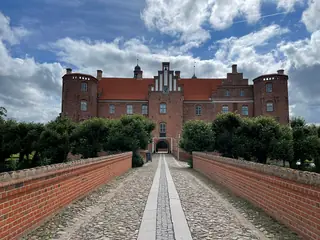
Denmark's manor house museum in the Renaissance moated castle of Gammel Estrup near Auning: living quarters of the gentry and servants spanning 400 years, plus a Baroque garden.
The Christmas exhibition shows how Christmas was celebrated in 1918 at the Gammel Estrup manor house, by the family and the domestic staff, with decorated trees and laid tables in the kitchen, the dining rooms and the Rittersaal.
About the museum
Gammel Estrup lies on Djursland, on the road between Randers and Grenaa. Excavations have uncovered wall remains from the 14th century; the oldest parts of the present complex go back to a stone fortified castle built by Lave Brock around 1490. The complex gained its present appearance, with red brick walls, a double moat, and a gate tower, mainly through the rebuilding that Eske Brock had carried out from 1616.
For around 600 years the estate remained in the hands of the same family, the Brocks and later the Counts Scheel, who were among the wealthiest noble families in the country. After the abolition of the feudal system around 1920, property and inheritance had to be divided among eleven heirs, so the family sold the estate. In 1928 Valdemar Uttental, a son-in-law of the last count, acquired the main building; in 1930, with public and private support, it became the independent institution Gammel Estrup, Jyllands Herregårdsmuseum. Since 2018 it has been called Gammel Estrup Danmarks Herregårdsmuseum.
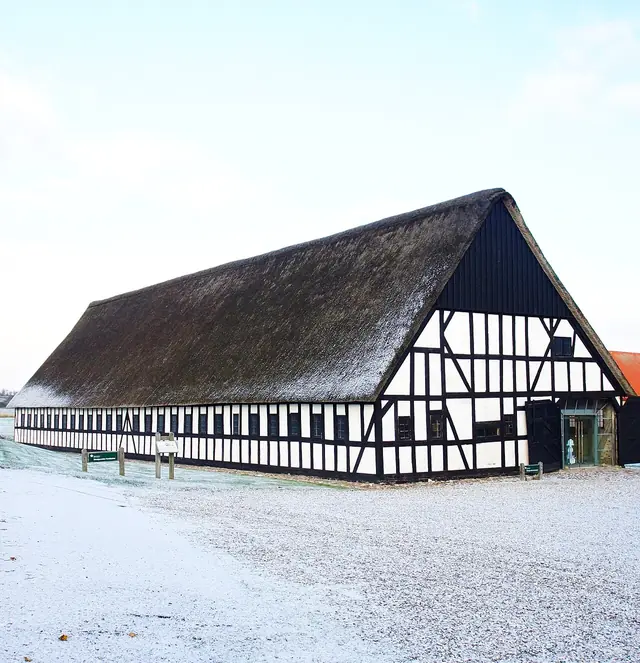
The farm buildings were used for agriculture until 1969; after that the state agricultural museum moved in, which today is located next door as Det Grønne Museum. In a sequence of fully furnished rooms, the manor house museum shows the life of the gentry and servants from the Renaissance to the 1920s, from Eske Brock's chapel through Baroque and Rococo chambers to the kitchen, attic, and servants' quarters. In addition there are a Baroque garden with orangeries, a fruit and kitchen garden, a vine house and peach house, and a forest worker's house from the 1930s. The museum also houses the Dansk Center for Herregårdsforskning, which researches the history of Denmark's more than 700 manor estates.
Highlights
Renaissance moated castle with double moat and gate tower
Furnished living quarters of the gentry and servants from 400 years
Manor house kitchen serving coffee and cake made from old recipes
Baroque garden with orangeries, orchard, and vine and peach house
Forest worker's house from the 1930s in the Lunden forest
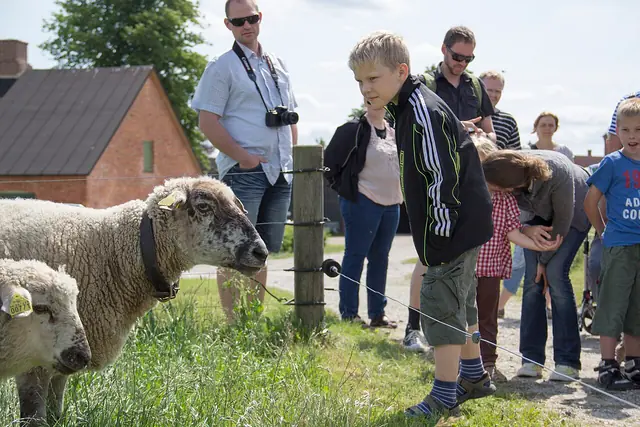
Hands-on children's stations for touching, listening, and dressing up (Børneuniverset)
Permanent exhibitions
Herskab & tjenestefolk – A sequence of historic interiors from the Renaissance to the 1920s shows how the count's family and the servants lived in the manor house, from the banquet hall and library to the kitchen and attic.
Haver & kulturmiljø – Symmetrical Baroque garden with orangeries, plus a fruit and kitchen garden, vine and peach house, carp ponds, ice cellar, and the burial site of the Scheel family.
Skovarbejderhuset – Small wooden house in the old manor forest, furnished as in the 1930s, when a forest worker lived here with his wife and three children.
Founded
1930
Operated by
Gammel Estrup Danmarks Herregårdsmuseum (selbstständige Institution)
Director
Kasper Steenfeldt Tipsmark
Visitors per year
approx. 66,862 (2025)
Admission & discounts
Adults
DKK 160
Reduced
DKK 90Students with student ID
Children & teens
freefree up to age 17 · Children and young people under 18 free.
Seniors
–No separate senior discount listed.
Visitors with disabilities
DKK 80Reduced price for wheelchair users.
Students & apprentices
DKK 90With student ID.
Groups (21+ people)
DKK 125 per personPrice per person for groups of more than 20 people.
Annual pass (Årskort)
DKK 280Valid for one person at both museums, all year.
Annual pass+1 (Årskort+1)
DKK 425For one person plus a changing companion.
Annual pass for students
DKK 150
Group package with guided tours at both museums
DKK 200Per person for groups of 25 or more; admission and guided tour at Gammel Estrup and Det Grønne Museum, at least 3 hours.
The ticket is valid for Gammel Estrup and the neighboring Det Grønne Museum; a ticket for only one of the two museums costs the same. Annual passes are sold at the ticket desk on site.
Accessibility
Partially wheelchair accessible
Elevator: not available
Accessible restroom
Accessible parking
Service dogs welcome
Tactile models & exhibits: no information
Sign language tours: no information
Easy-to-read materials: no information
Audio description: no information
From the ticket desk, a special paving surface leads to the manor house and into the Baroque garden (paths of compacted gravel); the castle courtyard has bumpy cobblestones. The first floor is reachable via ramps (check in at the shop on arrival); the exhibitions on the upper floors are not accessible to wheelchair users and people with severe walking difficulties. Accessible restroom in the park behind the playground. Dogs on a leash only outdoors; inside the building only guide dogs for the blind.
Kids & families
Great for kids & families
Kids’ admission
free up to age 17
Family tours & workshops
Activity booklet, scavenger hunt or kids’ audio guide
Hands-on stations
Stroller-friendly: not available
Baby changing facilities
Playground / play area
The Børneuniverset spreads stations throughout the house: digital stories for your phone, sound installations to touch, stereoscopes, and a large 18th-century dress to crawl into. During school holidays there are family activities, such as a children's trail. In the garden there is a playground with a climbing tower and sound columns. Because of narrow doors and steps, strollers are barely usable in the main building; the museum recommends a baby carrier. Baby changing table in a restroom on the first floor.
Getting there & parking
By public transit
Bus line 212 goes directly to the museum; the bus stop is about 100 m away.
By car
Free parking
Over 1,000 free parking spaces directly in front of the ticket desk, including some accessible parking spaces and EV charging stations.
Accessible parking
Near Auning in the north of Djursland on Route 16 between Randers and Grenaa (Randers approx. 20 km, Aarhus approx. 40 km, Grenaa approx. 35 km).
Coffee and homemade cake in the historic manor house kitchen (card, cash, MobilePay). Restaurant Den Gamle Stald in an old farm building (leased, own opening hours). Museum shop in the vaulted rooms at the gate. Food you bring yourself is allowed in the vaulted cellar (Borgestue) or at tables in the garden.
Events & venue rental
Spaces for rent
Corporate events
Weddings / ceremonies
Weddings in the Baroque garden, the castle chapel, or a historic hall (base price DKK 10,000 for up to 15 people). Conferences and evening meetings in historic parlors and halls with projector and Wi-Fi, from DKK 348 per person including catering. For celebrations, the museum refers to the restaurant Den Gamle Stald.
Photography for private purposes allowed indoors and outdoors; publication or commercial use only with the museum's permission.
Dogs
allowed in some areas only · Dogs on a leash only in the outdoor area, not allowed indoors.
Good to know
For the large grounds with both museums, plan several hours. Guided tours of the main building (about one hour, up to 20 people) from DKK 500 plus admission on weekdays, in English from DKK 750; expert tours on topics such as servants, the manor garden, or clothing from DKK 1,000; tours for people with intellectual disabilities are also offered. Coffee and cake with the tour DKK 50 per person (order in advance). Extensive school program for all grade levels.