June 24, 2026 – February 21, 2027
Væk med Skidtet
A family exhibition for children aged about 4 to 10 on dirt, rubbish and wastewater from the Stone Age to today: digging up waste, fishing rubbish out of a river and testing sorting knowledge.

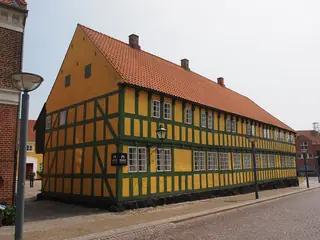
Cultural history museum in a yellow merchant's farmstead complex in Grenaa on the history of Norddjurs from the Stone Age to today – free admission.
June 24, 2026 – February 21, 2027
A family exhibition for children aged about 4 to 10 on dirt, rubbish and wastewater from the Stone Age to today: digging up waste, fishing rubbish out of a river and testing sorting knowledge.
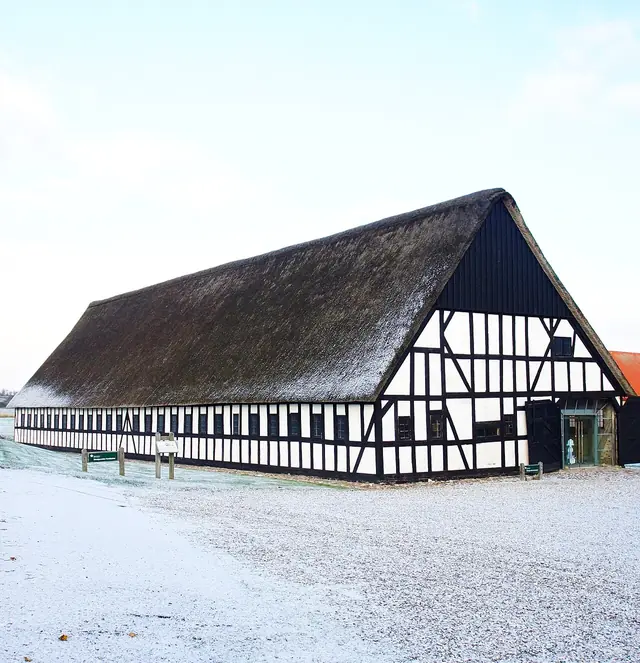
The museum was founded in 1917 as Djurslands Museum and is located in a listed merchant's farmstead with half-timbering from the 18th century, one of the most striking buildings in Grenaa. In the early 1980s a collection on fishing history was added. Among the best-known pieces are coins from the Kirial hoard found in 1967, the largest coin hoard ever discovered in Denmark; the larger part is held in the Nationalmuseet.
On January 1, 2011, the museum merged with the Kulturhistorisk Museum in Randers and the Museet for Syddjurs in Ebeltoft to form Museum Østjylland, one of the largest local history museums in the country and state-recognized for the municipalities of Randers, Norddjurs, and Syddjurs.
The permanent exhibition "Fire veje til Norddjurs" tells the history of the region in five sections: lime and flint as raw materials, the soil with farming, sand drift, and smallholders, life by the sea and at the former Kolindsund, the merchant town, and a treasure chamber. In October 2025 the merchant's farmstead had to close because of mold and has since been undergoing extensive restoration; in 2026 parts of the exhibition and the museum shop reopened.
Admission is free.
| Groups | –Admission is also free for groups; guided tours are charged. |
|---|---|
| Guided tour or lecture (per hour) | DKK 950Evenings and weekends DKK 1,250 per hour. |
| Museum club incl. yearbook | DKK 200For couples DKK 300. |
Free admission to all exhibitions of Museum Østjylland, including children's activities and family events.
Ramp at the main entrance on Kannikegade; courtyard entrance with uneven surface. Freight elevator to the second and third floors, stair lifts and platform lifts between the exhibition areas; some rooms of the listed farmstead have doors only 70 cm wide and high thresholds. Small loan wheelchair, induction loop at the reception desk and for films, easy-to-read texts, films in Danish and English with subtitles or dubbing, plenty of seating. Accessible restroom on the first floor to the left of the main entrance.
Great for kids & families
In the exhibition, children follow the traces of the curious boy Hugo; regular children's activities are possible throughout the opening hours. Everything that is not in display cases may be touched; at yellow boxes, objects make sounds when touched.
Parking available
Parking lot extending from the museum with two accessible parking spaces: one near the accessible entrance, the other in front of the public restrooms behind the Grenaa Egnsarkiv.
Museum shop with books, catalogs, jewelry, textiles, and toys. No café; coffee and snacks brought from outside may be consumed at tables in the museum courtyard.
The museum hasn’t published any information on this.
| Guided tours | yes |
|---|---|
| School programs | yes |
| Good to know | Guided tours and lectures for groups on request (DKK 950 per hour, evenings and weekends DKK 1,250). Museum Østjylland offers educational programs in the museum, in the urban space, and at schools. |
Loading experiences …