Burg Falkenberg
Revived castle in the northern Upper Palatinate with a museum on the diplomat Friedrich-Werner Graf von der Schulenburg and on castle history.
Have only individual sections read aloud
About the museum
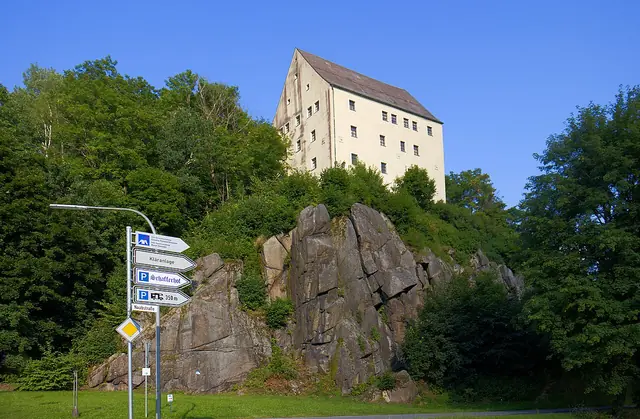
Falkenberg Castle sits on a rocky spur above the Waldnaab and the market town of the same name in the northern Upper Palatinate. The oldest remaining walls date to the 11th century; in 1154 a noble family of Falkenberg is first documented. From 1294 the complex belonged to the Cistercian monastery of Waldsassen, which expanded it because of the Hussite threat; the gatehouse and keep date from this period. Later the Palatine counts and the Bavarian dukes became the lords. In 1648 Swedish troops occupied the fortress, and after the order to abandon it, it fell into ruin.
In the 1930s the Prussian diplomat Friedrich-Werner Graf von der Schulenburg rebuilt the ruin to spend his retirement there. As a co-conspirator in the plot of July 20, 1944, he was murdered by the Nazis.
In 2009 the market town of Falkenberg acquired the castle from the Schulenburg family. After extensive restoration, begun in 2011, it opened as a culture castle on November 13, 2015. Today it combines the MuseumBurg, event rooms such as the Knights' Hall and the Chapter Hall, a small hotel, and a conference center at the foot of the castle. The tour leads through several floors and presents, besides the count's life, medieval building techniques, the castle's defenses, and its water supply.
Highlights
- MuseumBurg with an exhibition on Count Schulenburg and his path into the resistance
- Tour across four floors with around 20 stations
- Information film of about 15 minutes and six media stations
- Insights into medieval construction, defense, and water supply
- Knights' Hall, castle chapel, and rock stairwell with an elevator
Permanent exhibition
- MuseumBurg – Graf Schulenburg und die Geschichte der Burg – Tour across several floors on the life and resistance of the diplomat Friedrich-Werner Graf von der Schulenburg and the thousand-year history of the castle, with a film and media stations.
- Founded
- 2015
- Operated by
- Forum Falkenberg – Freunde der Burg e. V. (Eigentümer: Markt Falkenberg)
Admission & discounts
Admission is free.
Admission to the castle tours is free; the tours are run on a donation basis, with about €5 per person requested.
Accessibility
- Wheelchair accessible: no information
- Elevator
- Accessible restroom: no information
- Accessible parking: no information
- Service dogs welcome: no information
- Tactile models & exhibits: no information
- Sign language tours: no information
- Easy-to-read materials: no information
- Audio description: no information
The tour ends at the foot of the castle via a rock shaft with a steel staircase (over 180 steps) and an elevator. Wheelchair users, guests with mobility impairments, and people with strollers reach the elevator via the hotel entrance "In der Schwaige." Dogs are not permitted anywhere in the castle.
Kids & families
The museum hasn’t published any information on this.
Getting there & parking
By car
Parking available
Burgwiese parking area above the castle (Graf-Schulenburg-Weg); hotel parking at the conference center "In der Schwaige."
Via the A93 to the Falkenberg exit, then about 4 km to the town center.
Get directionsAmenities & dining
- Café
Beer garden in the castle courtyard from May to September, Sundays 13:00–18:00; castle café in the Knights' Hall (open on Sundays in bad weather and in autumn). Restrooms on the lower level.
Events & venue rental
- Spaces for rent
- Private parties
- Corporate events
- Weddings / ceremonies
Up to 140 guests.
Knights' Hall (up to 70 people) and Chapter Hall (up to 80 people) in the castle, Brewhouse Hall in the conference center at the foot of the castle (up to 140 people). Civil marriage ceremonies in the castle chapel (up to 30 people) and the Knights' Hall.
Inquiries & detailsPlan your visit
| Guided tours | yes |
|---|---|
| Good to know | Visiting without a guided tour is not possible. Multilingual dubbed information film of about 15 minutes; media stations with touchscreens. |