Freilichtmuseum Ammerländer Bauernhaus
One of Germany's oldest open-air museums: 17 half-timbered buildings around an Ammerland farmhouse in the spa park on the Zwischenahner Meer lake.
About the museum
The museum is run by the Verein für Heimatpflege Bad Zwischenahn (local heritage association), which grew out of a beautification society founded in 1872. In spring 1909 the painter Bernhard Winter suggested setting up a rural village museum in the town. The association financed the project by issuing shares and acquired two farmhouses from Torsholt and Linswege that had been built around 1695 and were slated for demolition. From October 1909 their parts were used to build the Ammerländer Bauernhaus (Ammerland farmhouse), which was inaugurated in June 1910 – making the site one of the earliest open-air museums of its kind in Germany.
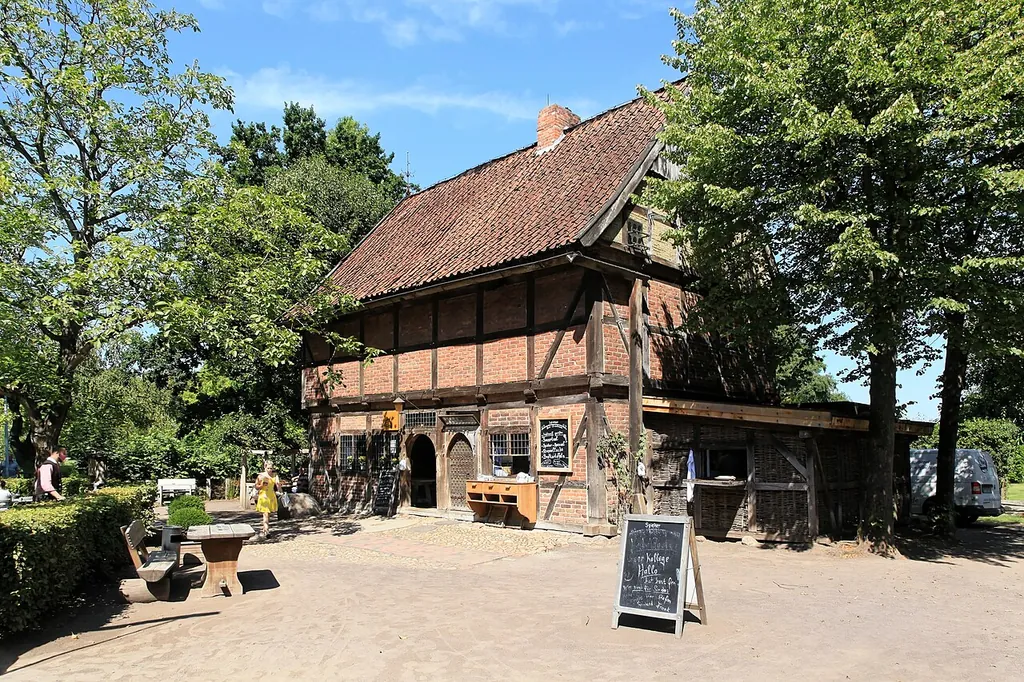
The main house is a two-post oak half-timbered building on glacial boulders, in which people and livestock lived under one roof. An open hearth without a chimney forms its center; ham is still smoked there today. Further buildings were gradually added, including a spieker (granary), a barn, a bargfred (open hay barn), a farm laborer's cottage from 1768 and the Dweersack double house bearing the date 1532. In 1960 a smock windmill with a gallery, built in 1811, was moved to the site from Hüllstede; it has a working set of millstones. The most recent of today's 17 buildings was constructed in 2013.
The farmstead lies between the Aue stream, a farm woodland and the southern shore of the Zwischenahner Meer in the spa park. In 1993 the association also acquired a former grain distillery in the Specken district, where furniture, traditional costumes, vehicles and textile crafts are displayed; a small Boßel museum there explains the regional folk sport of road bowling. For some years now, more than 80 QR code stations with audio texts have guided visitors around the grounds.
Highlights
- Ammerland farmhouse from 1910 with an open hearth without a chimney
- Smock windmill with gallery from 1811 with a working set of millstones
- Dweersack double house bearing the date 1532
- Farm laborer's cottage from 1768 and spieker (granary) with bakehouse and brewhouse
- More than 80 audio guide stations via QR code, including for children
- Founded
- 1910
- Operated by
- Verein für Heimatpflege Bad Zwischenahn – Heimatmuseum Ammerland e.V.
Admission & discounts
| Adults | €3.50 |
|---|---|
| Reduced | €2 |
| Children & teens | €2Children €2; age limit not specified. |
Prices according to Bad Zwischenahner Touristik; they apply to the farmhouse, while different prices apply for visiting other buildings. Museum Specken: adults €3.50, young people €2, children free.
Accessibility
The museum hasn’t published any information on this – please ask the museum directly.
Kids & families
Great for kids & families
- Activity booklet, scavenger hunt or kids’ audio guide
The free audio guide via the QR code stations on the grounds is also available in a child-friendly version.
Getting there & parking
By public transit
Bad Zwischenahn train station (regional trains Oldenburg–Leer); the museum is in the spa park on the southern shore of the Zwischenahner Meer.
Amenities & dining
- Restaurant
Restaurant "Spieker" with a beer garden in one of the museum's outbuildings, right on the Zwischenahner Meer; further association-run restaurants (Fährkroog, Museumskroog in Specken).
Events & venue rental
- Spaces for rent
- Weddings / ceremonies
Weddings in the farmhouse, with vows at the open hearth on request; champagne reception in the farmyard or in the house.
Inquiries & detailsPlan your visit
| Guided tours | yes |
|---|---|
| Audio guide | yes (DE, EN) |
| Good to know | Free audio guide via more than 80 QR code stations on the grounds (German, English and a children's version, available via museum.de). Guided tours year-round on request at tel. 04403 2071. |