Museum sächsisch-böhmisches Erzgebirge
Museum in the historic Bergmagazin in Marienberg on the cultural history of the Ore Mountains on both sides of the Saxon-Bohemian border.
About the museum
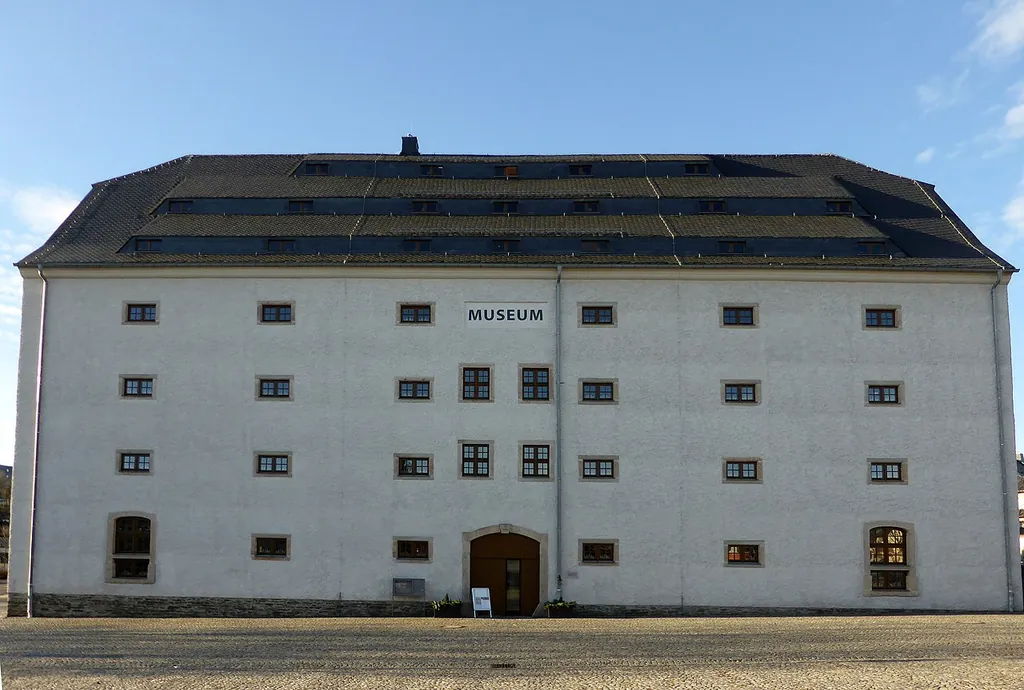
The museum is housed in the Bergmagazin (mining storehouse) on the Kaiserteich, a storage building constructed from 1806 to 1809 that is part of the historic layout of Marienberg and thus of the UNESCO World Heritage Site Erzgebirge/Krušnohoří Mining Region. The building has had many uses: as a granary, as a military hospital during the Wars of Liberation in 1813/14, as a military depot, for commercial businesses, as emergency housing after 1945, and as a fruit store in GDR times.
After its return to the city in 1993, the building was comprehensively renovated with European Union funds and reopened in 2006 as a house of encounter, education, and culture. Since then, the museum and the city library have shared the building. The museum took over the holdings of the former local history museum, which was housed in the Zschopauer Tor from 1966 to 2006.
The permanent exhibition tells the cultural history of the Ore Mountains on the Saxon and Bohemian sides as the biography of a region: the development of the mining town of Marienberg, the coexistence of Germans and Czechs from the Middle Ages to today, and the history of the building itself. Play stations and a discovery quiz also appeal to younger guests; several times a year, special exhibitions are added.
Highlights
- Historic Bergmagazin of 1806–1809 as part of the World Heritage town layout
- German-Czech neighborly history from the Middle Ages to today
- City history of the Renaissance mining town of Marienberg
- Play stations and discovery quiz
Permanent exhibitions
- Biografie einer Bergstadt – Tour through the history of Marienberg, shaped by mining, crafts, and the ideal of the Renaissance city.
- Deutsche und Tschechen – Biografie einer Nachbarschaft – Coexistence on both sides of the Ore Mountain ridge from the Middle Ages to today, with a focus on the 20th century.
- Biografie eines Hauses – The eventful history of the Bergmagazin from granary to cultural center.
- Founded
- 2006
- Operated by
- Stadt Marienberg
Admission & discounts
| Adults | €4.50 |
|---|---|
| Reduced | €3.50School students, trainees, university students |
| Children & teens | €3.50free up to age 16 · Children and young people up to age 16 free. |
| Students & apprentices | €3.50 |
| Groups | –Museum tour €15 flat rate, registration required. |
| Special exhibition only (adults) | €2.50Children and young people up to age 16 free. |
Reduction with the Gästekarte Marienberg (10–20%), EnviaMCard, press ID, and Kurkarte Warmbad (10% each).
Accessibility
- Wheelchair accessible
- Elevator
- Accessible restroom
- Accessible parking: no information
- Service dogs welcome: no information
- Tactile models & exhibits: no information
- Sign language tours: no information
- Easy-to-read materials: no information
- Audio description: no information
Entrance with a 5 cm step, door width 94 cm; elevator and accessible restroom available.
Kids & families
Great for kids & families
| Kids’ admission | free up to age 16 |
|---|
- Activity booklet, scavenger hunt or kids’ audio guide
- Hands-on stations
Play stations and discovery quiz in the exhibition; children's booklet series "Marie zeigt dir Marienberg" (€2.50 each); programs for daycare, after-school care, and schools.
Getting there & parking
By public transit
Marienberg, Markt
Bus stop Marienberg, Markt, a few minutes' walk from the museum.
By car
Free parking
Free parking directly in front of the Bergmagazin, more at the parking lot at the Stadthalle.
Via the B174 or B101; follow the signs for Zentrum/Bergmagazin. The museum is located on the edge of the old town.
Get directionsAmenities & dining
- Café: not available
- Restaurant: not available
Events & venue rental
The museum hasn’t published any information on this – please ask the museum directly.
Plan your visit
| Guided tours | yes |
|---|---|
| School programs | yes |
| Good to know | Tours by registration. Museum education programs from preschool to secondary schools. |