Pella
The capital of the Macedonian kingdom and birthplace of Alexander the Great, with houses, mosaic floors and the foundations of the agora.
Have only individual sections read aloud
About the museum
Pella is inextricably linked with the birth of Alexander the Great and became one of the most important political, economic and cultural centres of ancient Greece. King Archelaos moved the capital of Macedonia from Aigai to Pella at the end of the 5th century BC, and the city grew considerably thanks to the ambitious economic programme of Philip II.
The city acquired broad streets and exemplary town planning, as well as the largest square agora in the ancient Greek world, and attracted travellers, poets and artists. The latter left a strong mark on the mosaic floors and on the walls of wealthy houses, where rare examples of Greek painting with coloured plaster have been found.
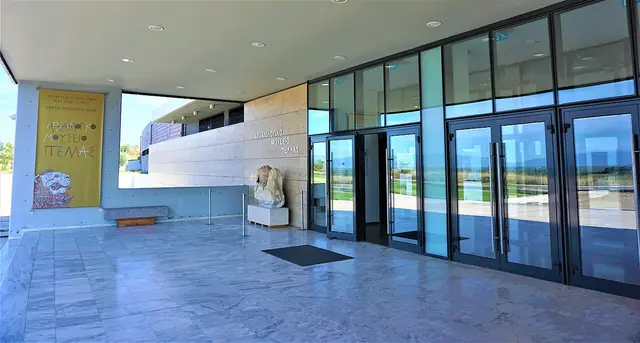
Excavations have revealed only a part of the ancient city, which covered a total of 4,000 stremmata. Visitors see courtyards with colonnades, elaborate mosaics and part of the foundations of the agora. The Archaeological Museum of Pella, with the finds from the city, operates separately, with its own ticket.
Highlights
- Houses with courtyards and colonnades
- Elaborate mosaic floors
- Rare painting with coloured plaster
- Part of the foundations of the agora, the largest square agora in the ancient Greek world
- Operated by
- Υπουργείο Πολιτισμού – Εφορεία Αρχαιοτήτων Πέλλας
Admission & discounts
| Adults | €10 |
|---|---|
| Reduced | €5 |
Free admission: 6 March, 18 April, 18 May, the last weekend of September, 28 October and the first and third Sunday of each month from 1 November to 31 March
Accessibility
- Wheelchair accessible: no information
- Elevator: no information
- Accessible restroom: no information
- Accessible parking: no information
- Service dogs welcome: no information
- Tactile models & exhibits: no information
- Sign language tours: no information
- Easy-to-read materials: no information
- Audio description: no information
The site is described as accessible for people with disabilities.
Kids & families
The museum hasn’t published any information on this.
Getting there & parking
By public transit
By intercity bus (KTEL) from Thessaloniki and by city bus from Giannitsa.
By car, the site is 45–60 minutes from Thessaloniki and 10–15 minutes from Giannitsa.
Get directionsAmenities & dining
The museum hasn’t published any information on this.
Events & venue rental
The museum hasn’t published any information on this.