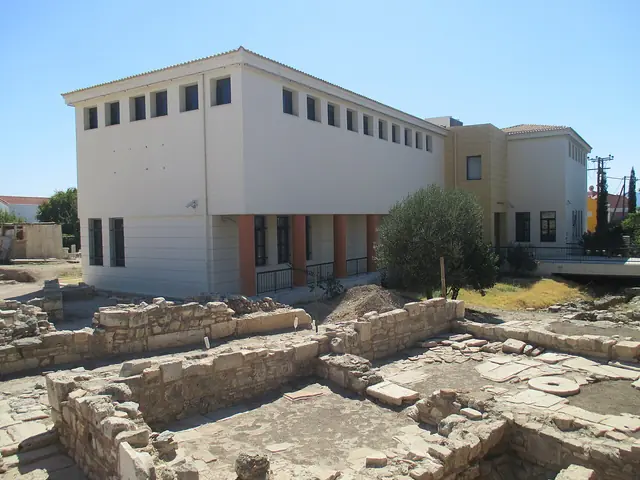
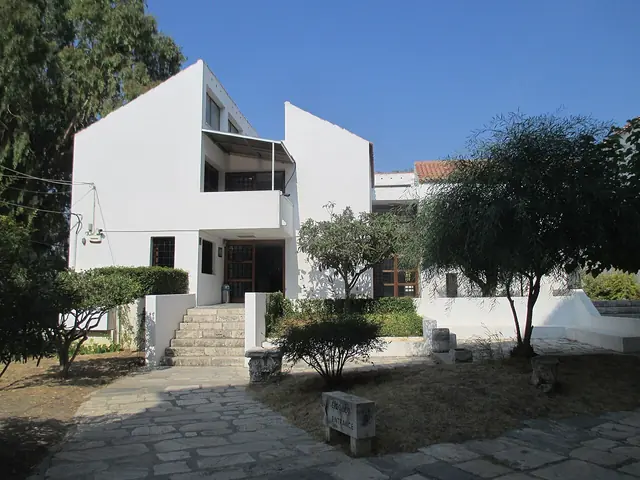
Heraion of Samos
The great sanctuary of Hera on Samos, with the colossal Ionic temple and finds from the 2nd millennium BC, a UNESCO monument.
Have only individual sections read aloud
About the museum
The Heraion was one of the most important sanctuaries of antiquity. It was built near the marshy delta of the Imvrasos river, on a site that made construction very difficult, and its use is attested as early as the 2nd millennium BC. According to myth, Hera, the protecting goddess of the island, was born on the riverbank beneath a willow tree and here she married Zeus.
Several temples succeeded one another on the same site: the Hekatompedos I in the 8th century BC, the Hekatompedos II at the end of the 7th century BC and, around 570–560 BC, a colossal Ionic dipteral temple more than 100 metres long, with columns about 18 metres high, the work of the architect Rhoikos and the artist Theodoros. This temple, regarded as a wonder of Ionic architecture, was destroyed by an earthquake a few years after its completion. In the age of the tyrant Polykrates, work began on an even larger temple, measuring 55.16 × 108.63 metres with 155 columns 20 metres high, which was probably never finished. Only part of one column survives in situ, on the south side.
Excavations at the sanctuary began before the early 20th century and continue to this day. Since 1992 the Heraion, together with the wider area of Pythagoreio, has been on the UNESCO World Heritage List.
Highlights
- Sanctuary of Hera with finds from the 2nd millennium BC
- Foundations of the Hekatompedos I and II temples
- The colossal Ionic dipteral temple of the 6th century BC
- UNESCO World Heritage monument
- Operated by
- Υπουργείο Πολιτισμού – Εφορεία Αρχαιοτήτων Σάμου και Ικαρίας
Admission & discounts
| Adults | €10 |
|---|---|
| Reduced | €5Citizens of Greece and other EU member states over 65 years of age from 1 October to 31 May (with ID or passport), accompanying parents on educational visits of primary schools in the EU and EEA, and accompanying teachers on educational visits of schools and institutions from countries outside the EU. |
| Combined ticket – full price | €6 |
| Combined ticket – reduced | €3 |
Free admission: 6 March, 18 April, 18 May, the last weekend of September, 28 October, and the first and third Sunday of each month from 1 November to 31 March.
Accessibility
- Wheelchair accessible
- Elevator: no information
- Accessible restroom: no information
- Accessible parking: no information
- Service dogs welcome: no information
- Tactile models & exhibits: no information
- Sign language tours: no information
- Easy-to-read materials: no information
- Audio description: no information
The site is described as accessible for people with disabilities.
Kids & families
The museum hasn’t published any information on this.
Getting there & parking
By car
Parking available
From the village of Heraion, the site is about 30 minutes on foot or 3 minutes by car.
Get directionsAmenities & dining
On site there are toilets and a car park.
Events & venue rental
The museum hasn’t published any information on this.