Museo Nazionale Etrusco di Chiusi
State museum in a neoclassical building of 1901 with Etruscan, Roman and Lombard finds from the Chiusi area, from canopic urns to the sphinx in stinkstone (pietra fetida).
Have only individual sections read aloud
About the museum
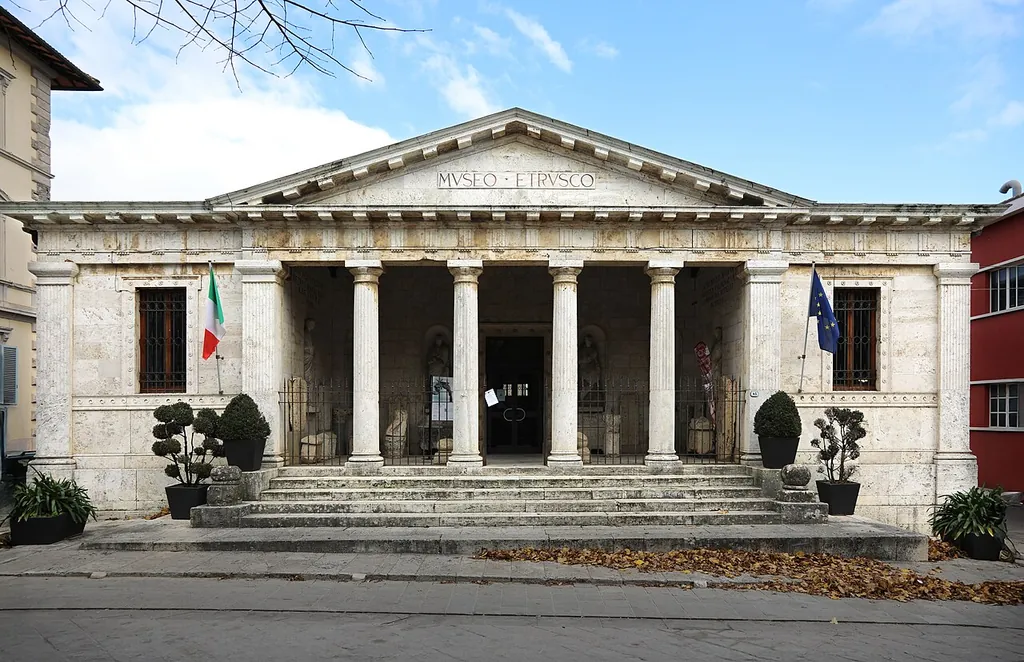
The Museo Etrusco di Chiusi was founded in 1871, just after Italian unification, to display the many finds from the Chiusi area that had been plundered for a long time. It opened on 28 October 1871 in via Mecenate and soon gathered the bishop's collection, which included the portrait of Augustus, as well as numerous urns and ceramics. As the premises were too small, in 1894 the Comune bought land in via Porsenna and entrusted the architect Giuseppe Partini with designing a neoclassical building inspired by temples, with a pronaos of four Doric columns. The new building opened on 22 August 1901.
The collections were enriched by the bequest of Count Giovanni Paolozzi in 1907 and by the donation of Leone Mieli's collection in 1934. The building was extended in 1932 to a design by Egisto Bellini; in 1944 it was damaged by shelling and reopened in 1948. In 1963 the civic museum passed to the State under the name Museo Nazionale Etrusco, while keeping a strong link with the town: the law stipulated that no object could ever be removed from Chiusi. The present display dates from 2003 and follows chronological and thematic criteria.
The route runs from the first traces of human presence in the Bronze Age (13th–10th century BC) through the Iron Age and the Etruscan period, with reliefs, statues, bucchero, Attic ceramics, grave goods, urns and sarcophagi, to the Roman section and the Lombard finds from the Arcisa hill (6th–7th century AD). Among the best-known pieces are the Coperchio dell'abbraccio (Lid of the Embrace), the canopic urns, including the one from Dolciano, the sphinx in stinkstone, the statues of mourners, the Attic vase with Telemachus and Penelope, the portrait of Augustus as pontifex maximus and the hunting-scene mosaic from Montevenere. An attached restoration workshop can be visited on request during exhibitions and events.
Highlights
- Funerary sphinx in stinkstone, the museum's symbol
- Canopic urns, including the one from Dolciano
- Coperchio dell'abbraccio (Lid of the Embrace)
- Portrait of Augustus as pontifex maximus
- Lombard brooch in gilded silver from the Arcisa necropolis
Permanent exhibition
- Collezione etrusca, romana e longobarda – Chronological and topographical route from the Bronze Age finds to the Roman section and the Lombard grave goods, with canopic urns, cinerary urns, the sphinx and painted tombs.
- Founded
- 1871
- Operated by
- Direzione regionale Musei nazionali della Toscana (Ministero della Cultura)
- Visitors per year
- approx. 21,261
Admission & discounts
| Adults | €6 |
|---|---|
| Reduced | €2citizens of the European Union aged 18 to 25 |
| Groups | –Booking is recommended for groups. |
Reductions and free admission follow the legal rules for state museums. Tickets are also on sale online; booking is recommended for groups.
Accessibility
The museum hasn’t published any information on this.
Kids & families
Great for kids & families
- Activity booklet, scavenger hunt or kids’ audio guide
Children's guides are available to download from the museum's website.
Getting there & parking
The museum is in via Porsenna, a short distance from the Duomo di Chiusi.
Get directionsAmenities & dining
The museum hasn’t published any information on this.
Events & venue rental
The museum hasn’t published any information on this.
Plan your visit
| School programs | yes |
|---|---|
| Good to know | The website offers the leaflet, a visit itinerary and two guides for children ("Gli Etruschi di Porsenna" and "Riscrivere il Passato"). |