Jakčev dom
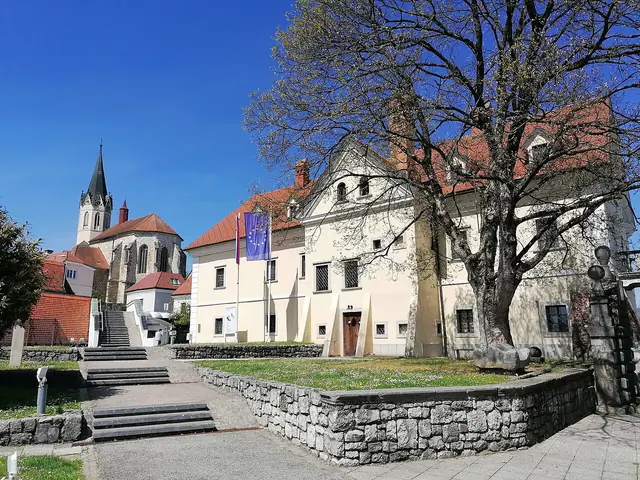
Gallery of the Dolenjska Museum in the former family house of Božidar Jakac, which holds his donation and the art collections of Dolenjska.
Have only individual sections read aloud
About the museum
The house was built in 1904 to designs by the Friulian architect Giuseppe Oliva by the father of Božidar Jakac, Anton Jakac. At first it was a modern hotel with a café; after the Second World War it housed a workers’ canteen and a cookery school. In 1984 it was converted into a gallery belonging to the Dolenjska Museum, thus symbolically returning it to the artist.
The wish for a permanent collection of Jakac’s works in Novo mesto dates back to 1964, when the Jakac Pavilion (Jakčev paviljon) was planned, but it was never built because of economic difficulties. Until 2006 the entire exhibition space was devoted to Jakac; then other artists were also included in the house.
Today the house hosts three permanent exhibitions: the collection of Božidar Jakac with 828 works, which he donated to his home town; the permanent art exhibition of the Dolenjska Museum from the 17th to the 20th century; and an art education collection. A smaller part of the space is devoted to gallery exhibitions by domestic and foreign artists.
Highlights
- Božidar Jakac collection with 828 donated works
- Permanent art exhibition of the Dolenjska Museum from the 17th to the 20th century
- Art education collection with more than 100 works by 60 Slovenian artists
- House from 1904, once the family home of the Jakac family
Permanent exhibitions
- Božidar Jakac – A selection from the collection of 828 works that the artist donated to his home town: early works, study in Prague, portraits, Dolenjska landscapes and motifs from travels in Europe, North America and North Africa.
- Stalna likovna razstava Dolenjskega muzeja – A chronological survey of the art of wider Dolenjska from the 17th to the 20th century, including a carved and painted winged altarpiece from 1651.
- Likovnovzgojna zbirka – A collection of more than 100 works by 60 Slovenian artists presents more than 30 artistic techniques, from drawing and painting to printmaking and sculpture.
- Founded
- 1984
- Operated by
- Dolenjski muzej Novo mesto (javni zavod)
Admission & discounts
| Adults | €4 |
|---|---|
| Reduced | €3children, students and pensioners |
| Children & teens | €3Children and students. |
| Seniors | €3Pensioners. |
| Students & apprentices | €3Students. |
| Groups (10+ people) | €3 per personPrice per person. |
| Families | €10Family ticket. |
| Museum workshop | €3.50 |
Dolenjska Museum card: adults €30, children and students €15 (valid for one year).
Accessibility
- Wheelchair accessible: no information
- Elevator: no information
- Accessible restroom: no information
- Accessible parking: no information
- Service dogs welcome
- Tactile models & exhibits: no information
- Sign language tours: no information
- Easy-to-read materials: no information
- Audio description: no information
The Dolenjska Museum is also open to dogs accompanied by their owners; details are on the page “Muzej, prijazen psom” (Dog-Friendly Museum).
Kids & families
Great for kids & families
| Family ticket | €10 · Family ticket. |
|---|
- Family tours & workshops
The art education collection presents more than 30 artistic techniques and is aimed especially at young people and their teachers; a family ticket and museum workshops are available.
Getting there & parking
By public transit
Information on bus and rail transport in Novo mesto is published by the Municipality of Novo mesto; the electric bus Leon runs free of charge through the town centre.
By car
Parking available
Nearby car parks are on Rozmanova ulica, Novi trg (square and multi-storey car park, car park by the post office), Kapiteljska ulica, Prešernov trg and Kandijska cesta.
Amenities & dining
The museum hasn’t published any information on this.
Events & venue rental
The museum hasn’t published any information on this.
Plan your visit
| Guided tours | yes |
|---|---|
| School programs | yes |
| Good to know | The art education collection is intended mainly for schools and young people; museum workshops are available. |