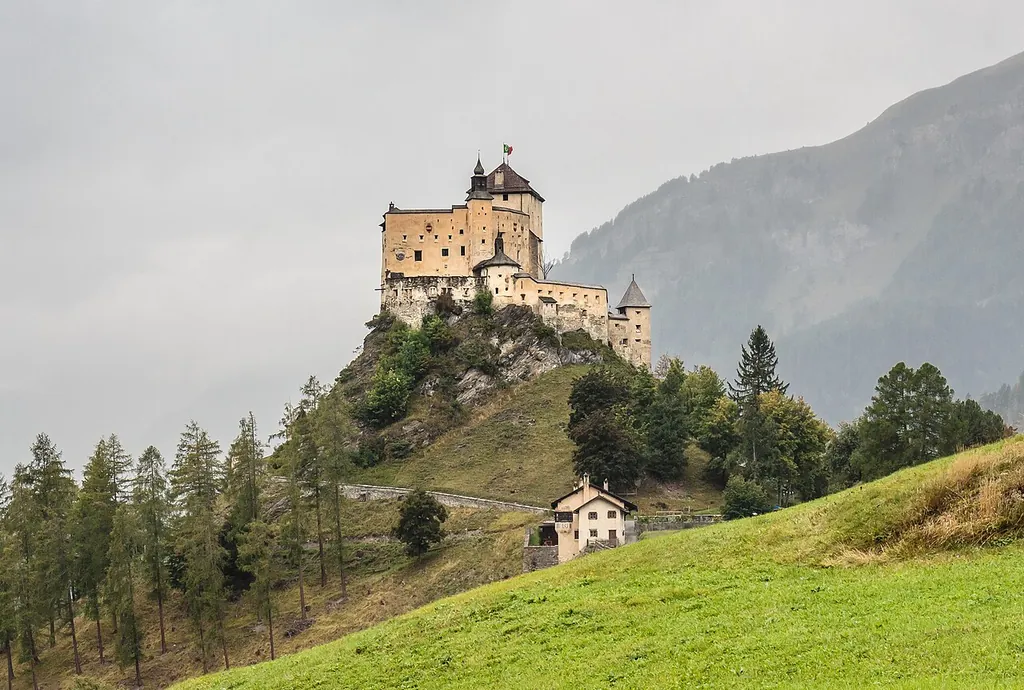
Schloss Tarasp
Landmark of the Lower Engadine on a rocky hill above Tarasp: an 11th-century castle with an art collection, can only be visited with a guide.
Have only individual sections read aloud
About the museum
The lords of Tarasp, who had come to the Engadine from the Lake Como region, built the castle around the year 1040. In 1239 the fortress passed to the counts of Tyrol, and from 1464 Tarasp was an Austrian domain. In the 16th century the owners expanded the complex into a border fortress. Only in 1803 did Napoleon assign Tarasp, one of the last Austrian enclaves on present-day Swiss soil, to the Helvetic Republic. In the following decades the castle changed owners several times and gradually fell into decay.
In the summer of 1900, Karl August Lingner, the Dresden industrialist and inventor of the mouthwash Odol, came to Vulpera for a cure. He bought the ruin and had it elaborately restored; for this he acquired wood paneling and furniture from Graubünden patrician houses, Tyrolean manor houses and Germany. In 1916 he had an organ by the Dresden firm Jehmlich installed in the former armory, today's music room, which is considered the largest organ in private ownership in Europe. Lingner died that same year. Because the last Saxon king declined the inheritance, the castle passed to Grand Duke Ernst Ludwig of Hesse.
The Hesse family owned Tarasp until 2016. On March 30, 2016, the artist Not Vital, originally from Sent, bought the castle. Today it is part of his foundation, which also includes the Parkin sculpture park in Sent and the Plantahaus in Ardez; in addition to the historic furnishings, it houses a collection of ancient, modern and contemporary art. The castle can only be visited as part of a guided tour.
Highlights
- Castle complex from the 11th century on a rocky hill above the Lower Engadine
- Historic rooms with wood paneling and furniture from the Lingner era
- Jehmlich organ from 1916, the largest organ in private ownership in Europe
- Collection of ancient, modern and contemporary art of the Not Vital Foundation
- Castle and art tours, audio guide in four other languages
- Café Schleppun with books and ceramics
Permanent exhibition
- Schlossräume und Kunstsammlung – The tour through the historically furnished rooms with the Lingner organ in the music room connects the history of the castle with works of ancient, modern and contemporary art from the collection of the Not Vital Foundation.
- Operated by
- Stiftung Not Vital
Admission & discounts
| Adults | CHF 15 |
|---|---|
| Reduced | CHF 13Guests with a Guest Card |
| Children & teens | CHF 8Children aged 7 to 15. |
| Groups (16+ people) | CHF 13 per personPrivate castle tour from 16 people, per person; groups of up to 15 people a flat CHF 200. Advance registration by email or telephone. |
| Public art tour (1.5 hours) | CHF 25With Guest Card CHF 20, children CHF 10. |
| Private castle tour for up to 15 people (1 hour) | CHF 200Flat fee per group. |
| Private art tour for up to 15 people (1.5 hours) | CHF 350Flat fee per group; from 16 people CHF 22 per person. |
Prices for the public castle tour. Payment in cash or by credit card.
Accessibility
- Wheelchair accessible: not available
- Elevator: no information
- Accessible restroom: no information
- Accessible parking: no information
- Service dogs welcome: no information
- Tactile models & exhibits: no information
- Sign language tours: no information
- Easy-to-read materials: no information
- Audio description: no information
The castle is not accessible; the walk from the parking lot or the PostBus stop takes about 20 minutes. More detailed information is available by email from the castle administration.
Kids & families
The museum hasn’t published any information on this.
Getting there & parking
By public transit
Fontana · 20-min walk
By the Rhaetian Railway (RhB) to Scuol-Tarasp, then by PostBus to Tarasp. From the Fontana PostBus stop, a signposted footpath leads up to the castle in about 20 minutes.
By car
Parking available · 20-min walk to the entrance
Sparsels parking lot at the end of the Sparsels district (about 20 minutes on foot to the castle); additional parking at the municipal building at the foot of the castle hill.
By car from the north via the Vereina car shuttle or over the Flüela Pass; from the east via Landeck toward St. Moritz; from the south over the Reschen or Ofen Pass.
Get directionsAmenities & dining
- Café
- Museum shop
Café Schleppun with a simple menu, plus sales of books, ceramics and other gift items; in 2026 open from June 2 to November 1, Tuesday to Sunday from 10:00 to 17:00.
Events & venue rental
The museum hasn’t published any information on this.
Plan your visit
| Guided tours | yes · approx. 60 min |
|---|---|
| Audio guide | yes (EN, FR, IT, RM) |
| Good to know | Public tours are held in German; visitors speaking other languages receive an audio guide at the ticket office. The castle tour lasts one hour and covers the history of the castle; the art tour lasts 1.5 hours and presents the art collection. School classes, clubs and larger groups register by email. Dogs are not allowed in the castle. |