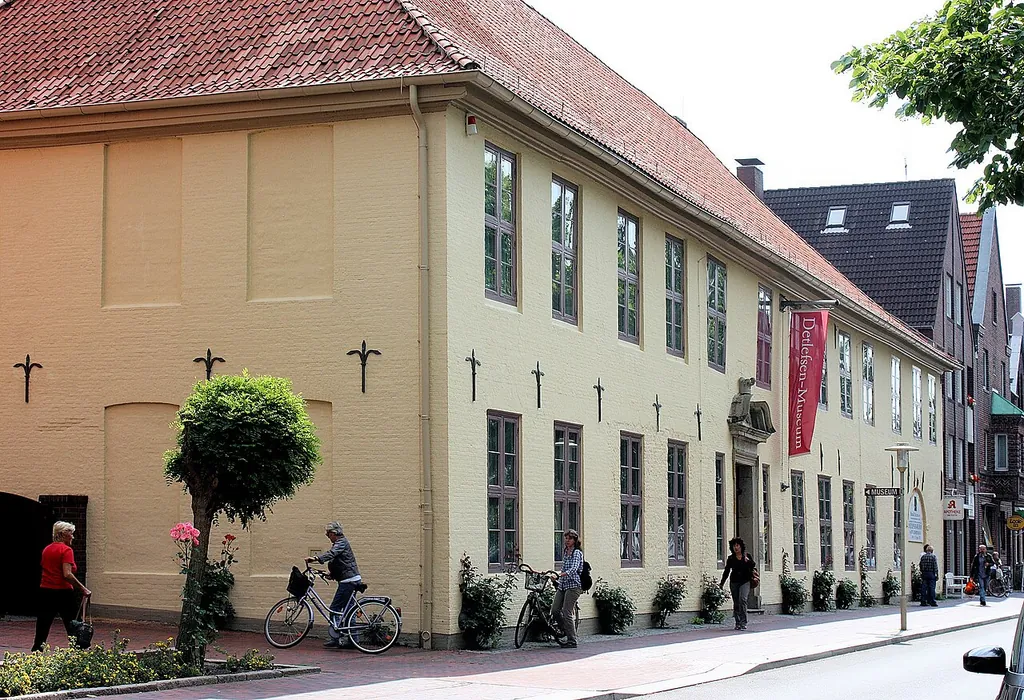
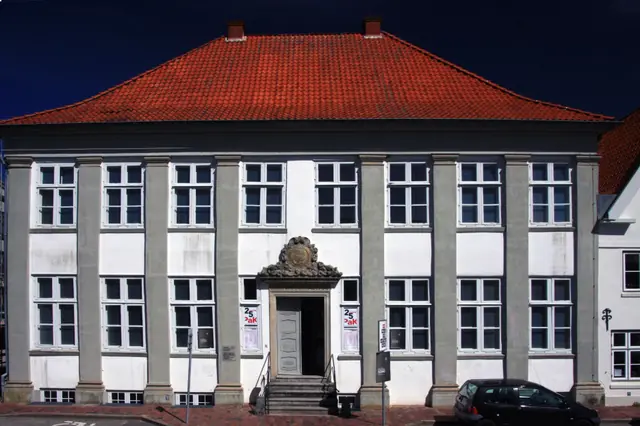
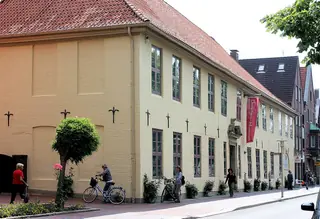
Regional museum in the Brockdorff Palace of 1632 on the art and cultural history of Glückstadt and the Elbe marshes – from whaling to the town pharmacy.
Using wooden swords, tin figures, self-built castles and plastic figures, the exhibition shows how images of the Middle Ages have become established in toys and pop culture, and questions heroic images and the distribution of roles.
About the museum
The museum goes back to the scholar Sönnich Detlef Friedrich Detlefsen, who founded the collection in 1894. Since 1969 it has been housed in the Brockdorff Palace on the Fleth, which it first shared with the town library and later with the town archive. After restoration as part of the town's urban renewal in 1992/93, the museum and archive used the building on their own; since the archive moved out in 2015/16, the entire building of over 1,000 square metres has been available to the museum. The museum is run by the town of Glückstadt.
The palace was built in 1631/32 for Count Christian Pentz, governor of the fortress and prospective son-in-law of the town's founder Christian IV. It is one of the few surviving buildings from Glückstadt's founding period. Painted timber-beam ceilings from 1695 characterise the ground floor; in the 18th century a side wing, a Baroque portal and the wooden staircase were added. The house takes its name from the von Brockdorff family, who owned it until 1877.
The permanent exhibition is devoted to the Krempe and Kollmar Elbe marshes and to the history of Glückstadt as a residence, fortress and tolerance town. Themes include whaling and herring fishing, rural and bourgeois domestic culture, trade and crafts, textiles, a historic town pharmacy, painting and graphic art, as well as the Sephardic community and the Augustin printing house. A farmhouse parlour from the 18th century also serves as the registry office's wedding room.
Highlights
Brockdorff Palace of 1631/32 with painted timber-beam ceilings
Whaling and herring fishing on the Lower Elbe
Historic town pharmacy
18th-century farmhouse parlour (Döns) – also a wedding room
Evidence of the Sephardic Jews and the Augustin printing house
Museum garden with coach house
Permanent exhibition
Kunst- und Kulturgeschichte der Elbmarschen – The permanent exhibition leads through Glückstadt's history as a residence, fortress and tolerance town and shows domestic culture, crafts, whaling, herring fishing and a historic pharmacy.
Founded
1894
Operated by
Stadt Glückstadt
Director
Christian Boldt
Admission & discounts
Adults
€4
Reduced
€2.50School pupils, students, trainees, people with disabilities, recipients of unemployment and social benefits
Children & teens
€2.50free up to age 13 · Children under 14 free; from age 14 the reduced pupil rate applies
Seniors
–No senior discount listed
Visitors with disabilities
€2.50
Students & apprentices
€2.50
Groups (10+ people)
€2.50 per person
Families
€7.50Max. 2 adults and 4 children
Guided tours for 6 or more people: €5 per person plus reduced admission. Company tour (approx. 1 hour) €50 plus admission; school and nursery tour €40 per class.
Accessibility
Partially wheelchair accessible
Elevator: not available
Accessible restroom: no information
Accessible parking
Service dogs welcome
Tactile models & exhibits: no information
Sign language tours: no information
Easy-to-read materials: no information
Audio description
Step-free access at the main entrance: please ring the bell and staff will set up a ramp. The first upper floor is not accessible; a 360-degree virtual tour on a tablet is available instead. Disabled parking directly in front of the entrance, folding stools to borrow, seating throughout the building. App with audio texts for blind and visually impaired people, films with subtitles. Dogs not permitted, except assistance dogs.
Kids & families
Great for kids & families
Kids’ admission
free up to age 13
Family ticket
€7.50 · Max. 2 adults and 4 children
Activity booklet, scavenger hunt or kids’ audio guide
Stroller-friendly
Children under 14 have free admission. Museum quiz for different age groups; according to the museum, the building can also be visited with a pushchair (ramp at the entrance, upper floor not accessible).
Getting there & parking
By public transit
Bahnhof Glückstadt
Glückstadt railway station on the Hamburg–Westerland line (roughly hourly); three minutes' walk from the station to the town centre.
By car
Disabled parking directly in front of the entrance.
Accessible parking
By car via the A23 (exit Hohenfelde) and Krempe. From Lower Saxony by the Elbe ferry Wischhafen–Glückstadt (roughly every half hour, approx. 25 minutes). Glückstadt lies on the Elbe Cycle Route; marina near the centre.
Public Wi-Fi "Zum Glück Netz" for downloading the app.
Events & venue rental
Spaces for rent
Corporate events
Weddings / ceremonies
Civil weddings in the historic farmhouse parlour (Döns) followed by a reception in the foyer or museum garden; company tours with punch in the Old Pharmacy or sparkling wine in the foyer.
Guided tours on request, including for individual collection areas and outside opening hours; guide for Danish-speaking guests. Free app "Glückstadt erleben" with audio tours of the museum, the town and the Jewish cemetery (loan devices for up to 25 people). VR application "Glückstadt 1650".