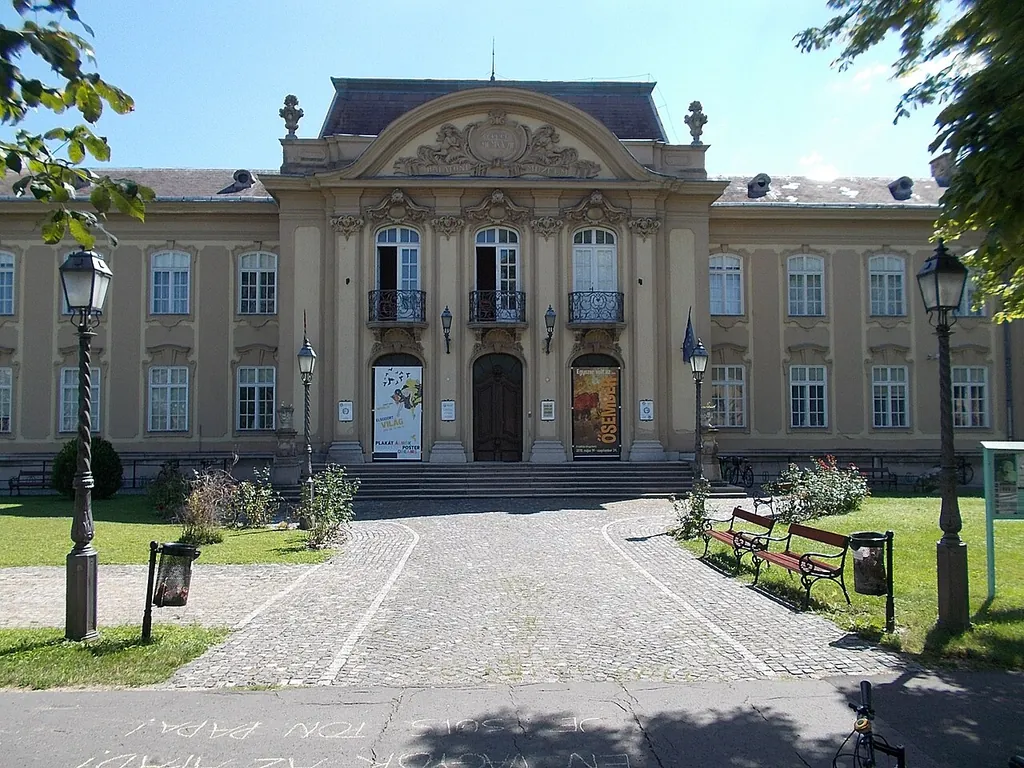
Balatoni Múzeum
The interactive exhibitions of the Balatoni Múzeum in Keszthely present the origin of the lake, its wildlife, fishing and bathing culture.
Have only individual sections read aloud
About the museum
The idea of a Balatonvidéki Múzeum (Lake Balaton Region Museum) arose in Keszthely during the preparations for the millennium, in the 1890s. The Balatoni Múzeum Egyesület (Balatoni Museum Association) was founded in June 1897, and it counted its operation from August 1898, from its constituent general meeting. The collection was initially housed in a few rented rooms of the old Gazdasági Tanintézet (Agricultural Teaching Institute); alongside the archaeological material of Csák Árpád, a natural-science and an ethnographic department, a library and a military-history section were also established.
Today’s building was made possible by a generous offer in the early 1920s: the Festetics entailed estate provided the plot and building materials, supplemented by state aid and city support. Construction began in 1925, and the technical handover took place in 1927. The building’s entrance now opens from Kossuth utca; the building itself stands on Múzeum utca.
The permanent exhibitions of the museum deal with the origin and geology of Lake Balaton, its flora and fauna, the fish of Lake Balaton and fishing, bathing culture, and the relationship between the lake and people. The exhibition spaces are interactive, and families have a play corner, a treasure-hunt game and children’s camps. The museum also organises temporary exhibitions and programmes.
Highlights
- The origin, geology, flora and fauna of Lake Balaton
- Fish of Lake Balaton and fishing
- Bathing culture of Lake Balaton and the relationship between the lake and people
- Interactive exhibition spaces, a treasure-hunt game and a play corner for children
- Accessible building with a lift, induction loop and audio map
Permanent exhibitions
- Balaton kialakulása, földtana – The origin of the lake and its geological background, in an interactive exhibition.
- Balatoni halászat – The history of fishing on Lake Balaton and its tools.
- Balatoni fürdőkultúra – The history of bathing life on Lake Balaton.
- Founded
- 1898
- Operated by
- Balatoni Múzeum
- Director
- Csalog József
Admission & discounts
| Adults | HUF 3,000 |
|---|---|
| Reduced | HUF 1,500students aged 6–26, pensioners aged 62–70, and the discounted adult family ticket |
| Children & teens | HUF 1,500free up to age 5 · Free admission under 6. |
| Seniors | HUF 1,500Aged 62–70; free admission over 70. |
| Visitors with disabilities | freeFree admission with a disability card; the companion can enter at a reduced price, paying the service fee. |
| Students & apprentices | HUF 1,500Aged 6–26. |
| Families | HUF 1,500Close relatives (up to two adults) accompanying at least two persons under 18 receive a 50% discount. |
| Guided tour for adult groups in Hungarian (10–30 people) | HUF 7,000Per group; in English or German HUF 10,000. Student group in Hungarian HUF 4,500. Groups of up to 20 people are scheduled. |
| Museum education session | HUF 1,000Per person; a four-session pass for kindergarten and lower-primary children costs HUF 2,400 per person, for upper-primary and secondary pupils HUF 2,800 per person. |
Free admission: On 15 March, 20 August and 23 October (for everyone); on the last Saturday of every month, visitors under 26 and up to two close relatives accompanying at least two persons under 18.
The ticket prices include a HUF 500 service fee (cloakroom, photo ticket, toilets, lift); those entering free must also pay it, except people who need assistance and teachers accompanying a class. Admission is free for children under 6 and visitors over 70, for teachers in public education and for members of certain professional organisations. Payment in cash, by bank card and with the SZÉP card.
Accessibility
- Wheelchair accessible
- Elevator
- Accessible restroom
- Accessible parking
- Service dogs welcome: no information
- Tactile models & exhibits: no information
- Sign language tours: no information
- Easy-to-read materials: no information
- Audio description
The exhibition spaces are accessible without barriers; there is an accessible toilet on the ground floor and a lift to the upper floor. Visitors with hearing impairments are helped by an induction loop. Visitors with visual impairments have an audio map available for download in MP3 format, and a mobile app. A free disabled parking space is available in front of the main entrance.
Kids & families
Great for kids & families
| Kids’ admission | free up to age 5 |
|---|---|
| Family ticket | HUF 1,500 · Close relatives (up to two adults) accompanying at least two persons under 18 receive a 50% discount. |
- Family tours & workshops
- Activity booklet, scavenger hunt or kids’ audio guide
- Hands-on stations
- Baby changing facilities
- Playground / play area
- Kids’ birthday parties
Interactive exhibition space, a play corner separated for under-3s, a treasure hunt with a mobile app, a separate children’s toilet, a changing table, a space for breastfeeding and heating baby food, family days, summer children’s camps and children’s birthday parties.
Getting there & parking
By public transit
Keszthely buszpályaudvar · 400 m
About 400 metres on foot from both the bus station and the railway station.
By car
Free parking
Parking is free all year round in the streets around the museum; special-service buses can also park here.
- Accessible parking
The museum entrance opens from Kossuth utca; from Fő tér along Kossuth utca, against the direction of the pedestrian street, it is about a 10-minute walk.
Get directionsAmenities & dining
- Coat check
The cloakroom is included in the service fee; there is a place to eat and rest in the foyer.
Events & venue rental
The museum hasn’t published any information on this.
Plan your visit
| Guided tours | yes |
|---|---|
| School programs | yes |
| Good to know | Guided tours for groups by prior arrangement; museum education sessions for kindergarten and school children, and children’s camps. An escape-room programme is also available. |