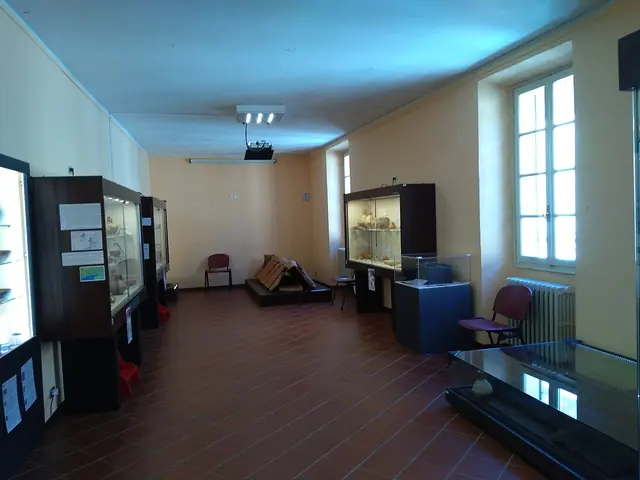
Civico Museo Archeologico di Sesto Calende
Civic museum with one of the main collections of the Golasecca culture, from the Bronze Age to the early Middle Ages, in Piazza Mazzini.
Have only individual sections read aloud
About the museum
The Civico Museo Archeologico di Sesto Calende tells the history of the lower Verbano area through finds from prehistory to the early Middle Ages. Among the oldest materials are objects from burials in natural rock shelters and finds from the last phases of the Bronze Age (13th–10th centuries BC), coming from the cremation necropolises of Somma Lombardo, in the area of Malpensa airport.
The museum holds one of the most important collections of finds from the Golasecca culture, a population of Celtic descent which, between the end of the 9th and the 5th century BC, created in the lower Verbano one of the largest population concentrations in northern Italy, in contact with the Etruscan and Mediterranean world and with the Transalpine Celtic principalities.
A second period of great flourishing in the Sesto area is documented by the Benedictine monastic church of San Donato: slabs, parapets (plutei) and small pillars decorated with interlace survive from the oldest building, dating to around the first half of the 9th century. The route is supplemented by staged reconstructions and a video on the Golasecca culture, in Italian and English.
Highlights
- Finds from the Golasecca culture, one of the most important collections
- Objects from the Bronze Age cremation necropolises of Somma Lombardo
- Early medieval slabs, parapets and pillars from the church of San Donato
- Staged reconstructions and videos in Italian and English
- Tactile section with Braille texts
Permanent exhibition
- Cultura di Golasecca e territorio del basso Verbano – Finds from the Bronze Age to the early Middle Ages, with the Golasecca collections, burials and fragments from the church of San Donato.
- Operated by
- Comune di Sesto Calende
- Visitors per year
- approx. 1,161
Admission & discounts
| Adults | €3 |
|---|---|
| Reduced | €1under-18s, students, over 65s and people with disabilities |
| Children & teens | €1Reduced rate for under-18s. |
| Seniors | €1Over 65s. |
| Visitors with disabilities | €1companion free · Free admission for an accompanying person. |
| Students & apprentices | €1 |
| Groups (10+ people) | –Guided group visit (minimum 10 people): €4 per person; accompanying adults free. Schools from Sesto Calende: free admission. |
Tickets are on sale on site; the audio guide costs €2. Workshops and guided tours in the area for groups of at least 10 people: €5. The Abbonamento Musei Lombardia pass is valid.
Accessibility
- Wheelchair accessible
- Elevator: no information
- Accessible restroom: no information
- Accessible parking: no information
- Service dogs welcome: no information
- Tactile models & exhibits
- Sign language tours: no information
- Easy-to-read materials: no information
- Audio description: no information
The museum has no architectural barriers and has a small touch section for visually impaired visitors, with Braille texts.
Kids & families
Great for kids & families
- Family tours & workshops
- Activity booklet, scavenger hunt or kids’ audio guide
Junior paper guide with games, interactive guided tours and educational workshops for schools of all levels.
Getting there & parking
By public transit
Stazione di Sesto Calende
Train on the Milan–Domodossola line: Sesto Calende station is very close to the museum.
By car from Varese or Milan, take the A8/E62 motorway towards Varese, then follow the signs towards Sesto Calende as far as the centre.
Get directionsAmenities & dining
The museum hasn’t published any information on this.
Events & venue rental
The museum hasn’t published any information on this.
Plan your visit
| Guided tours | yes |
|---|---|
| Audio guide | yes |
| School programs | yes |
| Good to know | Audio guides, a paper guide (also in a junior version with simple information and games) and visits with qualified staff are available; guided tours, educational workshops and special activities must be booked in advance by contacting the museum. |