Parco archeologico di Ercolano
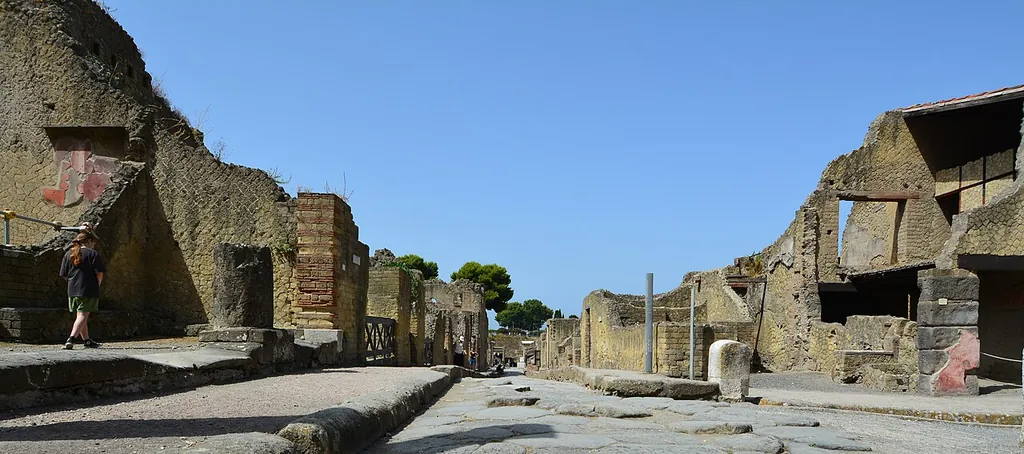
Roman town buried by the eruption of 79 AD and remarkably preserved, with two-storey houses, mosaics, baths, carbonised wood and vaulted boat-houses (fornici) on the sea.
Have only individual sections read aloud
About the museum
Like Pompeii, Herculaneum was overwhelmed by the eruption of Vesuvius in 79 AD, but it was buried by mudflows and volcanic material which, solidifying into a soft rock, protected buildings, furnishings and organic materials in an exceptional way. The site was rediscovered in 1709, when a farmer found fine marbles while digging a well.
From 1738, under the Bourbons, explorations were carried out in underground tunnels, which brought to light statues, frescoes and the famous Villa dei Papiri, and were then abandoned. Systematic open-air excavation was begun in 1927 by Amedeo Maiuri and has restored a substantial part of the town centre, with streets, houses, workshops and public buildings. Since 2001 the Herculaneum Conservation Project, supported by the Packard Humanities Institute, has been responsible for the conservation of the site.
Unlike Pompeii, at Herculaneum beams, doors and wooden furnishings in carbonised form still survive and, in the boat-houses along the ancient beach, more than three hundred skeletons of people who tried to escape by sea have been found. The site has been on the UNESCO World Heritage List since 1997, together with Pompeii and Oplontis. Today it is an autonomous state archaeological park, based in Corso Resina.
Highlights
- Casa dei Cervi, a large residence overlooking the sea
- House of Neptune and Amphitrite with the mosaic of the nymphaeum
- Suburban Baths and Baths of the Forum
- College of the Augustales
- Carbonised wooden furniture and beams
- Vaulted boat-houses (fornici) of the ancient beach with the skeletons of those who fled
- Operated by
- Parco archeologico di Ercolano (Ministero della Cultura)
- Visitors per year
- approx. 563,165 (2023)
Admission & discounts
| Adults | €16 |
|---|---|
| Reduced | €2Visitors aged 18 to 25. |
| Children & teens | –Children under 12 must be accompanied. For free admissions the national regulations apply (benefits of the Ministry of Culture). |
| Ercolano Card (1 person) | €30Valid for 365 days from first use; excludes events with a special ticket and evening openings. |
| Ercolano Card Family (2 adults and minors) | €58Valid for 365 days from first use. |
| Ercolano Card Young (18–25 years) | €5Valid for 365 days from first use. |
Free admission: Free admission on the first Sunday of every month and on 25 April, 2 June and 4 November; free tickets are collected at the ticket office on the same day and are not booked online.
Online tickets through CoopCulture, to be shown in digital or printed form. The Campania Artecard (also the Lite version, to be activated at the park's ticket office) and the 18app are accepted.
Accessibility
- Partially wheelchair accessible
- Elevator: no information
- Accessible restroom: no information
- Accessible parking: no information
- Service dogs welcome: no information
- Tactile models & exhibits: no information
- Sign language tours: no information
- Easy-to-read materials: no information
- Audio description: no information
The route “Ercolano per tutti” (Herculaneum for everyone), marked in blue on the map of accessible routes, is designed for visitors with motor disabilities: for directions, ask the security staff at the entrance. For children with autism the app “Avventura ad Ercolano” (iPad only) uses games and augmented reality; the park lends a tablet free of charge if requested by e-mail at least 5 working days before the visit.
Kids & families
Great for kids & families
| Time needed | approx. 2 hrs |
|---|
- Family tours & workshops
- Activity booklet, scavenger hunt or kids’ audio guide
For young visitors an illustrated map of the site with Geronimo Stilton is available; educational activities for schools are planned, and there is an app for children with autism.
Getting there & parking
By public transit
Ercolano Scavi · 6-min walk
Circumvesuviana Naples Centrale–Sorrento, stop Ercolano Scavi; from there the entrance on Corso Resina 187 is about 6 minutes on foot.
By car
Parking available
By car: A3 Naples–Salerno motorway, exit Ercolano Scavi, then follow the signs for the park. The second gate is in Via dei Papiri Ercolanesi.
Get directionsAmenities & dining
- Restaurant: not available
- Museum shop
- Coat check
There is no restaurant on the site; vending machines are available at the entrance bridge. Luggage storage is free (bags up to 35 × 30 × 15 cm). Bookshop among the park's services.
Events & venue rental
The museum hasn’t published any information on this.
Plan your visit
| Guided tours | yes |
|---|---|
| Audio guide | yes |
| School programs | yes |
| Photography | Photos and filming for private use are allowed; professional or commercial filming requires authorisation. |
| Good to know | The 3D audio guide with augmented reality is available as an app for iOS and Android (ercolano.tours) and for hire on site. Fixed-time guided tours only in Italian; guided tours for groups by booking from Monday to Saturday (not holidays), from 9:00 to 17:00, phone +39 081 010 6490 or tour@coopculture.it; for schools offered in Italian and English (edu@coopculture.it). Dogs are admitted on a leash or muzzled; in the Antiquarium, the Boat House and the houses with mosaic floors only if carried in arms or in a carrier. |