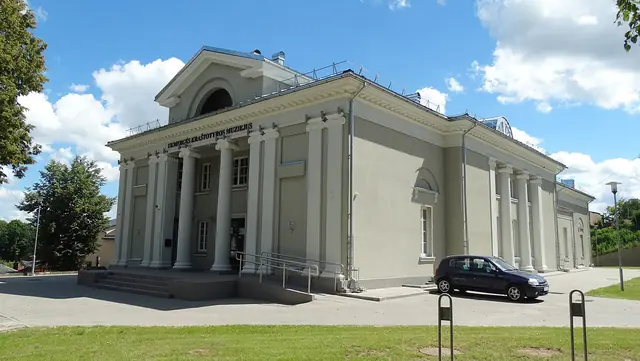
Užugirio mokykla-muziejus
Museum in the school built by President A. Smetona in 1935 in Užulėnis, with an ethnographic exhibition and an interwar classroom.
Have only individual sections read aloud
About the museum
The Užugirio krašto muziejinis kompleksas (Užugiris Regional Museum Complex) comprises the foundations of Antanas Smetona's birthplace, a school built by the President in 1935, and the manor estate with its land. The museum is in the street village of Užulėnis, in a building reminiscent of a palace, which the first President of independent Lithuania gave to the people of the region. In 1935 one of the most modern primary schools in Lithuania was established here.
As children in the villages decreased, the museum was set up in the school premises in 2003. Many of the exhibits were collected by local resident Regina Šviežikienė, to whom neighbours entrusted their ancestors' household goods, utensils, textile works and family relics. A special place in the exhibition is given to Antanas Smetona: here are gathered publications, photographs and paintings related to the President's personality; on the other side of the street, where his house stood, only a well with a swape (svirtinis šulinys), old apple trees and a model of the ancestral home remain.
The museum has an ethnographic exhibition and interwar and Soviet-era classrooms. A department of the old crafts centre also operates, where the educational sessions “Duonos kelias” (“The Path of Bread”), “Lino kelias” (“The Path of Flax”) and “Slapta mokykla” (“The Secret School”) take place and šakotis (tree cake) is baked; next to the museum is a vegetable garden with the vegetables of the region. The museum also tells of the partisans of the Vyčio apygarda (Vytis district) – the units of Juozas Krikštaponis and Danielius Vaitelis, which operated in the Užugiris forests.
Highlights
- Ethnographic exhibition with items donated by local residents
- Separate exhibition section on Antanas Smetona
- Interwar and Soviet-era educational classrooms with “Smetonian” benches
- Old crafts centre: “Duonos kelias”, “Lino kelias”, šakotis baking
- Stories about the Vytis district partisans in the Užugiris forests
Permanent exhibition
- Etnografinė ir A. Smetonos ekspozicija – Household goods, utensils, textiles, publications, photographs and paintings about President Antanas Smetona, donated by local residents; interwar and Soviet-era classrooms.
- Founded
- 2003
- Operated by
- Ukmergės kraštotyros muziejus
Admission & discounts
| Adults | €4 |
|---|---|
| Reduced | €2pupils, students, deportees, people of pensionable age (up to 80) and other reduced categories |
| Groups | –Guided tour of the museum: €25 for a group of up to 20 people (in Lithuanian), plus visitor tickets. |
Free admission: On the last Sunday of each month, visits to the museum and its branches are free of charge.
The ticket is valid for the museum and its branches (Siesikai Castle, the President A. Smetona Estate, the Užugirio mokykla-muziejus). A guided tour of the Užugirio mokykla-muziejus (1.5 hours, in Lithuanian, for groups of up to 20 people) costs €25, and each participant also buys a visitor ticket.
Accessibility
The museum hasn’t published any information on this.
Kids & families
- Family tours & workshops
- Hands-on stations
Children can sit on a “Smetonian” bench, write in an exercise book with a pen, bake a small loaf of bread and learn about farming in the museum's vegetable garden.
Getting there & parking
The museum is in the village of Užulėnis, Taujėnai eldership, A. Smetonos g. 20.
Get directionsAmenities & dining
The museum hasn’t published any information on this.
Events & venue rental
- Spaces for rent
The hall of the Užugiris education centre is rented out.
Plan your visit
| Guided tours | yes · approx. 1.5 hrs |
|---|---|
| School programs | yes |
| Good to know | For guided tours at Užugiris call +370 670 27306 or +370 640 42244. Educational sessions: “Slapta mokykla” (“The Secret School”), “Lietuvių kalba” (“Lithuanian Language”), “Istorija” (“History”), “Gamta” (“Nature”), “Duonos kelias” (“The Path of Bread”), “Lino kelias” (“The Path of Flax”). |