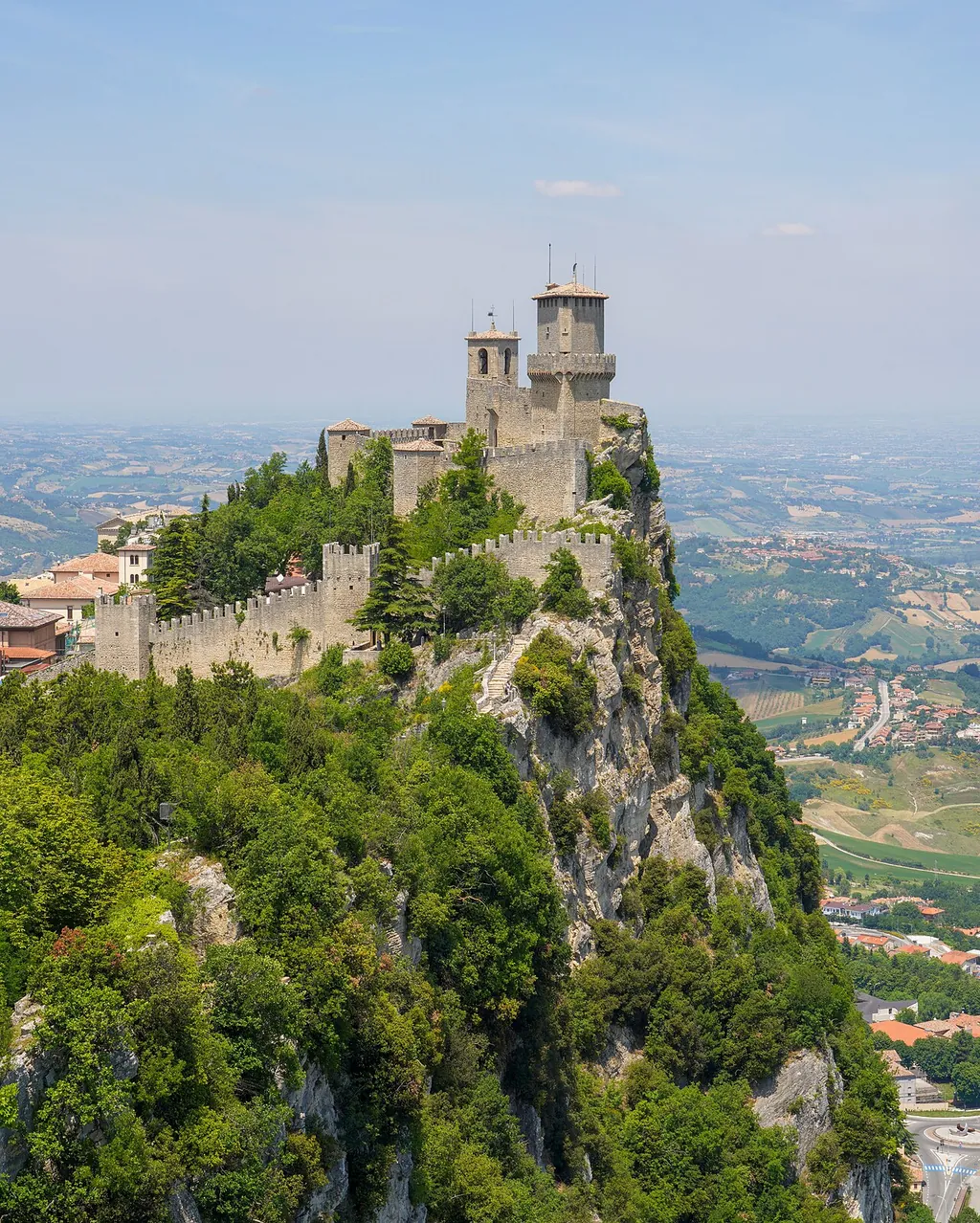
Prima Torre
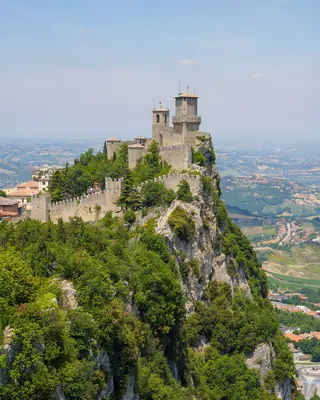
La Guaita is the largest and oldest of the three fortresses of Monte Titano, with two curtain walls, a bell tower and old prisons.
Have only individual sections read aloud
About the museum
The Prima Torre, also known as the Rocca or Guaita, is the largest and oldest of the three fortresses that overlook the City of San Marino. Its original core served as a guard post and refuge for the first inhabitants of Monte Titano and dates back to the 11th century, making it one of the oldest fortifications in Italy. The name still recalls its ancient role of surveillance, since among the inhabitants “guaita” means “to stand guard”.
The complex is protected by two curtain walls. The outer one, crenellated and reinforced at the corners by towers lowered in the 16th century, formed part of the city’s first line of defence. The inner, older wall has a raised entrance and encloses the bell tower, the garrison quarters and the Torre della Penna, the old watchtower rebuilt in the second half of the 15th century. The fortress reached its greatest importance in the 15th century, during the war against the Malatesta of Rimini.
From the second half of the 18th century until the 1970s, the garrison quarters served as prisons: convicts sentenced to terms of up to six months were held in the narrow cells. In the courtyard are some artillery pieces donated in 1907 by King Vittorio Emanuele III, which the Guardia di Rocca used until recent times for blank-shot salutes on the main holidays. Beside the entrance stands the small chapel of Santa Barbara, built in 1960, which keeps on its door a carved lunette from the ruins of a 13th-century church in Domagnano.
Highlights
- Bell tower with the “Campanone”, symbol of the people of San Marino
- Torre della Penna with views as far as the Seconda Torre and the Apennines
- Old prisons in the garrison quarters
- Courtyard with artillery donated in 1907 by Vittorio Emanuele III
- Chapel of Santa Barbara and walkway along the walls
- Operated by
- Istituti Culturali di San Marino (Musei di Stato)
Admission & discounts
| Adults | €11 |
|---|---|
| Reduced | €8Groups of more than 25 people, people over 65, university students with student card |
| Children & teens | freefree up to age 17 · Free admission for under-18s |
| Seniors | €8Reduced rate for over-65s |
| Visitors with disabilities | freecompanion free · Free for visitors with disabilities who are not self-sufficient (100% disability) |
| Students & apprentices | €8University students with student card |
| Groups (26+ people) | €8 per personReduced rate for groups of more than 25 people; school groups free of charge |
| Biglietto Ultima Fascia (valid for all Musei di Stato sites from 16:00 until closing, sold only at the ticket desks) | €5 |
Free admission: 5 February, 7 July, 3 September, 27 September and European Heritage Day (according to the annual calendar)
The Pass ticket (full €11, reduced €8) gives entry to all Musei di Stato (State Museums). Admission is also free for teachers with a certificate form, ICOM members and journalists with a press card; citizens of San Marino with an identity document enter the monuments (Prima Torre, Seconda Torre, Palazzo Pubblico) free of charge.
Accessibility
The museum hasn’t published any information on this.
Kids & families
The museum hasn’t published any information on this.
Getting there & parking
By public transit
Daily bus service between Rimini and San Marino, including weekends and public holidays.
By car
Paid parking
Paid parking in the historic centre (1 April to 30 September 08:00–24:00, 1 October to 31 March 08:00–20:00); the P9 is a covered multi-storey car park with panoramic lifts up to the historic centre.
From car park P11 in Borgo Maggiore, the panoramic cable car reaches the historic centre in a few minutes.
Get directionsAmenities & dining
The museum hasn’t published any information on this.
Events & venue rental
The museum hasn’t published any information on this.
Plan your visit
| Good to know | The visit includes the courtyard with the artillery, the Santa Barbara chapel, the walkway along the walls, the prisons and the Torre della Penna, reached by a flight of steps. The Pass ticket is valid for all Musei di Stato. |
|---|