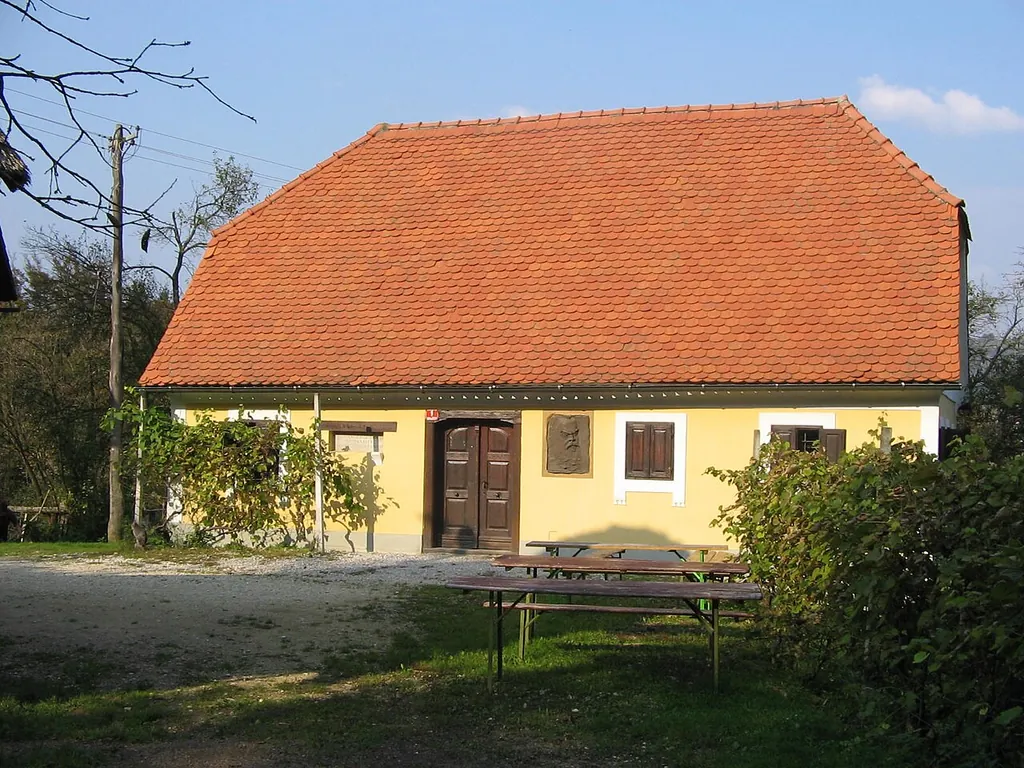
Aškerčeva domačija
The farmstead of the poet Anton Aškerc at Senožete: literary-ethnological museum with a black kitchen, and the farm as an ethno-architectural open-air museum.
Have only individual sections read aloud
About the museum
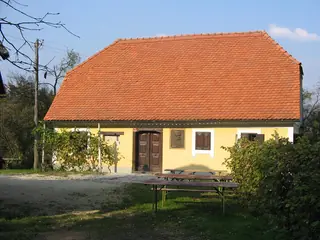
Senožete is a small village on the northern side of the Stražnik hill above Rimske Toplice. The Aškerc farmstead, formerly the Hrušovar farm, has stood there since at least 1542. The Aškerc family came to Senožete in 1789, when Matija Aškerc married the widow of Hrušovar. The poet Anton Aškerc was born in 1856 in Globoko; the family moved to Senožete in 1859.
In 1932 the Zgodovinsko društvo (Historical Society) from Maribor placed a memorial plaque on the house, and on the centenary of the poet's birth a memorial room was set up in it. In the eighties of the 20th century the house was bought by the Občina Laško, and the central part was completely reorganised as a literary-ethnological museum. Today visitors see the literary collection, the black kitchen, the entrance hall, the storeroom (kamra) and the štibelc (bench room).
The farm is also of interest for its architecture: beside the residential house stand a double hayrack barn (kozolec toplar), a frjača (fruit-drying kiln), a wooden granary and a stable, and beside the farmstead is a small pond. In the granary, more than five hundred years old, a tasting and sales area with cheeses and jams has been set up. The farmstead lies on the Aškerc theme trail, intended for walkers and cyclists.
Highlights
- Literary collection on the poet Anton Aškerc
- Black kitchen, entrance hall, storeroom and štibelc (bench room)
- Farm as an ethno-architectural open-air museum with a double hayrack barn, frjača and wooden granary
- Tasting of local cheeses in a granary more than 500 years old
- Aškerc theme trail for walkers and cyclists
Permanent exhibition
- Aškerčeva hiša – literarno-etnološki muzej – The central part of the house holds the literary collection on the poet Anton Aškerc and an ethnological display with the black kitchen, entrance hall, storeroom and štibelc.
Admission & discounts
| Adults | €2 |
|---|---|
| Children & teens | freefree up to age 5 · Children up to the age of six enter free. |
The price of €2 per person applies to a guided tour of the museum. A visit with a tasting of local cheeses is possible by arrangement.
Accessibility
- Wheelchair accessible
- Elevator: no information
- Accessible restroom: no information
- Accessible parking: no information
- Service dogs welcome: no information
- Tactile models & exhibits: no information
- Sign language tours: no information
- Easy-to-read materials: no information
- Audio description: no information
According to the house, the museum is accessible to persons with disabilities.
Kids & families
The museum hasn’t published any information on this.
Getting there & parking
By car
Parking available
Well-organised car park for cars and buses.
The farmstead stands on the Aškerc theme trail.
Get directionsAmenities & dining
- Museum shop
In the old granary there is a tasting and sales area with cheeses and jams.
Events & venue rental
The museum hasn’t published any information on this.
Plan your visit
| Guided tours | yes |
|---|---|
| Good to know | Visits to the museum are conducted with a guide; advance booking is recommended on the telephone numbers 031 207 291, 031 237 139 or 070 380 616. |