Museo de Almería
Archaeological museum of the province of Almería, with a permanent exhibition focused on the cultures of Los Millares and El Argar.
Have only individual sections read aloud
About the museum
The museum was created on 28 March 1933 as the Museo Arqueológico Provincial, by decree of the President of the Republic at the request of the Diputación Provincial. Its first holdings came from the Comisión Provincial de Monumentos and, above all, from the donation of the Belgian mining engineer Luis Siret, a pioneer of scientific archaeology in Andalusia, who had excavated the sites of Los Millares and El Argar. In his honour, the museum's name incorporated his.
The institution went through several premises. First it occupied a building on calle Javier Sanz; in 1979 it was transferred to the Ministry of Culture, which adapted the former Colegio Menor de Santa María del Mar and opened it in 1982. Structural problems with that building forced its closure to the public in 1991, and for years only small displays could be seen in other spaces around the city.
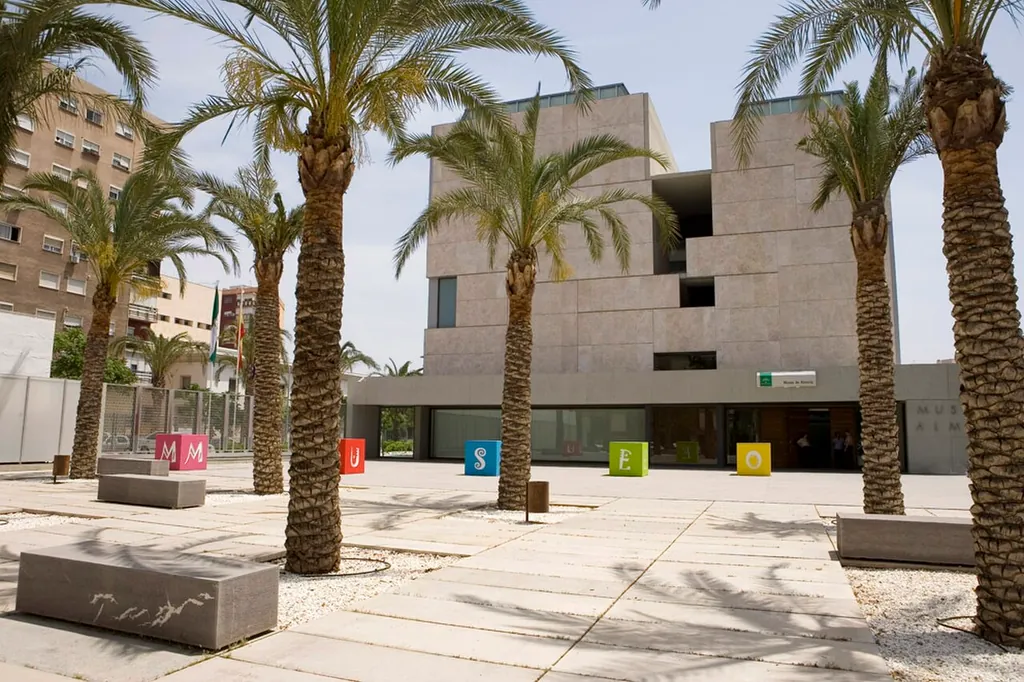
The Ministry decided to build a new purpose-designed venue on the same site, designed by the architects Ángela García Paredes and Ignacio García Pedrosa. The contemporary building, with a central hall and a double staircase organising circulation, opened to the public after its inauguration by the Princes of Asturias on 23 March 2006. The permanent exhibition now focuses on the cultures of Los Millares and El Argar, from the 3rd and 2nd millennia BC, with audiovisual resources, interactive elements and stage sets.
Highlights
- Permanent exhibition on the cultures of Los Millares and El Argar
- Sculpture of Dionysos
- Anthropomorphic stele
- Alabaster vessel
- Contemporary building by García Paredes and García Pedrosa, with central hall and double staircase
Permanent exhibition
- Exposición permanente: Los Millares y El Argar – A tour of the two prehistoric cultures that shaped the south-east of the Iberian Peninsula in the 3rd and 2nd millennia BC, with audiovisuals, interactive elements and stage sets.
- Founded
- 1933
- Operated by
- Junta de Andalucía (Consejería de Cultura, Patrimonio Histórico y Deporte)
- Director
- Tania Fabrega Garcia
Admission & discounts
| Adults | €1.50 |
|---|
General admission: €1.50. Free admission for citizens and residents of the European Union.
Accessibility
- Wheelchair accessible: no information
- Elevator: no information
- Accessible restroom: no information
- Accessible parking: no information
- Service dogs welcome: no information
- Tactile models & exhibits: no information
- Sign language tours: no information
- Easy-to-read materials
- Audio description: no information
The museum has an easy-to-read guide.
Kids & families
- Family tours & workshops
The museum organises family workshops, such as “El gran puzle de la Historia”, and its education room offers activities aimed mainly at school groups.
Getting there & parking
By public transit
Delegación Territorial de Igualdad, Salud y Políticas Sociales (Carretera de Ronda, 101)
City buses: lines 2, 6, 7, 12 and 18 on calle Federico García Lorca; lines 2, 5, 6, 11, 20 and 30 at the stop for the Delegación Territorial de Igualdad, Salud y Políticas Sociales (Carretera de Ronda, 101). Renfe train and bus intermodal station on Plaza de la Estación, on the Carretera de Ronda.
By car
Nearby public car parks: calle Padre Méndez (Padre Méndez car park), avenida Federico García Lorca and Rambla del Obispo Orberá.
The museum entrance is on calle Hermanos Pinzón. Taxi ranks on calle Rafael Alberti and at the Intermodal Station.
Get directionsAmenities & dining
Luis Siret Library with open access (Monday to Friday 10:00–14:30), assembly hall with capacity for 176 people, temporary exhibition room of 255 m² and an education room.
Events & venue rental
The museum hasn’t published any information on this.
Plan your visit
| School programs | yes |
|---|---|
| Good to know | Information leaflet in Spanish, English and French. Visits can be booked on the booking platform of the Consejería de Cultura. The museum also runs concerts, film cycles and lectures. |