Glimmingehus
Late medieval stone castle in Österlen from 1499, with guided tours, the exhibition Borgfolk (Castle Folk), medieval workshops and a castle courtyard.
Have only individual sections read aloud
About the museum
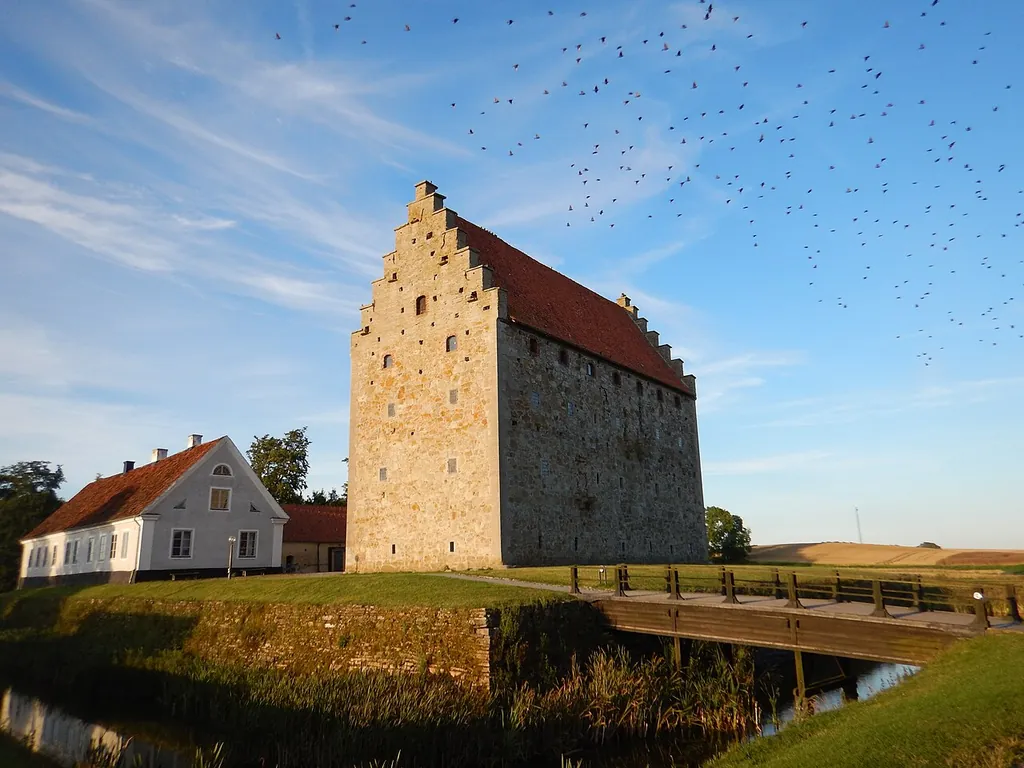
The foundation stone of Glimmingehus was laid on 2 May 1499. The builder was the Danish knight Jens Holgersen Ulfstand, one of the most powerful men in Denmark at the time and lord of Gotland. The castle was built as a so-called fast hus (fortified house), in which defence, representation, living quarters and kitchen were under the same roof. The walls are about two metres thick, and the defences consisted of loopholes, portcullises and murder holes. At the same time there were comforts such as a warm-air heating system and toilets. The German stonemason Adam van Düren made the unique wild man statue that still stands in the castle.
After Jens Holgersen's death in 1523 the castle's great era came to an end. In the late 16th century the estate passed by marriage to the Rosencrantz family, who owned it for over 170 years. They soon moved out of the stone house into new buildings in the courtyard. During the Scanian War of the 1670s, Karl XI ordered the castle to be demolished, but the walls were so strong that the demolition failed. The house was then used, among other things, as a granary, which helped preserve it in its original condition.
In the 19th century scientific interest in the castle was awakened, and Chamberlain Adéle Rosencrantz arranged the first tours. Through a donation in the 1920s, Glimmingehus became state property. Today visitor activities are run by the Swedish National Heritage Board (Riksantikvarieämbetet). Visitors can join a guided tour, explore the castle on their own with a digital guide, see the exhibition Borgfolk in a newer building and try medieval crafts in the Stekarehuset.
Highlights
- The best-preserved late medieval castle in the North, from 1499
- The wild man sculpture by Adam van Düren
- The exhibition Borgfolk (Castle Folk) about the people who lived on the site
- View from the archers' loft, on clear days all the way to Bornholm
- Medieval workshops and a construction hut in the castle courtyard
- Jens Holgersen's grave sword among the finds in the museum
Permanent exhibitions
- Borgfolk – Exhibition in a newer building about the people who lived and worked at Glimmingehus over four centuries, with archaeological finds from the moat.
- Bygghyttan – At the north-western corner of the castle moat, the way the building material for the castle was produced is shown.
- Founded
- 1499
- Operated by
- Riksantikvarieämbetet
Admission & discounts
| Adults | SEK 100 |
|---|---|
| Reduced | SEK 80Pensioners and students |
| Children & teens | freefree up to age 17 · Children and young people up to and including 17 years old enter free, but still need a ticket. |
| Seniors | SEK 80 |
| Visitors with disabilities | SEK 50companion free · Wheelchair users pay half price. Companions or personal assistants enter free. |
| Students & apprentices | SEK 80 |
| Groups | –Group visits are booked via the website. |
The Kulturarvskortet (Cultural Heritage Card) gives a 50% discount. The castle tour is included in the entrance fee. Visiting only Café Borggården is free, but requires a sticker that is collected at the entrance.
Accessibility
- Partially wheelchair accessible
- Elevator: not available
- Accessible restroom
- Accessible parking: no information
- Service dogs welcome
- Tactile models & exhibits
- Sign language tours
- Easy-to-read materials
- Audio description
The castle has no lift or ramp; the stairs are partly very high and the lighting is weak, especially in the cellar, which also has an uneven floor. Ramps lead to the café, the brewhouse (bryggeri) and the museum in the courtyard, and a stone-paved path runs from the entrance building up to the castle. The entrance building has automatic doors and an accessible toilet with an alarm cord and changing table. Guided tours with sign language and a tactile model can be booked for groups. The digital guide on a tablet includes audio description and sign language. Dogs may not accompany visitors into the buildings but are welcome in the courtyard; guide and service dogs may go everywhere. Folding chairs can be borrowed at the museum.
Kids & families
Great for kids & families
| Kids’ admission | free up to age 17 |
|---|
- Family tours & workshops
- Hands-on stations
- Baby changing facilities
The exhibition Borgfolk is aimed at both children and adults. In summer visitors can try period clothing and medieval board games in the Stekarehuset, and there is a digital tour for children. Pushchairs may be used in most buildings except the castle and can be parked in the courtyard.
Getting there & parking
By public transit
Glimmingehus Borgvägen · 500 m
On-demand bus line 576 (Skånetrafiken) goes to the stop Glimmingehus Borgvägen, about 500 metres from the castle; the journey must be booked in advance. Line 570 goes to the stop Vranarpskorset, from where it is about 4 km on foot.
By car
Free parking
Free parking for cars and buses next to the castle. During high season the spaces may run out. There is a barrier at the entrance; honk and staff will open it.
The castle lies in the middle of the Österlen plain; the nearest village is Hammenhög. Going by car is easiest.
Get directionsAmenities & dining
- Café
- Museum shop
- Coat check: not available
- Lockers: not available
Café Borggården is in the building Nådan and is operated in summer; it serves sandwiches, bread, cakes, ice cream and drinks. The shop at the entrance building sells postcards, books, replicas of finds, sweets and ice cream, among other things. There is no luggage storage. Visitors may eat their own packed food on the site (picnic tables south of the bygghyttan, the construction hut).
Events & venue rental
The museum hasn’t published any information on this.
Plan your visit
| Guided tours | yes |
|---|---|
| Audio guide | yes (SV, EN, DE, DA) |
| School programs | yes |
| Photography | Photography of objects and of all rooms is allowed; do not publish photos of other people without their permission. |
| Good to know | The digital guide on a tablet is borrowed against a deposit at the entrance. Signs in simple Swedish are placed in the castle, and folders with translations into English, German and Danish can be borrowed. School classes are divided into smaller groups, with an adult in the shop. Children must be supervised by adults, as the castle can be dangerous. |