Naturhistoriska riksmuseet
Sweden's largest natural history museum in Frescati, with exhibitions about animals, fossils, minerals and humans, and Cosmonova with a planetarium and IMAX cinema.
Have only individual sections read aloud
About the museum
The Naturhistoriska riksmuseet (Swedish Museum of Natural History) was established in 1819, when the zoologist and court marshal Gustaf von Paykull's rich zoological collections were merged with the natural history collections of the Royal Swedish Academy of Sciences. The Academy's collections grew through gifts, including mineral and insect collections and natural objects that had belonged to Queen Lovisa Ulrika. The museum was already open to the public at certain times from 1784.
The collections moved in 1828 to the Westmanska palatset (Westman Palace), and the museum opened to the public in November 1831. Over time new departments were added, including ones for fossil animals and fossil plants. Today the museum is a government agency under the Ministry of Culture, a leading research institution and Sweden's largest museum complex.
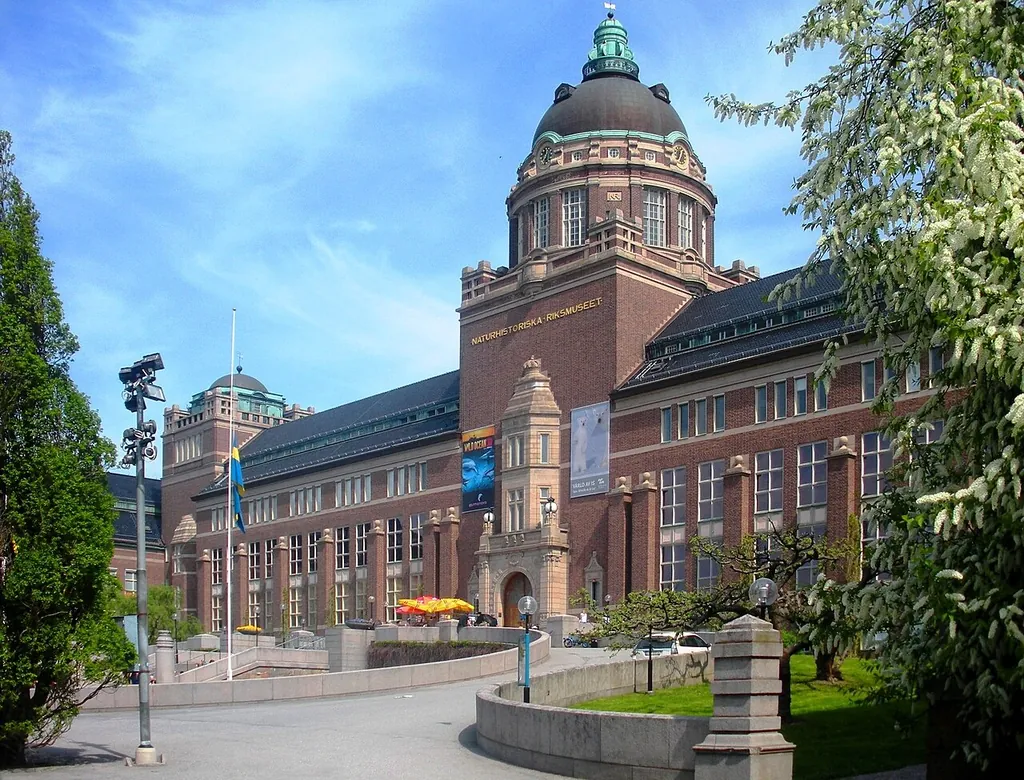
The present museum building in Frescati was designed by the architect Axel Anderberg and built in 1907–1916. The building was inaugurated on 13 November 1916 and is dominated by a 25-metre-high central tower. The Hvalmuseet (Whale Museum) with its whale skeleton was one of the first parts to be completed. In 1993 Cosmonova was added, a planetarium and Sweden's only dome-shaped IMAX cinema.
The exhibitions present everything from Swedish animals in their habitats and life in the seas to fossils, minerals and human evolution. The museum lies within the Kungliga nationalstadsparken (Royal National City Park).
Highlights
- Natur i Sverige – animals in their natural habitats
- Fossil och evolution and Den mänskliga resan
- Gemstones, crystals and rare minerals
- Cosmonova with planetarium and IMAX
- Djuret människan – the museum's most interactive exhibition
Permanent exhibitions
- Natur i Sverige – The animals in their natural habitats and how they interact in Swedish nature.
- Fossil och evolution – A journey through the Earth's history, more than 4,500 million years long.
- Djuret människan – The museum's most interactive exhibition, where you can test how the human body works and compare yourself with other animals.
- Founded
- 1819
- Operated by
- Naturhistoriska riksmuseet (statlig myndighet)
- Visitors per year
- approx. 330,211
Admission & discounts
| Adults | SEK 170 |
|---|---|
| Reduced | SEK 120Pensioners with ID and students with a Mecenatkort or equivalent |
| Children & teens | freefree up to age 18 · Exhibitions are free of charge for children and young people up to 18, but a ticket is required; Cosmonova SEK 100 |
| Seniors | SEK 120 |
| Visitors with disabilities | –companion free · Companions always enter exhibitions and Cosmonova films free |
| Students & apprentices | SEK 120With a valid Mecenatkort or equivalent |
| Combined ticket exhibitions + film (adult) | SEK 260Children and young people up to and including 18 years SEK 100 |
| Cosmonova (adult) | SEK 160Children and young people SEK 100 |
| Annual pass for the exhibitions | SEK 400Friends of the Riksmuseum SEK 200 |
| Escape Extinction (per participant) | SEK 260Aged 16 and over, or 12 with an adult |
| Skapa i Labbet (per child) | SEK 50With an accompanying adult and a museum ticket |
Prices are for the adult exhibition ticket: SEK 170. The museum does not accept cash, only card. Members of Riksmusei vänner (Friends of the Riksmuseum) pay SEK 85 for the exhibitions.
Accessibility
- Wheelchair accessible
- Elevator
- Accessible restroom
- Accessible parking
- Service dogs welcome: no information
- Tactile models & exhibits: no information
- Sign language tours: no information
- Easy-to-read materials
- Audio description: no information
All exhibitions are adapted for wheelchairs and mobility scooters, and the doors to the exhibitions are propped open during visiting hours. Toilets, accessible toilets and baby-changing rooms are on all floors. Two parking spaces are reserved for visitors with disabilities. A few wheelchairs can be borrowed behind the information desk in the entrance hall.
Kids & families
Great for kids & families
| Kids’ admission | free up to age 18 |
|---|
- Family tours & workshops
- Activity booklet, scavenger hunt or kids’ audio guide
- Hands-on stations
- Stroller-friendly
- Baby changing facilities
Activities such as Skapa i Labbet (Create in the Lab), Labbet för unga (Lab for Young People) and Escape Extinction, as well as activities during the autumn holiday. It is easy to get around the exhibitions and between floors with a pram; prams cannot be taken into Cosmonova.
Getting there & parking
By public transit
Universitetet
Metro red line 14 towards Mörby centrum to Universitetet station, then a walk to the museum. Bus 50 or 540 to Naturhistoriska riksmuseet. Roslagsbanan from Östra station to Universitetet station.
By car
Paid parking
About 300 paid parking spaces in the area (P1–P4), with electric car charging points. Two spaces for visitors with disabilities.
- Accessible parking
Cycle paths almost all the way from the inner city, and bicycle parking at the main entrance. Bergiusvägen north of the museum is closed to traffic until the end of November.
Get directionsAmenities & dining
- Café
- Restaurant
- Museum shop
- Coat check
- Lockers
Bistro Naturhistoriska with lunch, café and a children's menu, and a packed-lunch room on floors 3 and 4. Unstaffed cloakroom on floor 3 and lockable lockers for clothes and smaller bags. Luggage, larger bags and rucksacks are not allowed.
Events & venue rental
The museum hasn’t published any information on this.
Plan your visit
| School programs | yes |
|---|---|
| Good to know | A ticket is required for children too. Advance booking is recommended, and weekday afternoons are the calmest. Batteries for bicycles, e-scooters or e-mopeds may not be brought in. Cosmonova shows begin with a short demonstration of the IMAX technology; infants should not be in the auditorium. |