Museum im Turmhof
Local history museum in the medieval Turmhof on the Untersee in Steckborn, with archaeology, tiled stoves, lace, and Bernina sewing machines, free admission.
Have only individual sections read aloud
About the museum
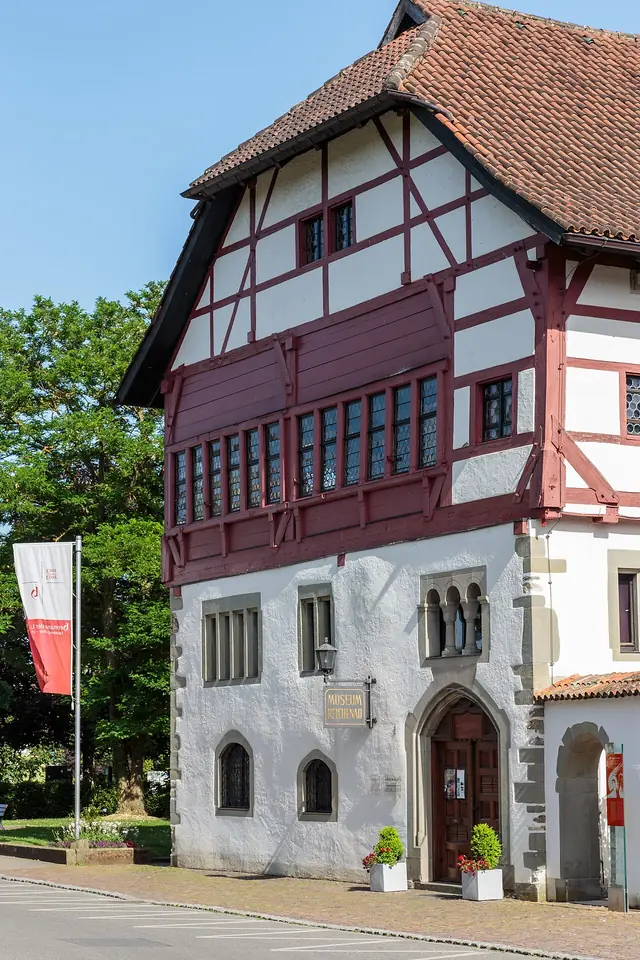
The Museum im Turmhof presents the culture, history and crafts of the Untersee region. The Turmhof, the architectural landmark of Steckborn, was built in 1282 by Albrecht von Ramstein, Abbot of the Reichenau monastery, as an abbot’s residence. It was exempt from taxes and tolls and had the right of asylum. The building is first documented in 1371; in 1639 the municipality of Steckborn acquired it and used it as a workhouse for the poor, a school and accommodation. In 1902 it passed to the Evangelical parish, which sold it to the Stiftung Turmhof foundation in 2002. The Turmhof is considered cultural property of national significance.
The museum opened in 1937 under the leadership of the museum association (then the Heimatvereinigung am Untersee, Untersee Local Heritage Association). After a conversion and renovation starting in 2017, it reopened in August 2018.
The collection ranges from prehistoric finds from pile dwellings in Steckborn and on the island of Werd, through Roman finds from Eschenz, to Alamannic finds from Steckborn and Ermatingen. Other highlights are the Steckborn tiled stoves of the stove-maker families Meyer and Düringer, Steckborn lace and bobbin lace-making, Bernina sewing machines with the history of the Gegauf family, a printing and typesetting machine, and the first automobile in Thurgau, from 1895. There are also pictures by local artists and a special exhibition every year.
Highlights
- Pile-dwelling, Roman and Alamannic finds from the Untersee region
- Steckborn tiled stoves by the stove-makers Meyer and Düringer
- Steckborn lace and bobbin lace-making
- Bernina sewing machines from Steckborn
- The first automobile in Thurgau (1895)
- Medieval Turmhof, cultural property of national significance, free admission
Permanent exhibitions
- Archäologie – Finds from pile dwellings in Steckborn and on the island of Werd, from the Roman period (Eschenz), the Bronze Age, and the Alamanni in Steckborn and Ermatingen.
- Kachelöfen (Steckborner Öfen) – The stove-building tradition of the Steckborn potter families, including Meyer and Düringer, with their stove painting.
- Nähmaschinen, Klöppelspitzen und erstes Auto – Bernina sewing machines and the history of the Gegauf family, Steckborn lace, a former printing-shop typesetting machine, and the first automobile in Thurgau from 1895.
- Founded
- 1937
- Operated by
- Museumsverein Steckborn
Admission & discounts
Admission is free.
Admission is free.
Accessibility
The museum hasn’t published any information on this.
Kids & families
The museum hasn’t published any information on this.
Getting there & parking
By public transit
Steckborn
By Thurbo line S1 to Steckborn. By the URh excursion boat (Kreuzlingen–Schaffhausen) to the Schifflände Steckborn landing stage, then about a 5-minute walk.
Amenities & dining
Book sales featuring publications of the museum.
Events & venue rental
The museum hasn’t published any information on this.
Plan your visit
| Guided tours | yes |
|---|---|
| Good to know | Museum tours and city tours can be requested by email from the role-based addresses museumsfuehrungen@turmhof-museum.ch and stadtfuehrung@turmhof-museum.ch; duration and costs are not published. According to muse.tg, films about the local history of Steckborn are shown in the museum’s in-house cinema. |