Gedenk- und Dokumentationsstätte KZ Drütte
Memorial in the historic accommodation room under the elevated road on the Salzgitter AG works site; visits generally by guided tour.
Have only individual sections read aloud
About the museum
KZ Drütte was one of the first external camps of the Neuengamme concentration camp. From October 1942, prisoners were housed in a camp under an elevated road on the grounds of the Reichswerke "Hermann Göring"; up to around 3,000 men had to work in armaments production, mainly making shells. Several hundred died. On April 7, 1945, the SS cleared the camp.
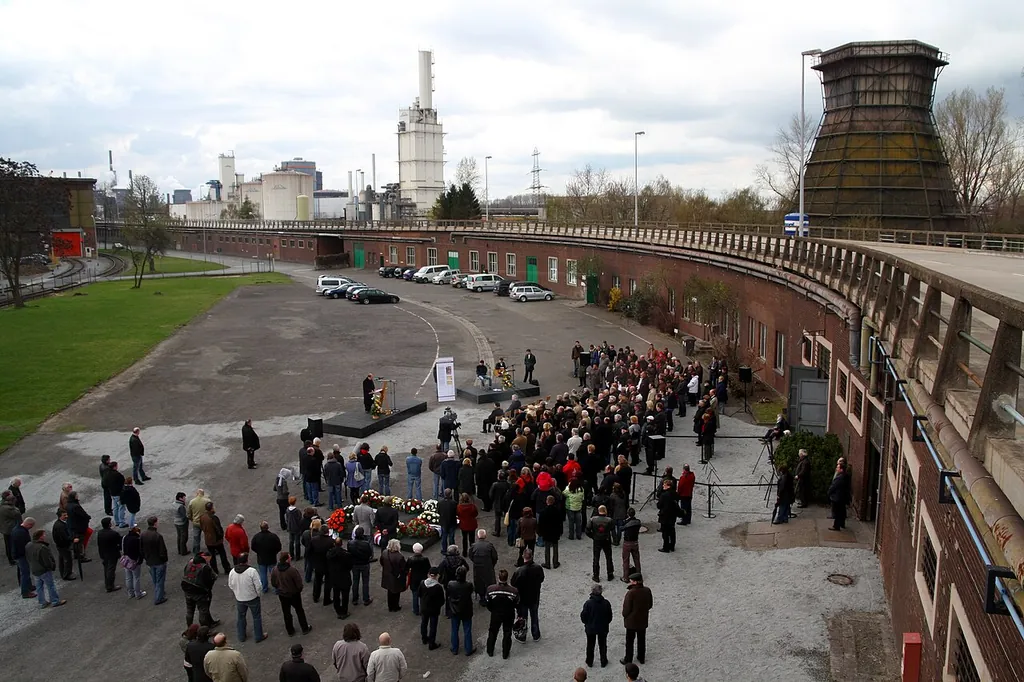
Until the 1980s this history was largely suppressed. After a series of events marking the town's 1982 anniversary, committed citizens founded the Arbeitskreis Stadtgeschichte (local history working group) in 1983, which campaigned together with IG Metall and the works council for a memorial. Since 1985 a commemoration has been held every year on the former roll-call ground. In 1992 the company's board and the works council agreed to provide one of the four former accommodation rooms; the memorial and documentation site opened on April 11, 1994.
The protected room displays the permanent exhibition in six steel cubes and also serves as an event venue. Later additions included information boards on the grounds, a model of the site in a converted bus shelter with a view across the roll-call ground, and seminar rooms for educational work. Because the site lies in the middle of a working industrial plant, the difficult handling of Nazi history is also visible here.
Key themes
- Historic accommodation room of the external camp under the elevated road
- Permanent exhibition in six steel cubes
- Model of the site in a former bus shelter
- View of the former roll-call ground
- Tours and workshops on forced labor and memorial culture
Permanent exhibition
- Dauerausstellung in den Stahlkuben – In the protected accommodation room of the former external camp, the exhibition in six steel cubes tells the story of forced labor and the camp; a model of the site in the former bus shelter shows the layout.
- Founded
- 1994
- Operated by
- Arbeitskreis Stadtgeschichte e.V.
- Director
- Maike Weth
Admission & discounts
| Adults | €3 |
|---|---|
| Students & apprentices | €1Learners, for guided tours |
The prices apply to guided tours: adults €3, learners €1. Cash payment only, ideally exact change.
Accessibility
- Wheelchair accessible: no information
- Elevator: no information
- Accessible restroom: no information
- Accessible parking: no information
- Service dogs welcome: no information
- Tactile models & exhibits: no information
- Sign language tours: no information
- Easy-to-read materials: no information
- Audio description: no information
Tours take place partly or entirely outdoors (weatherproof clothing recommended). If mobility is limited, please contact the memorial in advance.
Kids & families
Only partly suitable for kidsRecommended for ages 12+
Visitors should be at least 12 years old.
Getting there & parking
By public transit
Tor 1 der Salzgitter AG (Linie 603)
KVG bus line 603 stops directly at Gate 1 of Salzgitter AG.
By car
Parking available · 500 m to the entrance
Large parking area in front of Gate 1 (at the visitor center). Driving onto the works site is not possible; register with the gatekeeper, then walk about 500 m to the memorial.
Route via the A39 to the Salzgitter-Watenstedt or Salzgitter-Thiede exit, then follow the signs to Gate 1 on the Eisenhüttenstraße.
Get directionsAmenities & dining
The museum hasn’t published any information on this.
Events & venue rental
The museum hasn’t published any information on this.
Plan your visit
| Guided tours | yes · approx. 1.5 hrs |
|---|---|
| School programs | yes |
| Photography | Photography and filming are generally not permitted on the grounds of Salzgitter AG. |
| Good to know | The tour "Concentration camp prisoners in armaments production" takes at least 1.5 hours, or at least 3 hours with a workshop; "The Struggle for the Memorial" at least 2 hours; shorter tours from 1 hour by arrangement. Access to the works site requires a participant list with first and last names. Groups of up to 30 people. |