Palace of the Grand Master
The Palace of the Grand Master in the Medieval City of Rhodes, seat of the Knights Hospitaller, houses two permanent exhibitions and mosaic floors.
Have only individual sections read aloud
About the museum
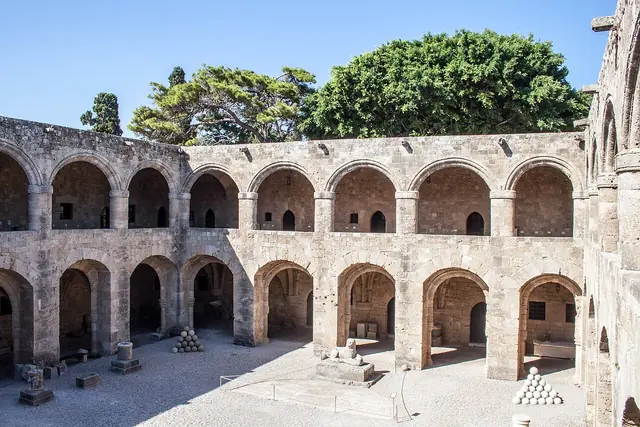
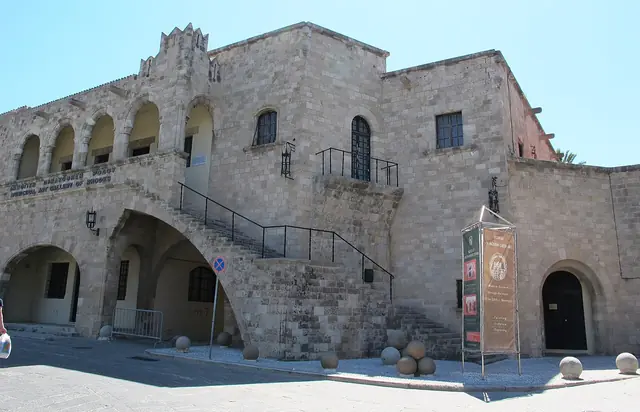
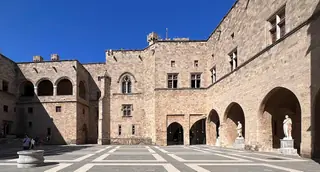
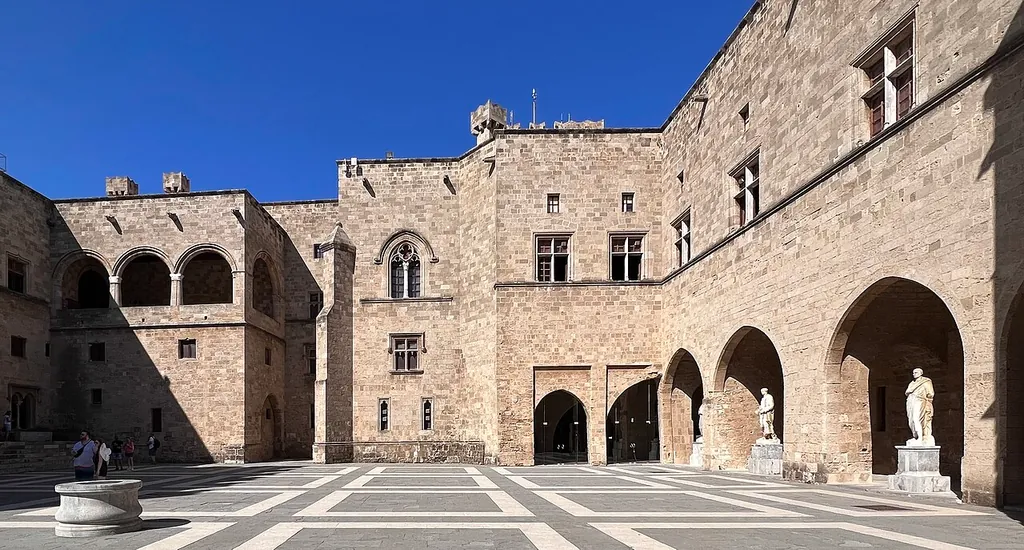
The Palace of the Grand Master rises at the north-western end of the Medieval City of Rhodes and is considered one of the most important monuments of the age of the Knights. It is believed to have been built on the site of the Byzantine citadel shortly after the Knights Hospitaller settled on the island in the early 14th century, as the residence of the Grand Master and administrative centre of the Order. The rectangular building is arranged around a central open courtyard and reinforced with towers and high walls.
In 1856 a powerful explosion destroyed much of the building. In the 1930s, during the Italian occupation of the Dodecanese, the palace was restored and took on its present layout as the seat of government and residence of the Italian governor. Only the interior follows the original plan faithfully, as the other drawings had been lost. The halls were decorated with mosaic floors, mainly transferred from secular and ecclesiastical buildings on Kos, as well as with columns, capitals, medieval furniture, mirrors, paintings and candlesticks.
Today two permanent exhibitions operate on the ground floor. One tells the story of Rhodes from the early Christian period to its conquest by the Ottomans in 1522 and was established in 1993. The other presents the ancient city of Rhodes through the finds and more than fifty years of research.
Highlights
- Seat of the Grand Master of the Knights Hospitaller
- Mosaic floors from Kos in the halls of the upper floor
- Permanent exhibition on Rhodes up to 1522
- Permanent exhibition on the ancient city of Rhodes
- Walkway on the City Walls of Rhodes, with separate ticket
Permanent exhibitions
- Η Ρόδος από την παλαιοχριστιανική εποχή έως την κατάληψή της από τους Οθωμανούς (1522) – Finds from the excavations in the Medieval City, such as ceramics, sculptures, wall paintings and panel icons, present the early Christian, Byzantine and knightly city.
- Αρχαία Ρόδος – 2.400 χρόνια – The exhibition presents the ancient city of Rhodes through archaeological finds and more than fifty years of research.
- Founded
- 1320
- Operated by
- Εφορεία Αρχαιοτήτων Δωδεκανήσου
- Visitors per year
- approx. 242,759
Admission & discounts
| Adults | €20 |
|---|---|
| Reduced | €10Citizens of the EU over 65 and students from non-EU countries, upon presentation of ID |
| Visitors with disabilities | freecompanion free · People with a disability of 67% or more and one companion, with a disability certificate. |
| Students & apprentices | freeStudents at universities in the EU, with a valid student ID. |
| Rhodes City Walls walkway | €5reduced ticket €3 |
Free admission: 6 March, 18 April, 18 May, the last weekend of September, 28 October, and the first and third Sunday of each month from 1 November to 31 March.
Accessibility
- Wheelchair accessible
- Elevator
- Accessible restroom: no information
- Accessible parking: no information
- Service dogs welcome: no information
- Tactile models & exhibits: no information
- Sign language tours: no information
- Easy-to-read materials: no information
- Audio description: no information
The site is described as accessible and has a lift.
Kids & families
The museum hasn’t published any information on this.
Getting there & parking
The Palace is located in the Medieval City, about 10 minutes on foot from the centre of Rhodes town (Mandraki).
Get directionsAmenities & dining
- Café
- Museum shop
- Wi-Fi
A café or restaurant, and a shop, operate on site, and visitors have access to WiFi.
Events & venue rental
The museum hasn’t published any information on this.