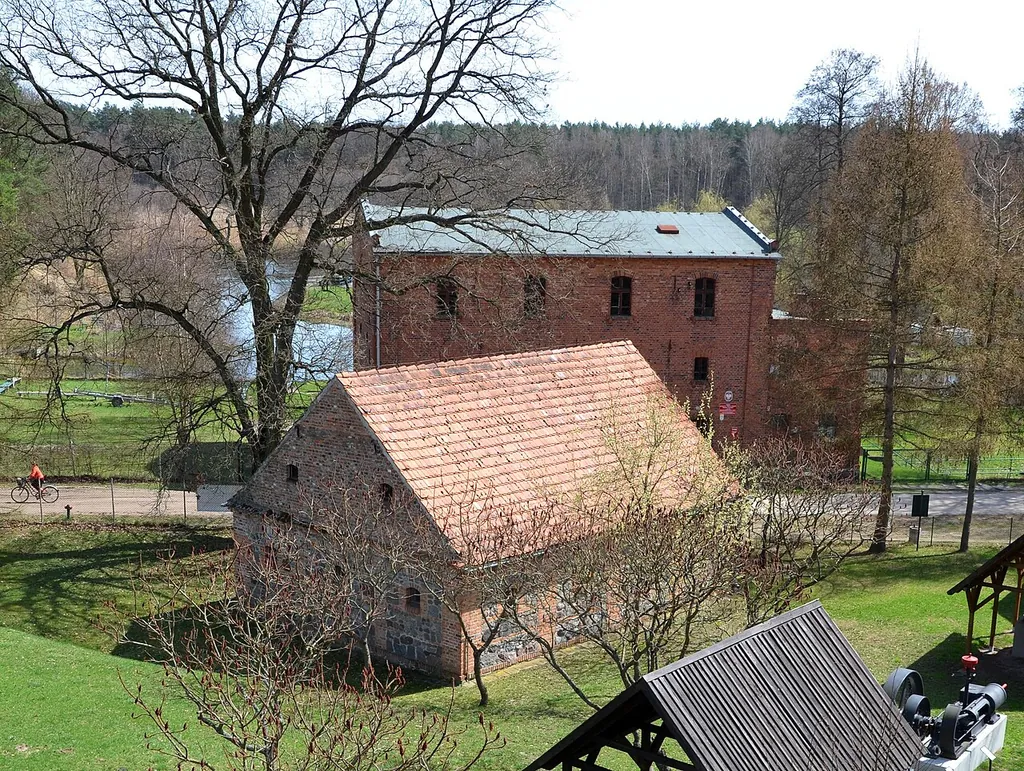
Muzeum Młynarstwa i Wodnych Urządzeń Przemysłu Wiejskiego w Jaraczu
Branch of the Szreniawa museum in the mill settlement on the Wełna river, with a water mill, a trestle windmill (koźlak) and a collection of windmill models.
Have only individual sections read aloud
About the museum
The Muzeum Młynarstwa has operated since 1981 in the mill settlement at Jaracz, about 40 km from Poznań, on the eastern edge of the Puszcza Notecka (Noteć Forest), by the river Wełna. The first written mention of the mill at Jaracz dates from the fifteenth century; it was one of many mills driven by water wheels on the tributaries of the Warta. Next to the museum is the end of the Wełna nature reserve, which protects a stretch of river with a fast current.
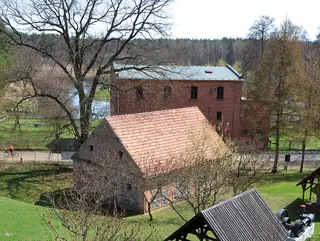
The settlement’s buildings include a water mill from the turn of the nineteenth and twentieth centuries with its system of mill races, a trestle windmill from the end of the eighteenth century, a turbine windmill from the mid-twentieth century, a stable by the mill and a nineteenth-century dwelling house. In the mill, driven by a Francis turbine, the whole cycle of grinding grain into flour is shown on machines from the 1920s. The trestle windmill, moved from the village of Czacz, is a typical windmill of Greater Poland, and its sails still turn when the wind is favourable.
The museum also has an exhibition on traditional grain processing and a collection of more than forty models of windmills by engineer Feliks Klaczyński. A small hydroelectric plant with an output of 45 kW operates here. Activities include the classes “Od ziarenka do bochenka” (From Grain to Loaf) for children and events such as Marzanna, the Festyn Młynarski (Miller’s Festival) and the Spotkania Miłośników Wiatraków i Młynów Wodnych (Meetings of Lovers of Windmills and Water Mills).
Highlights
- Water mill with a Francis turbine and machines from the 1920s
- Trestle windmill from the end of the eighteenth century with working sails
- Collection of more than forty windmill models by engineer Feliks Klaczyński
- Exhibition on traditional grain processing: querns, pestles and hand mills
- Small hydroelectric plant Jaracz, 45 kW
- Location on the Wełna river, next to a nature reserve
Permanent exhibitions
- Przemysłowa technika młynarstwa – On three floors of the water mill, the whole cycle of grinding grain on machines from the early twentieth century, with a Francis turbine and models of water mills.
- Kolekcja modeli wiatraków inż. Feliksa Klaczyńskiego – More than forty windmill models on a 1:40 scale, showing nineteenth-century types of Polish windmills, and mementos of the collection’s creator.
- Tradycyjne przetwórstwo zbożowe – The historic stable displays querns, pestles, hand mills for flour and groats, and grain crushers from earliest times to the early twentieth century.
- Founded
- 1981
- Operated by
- Muzeum Narodowe Rolnictwa i Przemysłu Rolno-Spożywczego w Szreniawie
Admission & discounts
| Adults | 15 zł |
|---|---|
| Reduced | 10 zł |
| Families | 30 złFamily ticket for a maximum of two adults with children. |
| Walking ticket (bilet spacerowy) | 5 zł |
| Ticket for workshops or demonstrations (per person) | 30 zł |
| Guide | 50 złIn addition to the admission ticket. |
| Museum lesson | 90 złIn addition to the admission ticket. |
| Campfire organisation | 150 złCampfire for up to 1.5 hours; sausage forks included in the price; advance booking required. |
Group trips and campfire bookings must be announced in advance.
Accessibility
- Partially wheelchair accessible
- Elevator: no information
- Accessible restroom
- Accessible parking: no information
- Service dogs welcome: no information
- Tactile models & exhibits
- Sign language tours: no information
- Easy-to-read materials: no information
- Audio description: no information
A tarmac road leads to the car park by the Dom Młynarza (Miller’s House). The Miller’s House is partly accessible: on the lower floor there are the ticket office with a shop and three exhibition rooms, with thresholds of 1–2 cm; the floor with the hotel rooms is reachable only by stairs. A portable induction loop is available at the ticket office, and there is a tactile plan in front of the building. The exhibition in the water mill and the windmill have steep stairs and are not accessible to wheelchair users; the stable can be entered with the help of an assistant. The area between the buildings is grassy, with no paved paths. There are toilets by the car park, including one adapted toilet. The museum has no audio guides.
Kids & families
Great for kids & families
| Family ticket | 30 zł · Family ticket for a maximum of two adults with children. |
|---|
- Family tours & workshops
- Hands-on stations
- Playground / play area
Children take part in the “Od ziarenka do bochenka” classes, during which they work with pestles, querns and sieves. There is an art station for children at the exhibition of windmill models, and a playground on the museum grounds.
Getting there & parking
By public transit
By PKS or KSK bus to the stops on the main road, then 2.5 km on foot; by train to Parkowo station, then 4 km along the marked trail through the village of Wełna.
By car
Parking available
Car park by the Dom Młynarza; access by tarmac road.
By car on national road no. 11 from Poznań towards Koszalin; after Oborniki Wielkopolskie turn left and drive 3 km on a local road to Jaracz.
Get directionsAmenities & dining
- Museum shop
The museum shop is at the ticket office in the Dom Młynarza; the building also has hotel rooms.
Events & venue rental
The museum hasn’t published any information on this.
Plan your visit
| Guided tours | yes |
|---|---|
| Audio guide | no |
| School programs | yes |
| Good to know | A guide costs extra. The museum runs lessons and workshops, including “Od ziarenka do bochenka”, and demonstrations of the windmill at work. |